Azerbaijan Physical Security Market Size & Growth Rate (2026-2032)
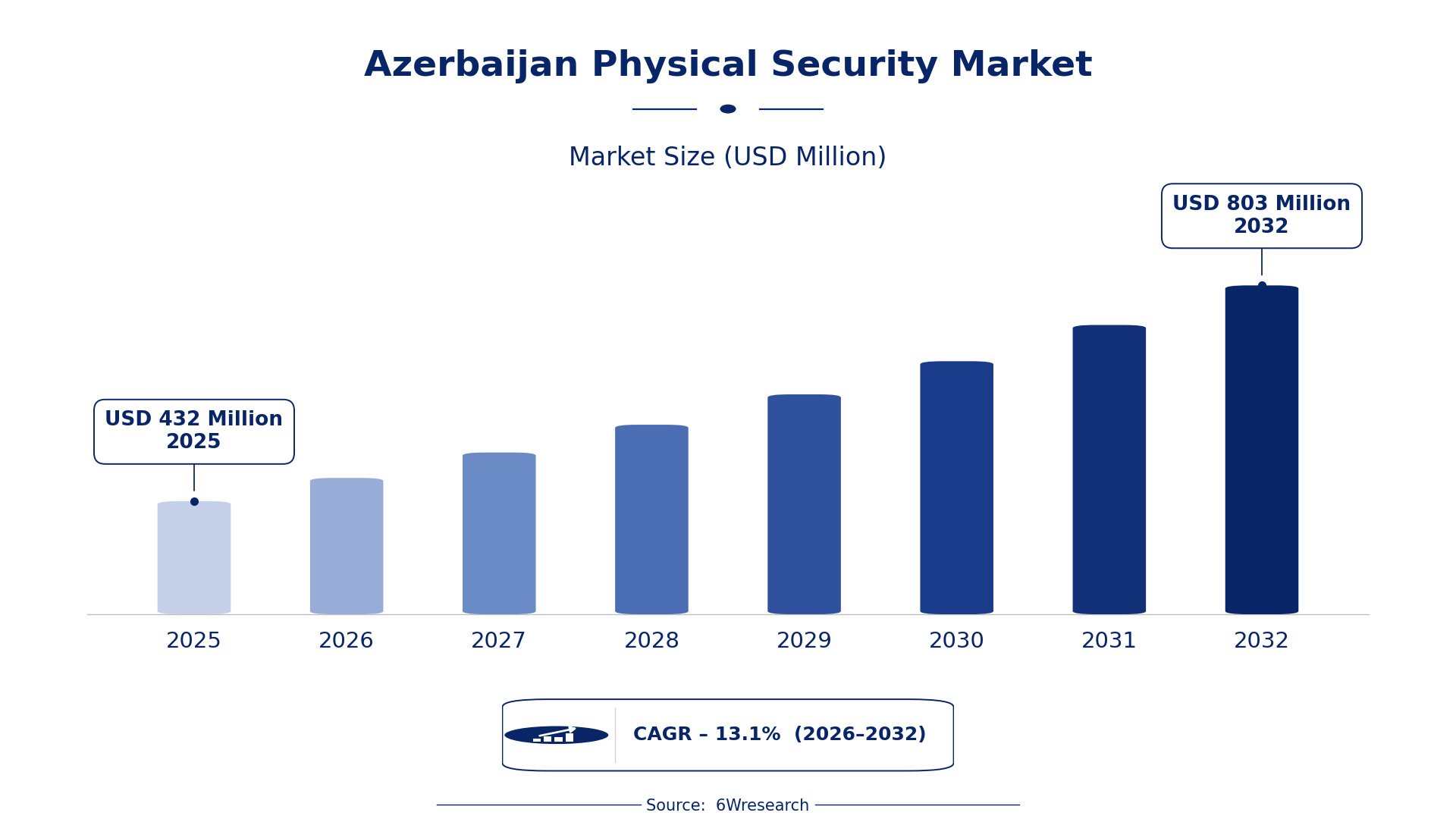
The Azerbaijan Physical Security Market was estimated at USD 432 Million in 2025 and is projected to reach USD 803 Million by 2032, growing at a CAGR of 13.1% from 2026 to 2032.
Azerbaijan Physical Security Market Synopsis
The Azerbaijan Physical Security Market is witnessing a notable surge, propelled by urbanization, increasing crime rates, and heightened awareness regarding the necessity for security measures. This market includes various segments such as access control systems, video surveillance, intruder alarms, and perimeter security systems, with a mix of international and local providers catering to diverse needs.
Government focus on enhancing security in critical sectors—like energy and transportation—is further fuelling market demand. As Azerbaijan continues to develop its urban infrastructure, the integration of smart technologies and cloud-based solutions into physical security measures is increasingly becoming vital for businesses and governmental entities alike.
Azerbaijan Physical Security Market Year-wise Growth Rate and Key Drivers
This graph illustrates the annual growth rates of the Azerbaijan Physical Security Market from 2021 to 2032, highlighting a steady upward trajectory and projected expansion over the forecast period.

The table below presents the year‑wise growth rates along with the key drivers influencing the market
| Year | Growth Rate | Major Drivers |
| 2021 | 8.7% | Government investments in national security infrastructure projects. |
| 2022 | 9.1% | Increased oil production driving demand for facility security. |
| 2023 | 9.5% | Growing cybersecurity threats prompting physical security upgrades. |
| 2024 | 9.9% | National Anti-Terrorism Strategy enhancing public safety initiatives. |
| 2025 | 10.3% | Rising foreign investments necessitating improved security protocols. |
| 2026 | 10.7% | Strengthened laws on crime prevention boosting security solutions. |
| 2027 | 11.1% | Tourism growth spurring demand for enhanced venue security. |
| 2028 | 11.5% | Legislative support for private security sector expansion initiatives. |
| 2029 | 11.9% | More public events requiring advanced crowd security measures. |
| 2030 | 12.3% | Technological advancements in biometric security adoption rising. |
| 2031 | 12.7% | Increased international partnerships fostering security technology growth. |
| 2032 | 13.1% | Evolving safety regulations mandating upgraded physical security standards. |
Note: Market size estimations and growth projections presented in this report are based on 6Wresearch's proprietary forecasting methodology, utilizing the latest available industry data, government publications, and primary research inputs.
Azerbaijan Physical Security Market Key Takeaways
Below are some of the specific key takeaways from the market, including:
- The market is driven by rising crime rates and urbanization, leading to increased demand for security solutions.
- Investment opportunities are abundant in video surveillance and access control systems.
- Government initiatives are supporting the establishment of standardized regulations for security providers.
- The integration of AI and analytics into security systems is reshaping threat detection methods.
- Cloud-based security solutions are gaining traction due to their flexibility and scalability.
Evaluation of Restraints in Azerbaijan Physical Security Market
Despite the promising growth, the Azerbaijan Physical Security Market faces significant hurdles. A lack of standardized regulations can lead to discrepancies in how security measures are implemented across various sectors. This inconsistency undermines confidence in the effectiveness of security systems. on top of that, the rise in cyber threats poses challenges, especially as the lines between physical and digital security blur. Limited awareness about advanced security technologies among end-users is another restraint, which can impede the adoption of innovative solutions. Lastly, regional economic instability can affect investment decisions, making budget constraints a reality for organizations aiming to enhance their security measures.
Azerbaijan Physical Security Market Trends
There’s a pronounced shift towards advanced technology in the Azerbaijan Physical Security Market. This trend includes a growing demand for video surveillance, access control, and biometric solutions. The integration of AI and analytics into physical security systems is notable, as it enables more efficient monitoring and rapid threat detection. Additionally, the market is increasingly embracing cloud-based security systems, which offer flexibility and scalability, responding to the evolving landscape of security needs.
Azerbaijan Physical Security Market Opportunities
Opportunities abound within the Azerbaijan Physical Security Market, particularly given the escalating demand for sophisticated security solutions. Key areas ripe for investment include video surveillance systems, access control technologies, and intruder detection systems. The need to address theft, vandalism, and unauthorized access has never been more pressing, making integrated security solutions essential. on top of that, there’s potential in offering consulting, installation, and monitoring services, which can capitalize on the market's growth while providing critical support to businesses and organizations in the region.
Government Initiatives in the Azerbaijan Physical Security Market
The Azerbaijan government is actively shaping the Physical Security Market through various initiatives aimed at improving the overall security environment. These policies not only regulate the industry but also promote trust among consumers. As urban areas expand and security becomes more essential, government actions will play a critical role in standardizing practices and enhancing service quality.
- A licensing program initiated in 2024 requires security companies to comply with standards set by the Ministry of Internal Affairs.
- Current regulations mandate that security providers utilize approved surveillance equipment, ensuring compliance with privacy rights.
- A recent initiative aims to improve security infrastructure in energy sectors, with a focus on integrating modern technologies.
- A planned public-private partnership is expected to enhance security measures for transportation systems by 2027.
- An ongoing national campaign is aimed at raising awareness about the importance of physical security across various sectors.
Future Insights of the Azerbaijan Physical Security Market
Looking ahead to the period from 2026 to 2032, the Azerbaijan Physical Security Market appears to be on an upward trajectory. The increasing urbanization and commercial development will necessitate more sophisticated security infrastructures. Businesses and government institutions are likely to continue investing in modern solutions to protect assets and enhance public safety. on top of that, advancements in technology—such as the adoption of cloud-based systems and AI-driven security measures—will further shape the market's evolution, aligning with the growing demand for integrated security solutions.
Azerbaijan Physical Security Market Latest Developments
The past 12-14 months have seen a series of strategic developments in the Azerbaijan Physical Security Market, reflecting a robust commitment to enhancing security measures. As awareness of security needs grows, industry players are adapting to meet the increasing demands for advanced technologies and integrated solutions.
- A major technology vendor announced the rollout of a new cloud-based security platform in early 2025, aimed at improving access control and surveillance.
- In Q3 2025, a leading regional operator completed an extensive upgrade of video surveillance systems in multiple urban centers, enhancing real-time monitoring capabilities.
- A partnership between several local firms is currently underway, focusing on developing AI-driven security analytics tools for various sectors.
- A regulatory body plans to introduce updated standards for security service providers by mid-2026, aiming to improve service quality and compliance.
- An initiative to enhance cybersecurity measures in physical security systems is expected to commence in late 2025, integrating both realms for improved safety.
Azerbaijan Physical Security Market - Key Attractiveness of the Report
- 10 Years of Market Numbers
- Historical Data Starting from 2022 to 2025
- Base Year: 2025
- Forecast Data until 2032
- Key Performance Indicators Impacting the Market
- Major Upcoming Developments and Projects
Key Highlights of the Report:
- Azerbaijan Physical Security Market Outlook
- Market Size of Azerbaijan Physical Security Market, 2025
- Forecast of Azerbaijan Physical Security Market, 2032
- Historical Data and Forecast of Azerbaijan Physical Security Revenues & Volume for the Period 2022-2032F
- Azerbaijan Physical Security Market Trend Evolution
- Azerbaijan Physical Security Market Drivers and Challenges
- Azerbaijan Physical Security Price Trends
- Azerbaijan Physical Security Porter's Five Forces
- Azerbaijan Physical Security Industry Life Cycle
- Historical Data and Forecast of Azerbaijan Physical Security Market Revenues & Volume By Component for the Period 2022-2032F
- Historical Data and Forecast of Azerbaijan Physical Security Market Revenues & Volume By Systems (PACS, PSIM, PIAM, Video Surveillance, Fire and Life Safety) for the Period 2022-2032F
- Historical Data and Forecast of Azerbaijan Physical Security Market Revenues & Volume By Services for the Period 2022-2032F
- Historical Data and Forecast of Azerbaijan Physical Security Market Revenues & Volume By Vertical for the Period 2022-2032F
- Historical Data and Forecast of Azerbaijan Physical Security Market Revenues & Volume By BFSI for the Period 2022-2032F
- Historical Data and Forecast of Azerbaijan Physical Security Market Revenues & Volume By Government for the Period 2022-2032F
- Historical Data and Forecast of Azerbaijan Physical Security Market Revenues & Volume By Retail for the Period 2022-2032F
- Historical Data and Forecast of Azerbaijan Physical Security Market Revenues & Volume By Transportation for the Period 2022-2032F
- Historical Data and Forecast of Azerbaijan Physical Security Market Revenues & Volume By Residential for the Period 2022-2032F
- Historical Data and Forecast of Azerbaijan Physical Security Market Revenues & Volume By Telecom and IT for the Period 2022-2032F
- Historical Data and Forecast of Azerbaijan Physical Security Market Revenues & Volume By Other Verticals (Healthcare, Manufacturing, Energy and Utilities, and Education). for the Period 2022-2032F
- Historical Data and Forecast of Azerbaijan Physical Security Market Revenues & Volume By Organization Size for the Period 2022-2032F
- Historical Data and Forecast of Azerbaijan Physical Security Market Revenues & Volume By SMEs for the Period 2022-2032F
- Historical Data and Forecast of Azerbaijan Physical Security Market Revenues & Volume By Large Enterprises for the Period 2022-2032F
- Azerbaijan Physical Security Import Export Trade Statistics
- Market Opportunity Assessment By Component
- Market Opportunity Assessment By Vertical
- Market Opportunity Assessment By Organization Size
- Azerbaijan Physical Security Top Companies Market Share
- Azerbaijan Physical Security Competitive Benchmarking By Technical and Operational Parameters
- Azerbaijan Physical Security Company Profiles
- Azerbaijan Physical Security Key Strategic Recommendations






































