Azerbaijan Printed Electronics Market Size, Share & Growth Rate
The Azerbaijan Printed Electronics Market was estimated at USD 534 Million in 2025 and is projected to reach USD 1004 Million by 2032, growing at a CAGR of 9.4% from 2026 to 2032. This robust growth trajectory is primarily fueled by a rising demand for innovative, lightweight electronic devices across diverse applications, including displays and sensors. The advantages of cost-effectiveness and the ability to integrate with various substrates are further catalyzing market expansion.
Azerbaijan Printed Electronics Market Year-wise Growth Rate and Key Drivers
This graph highlights how the Azerbaijan Printed Electronics Market has steadily grown over the years, supported by major growth factors.
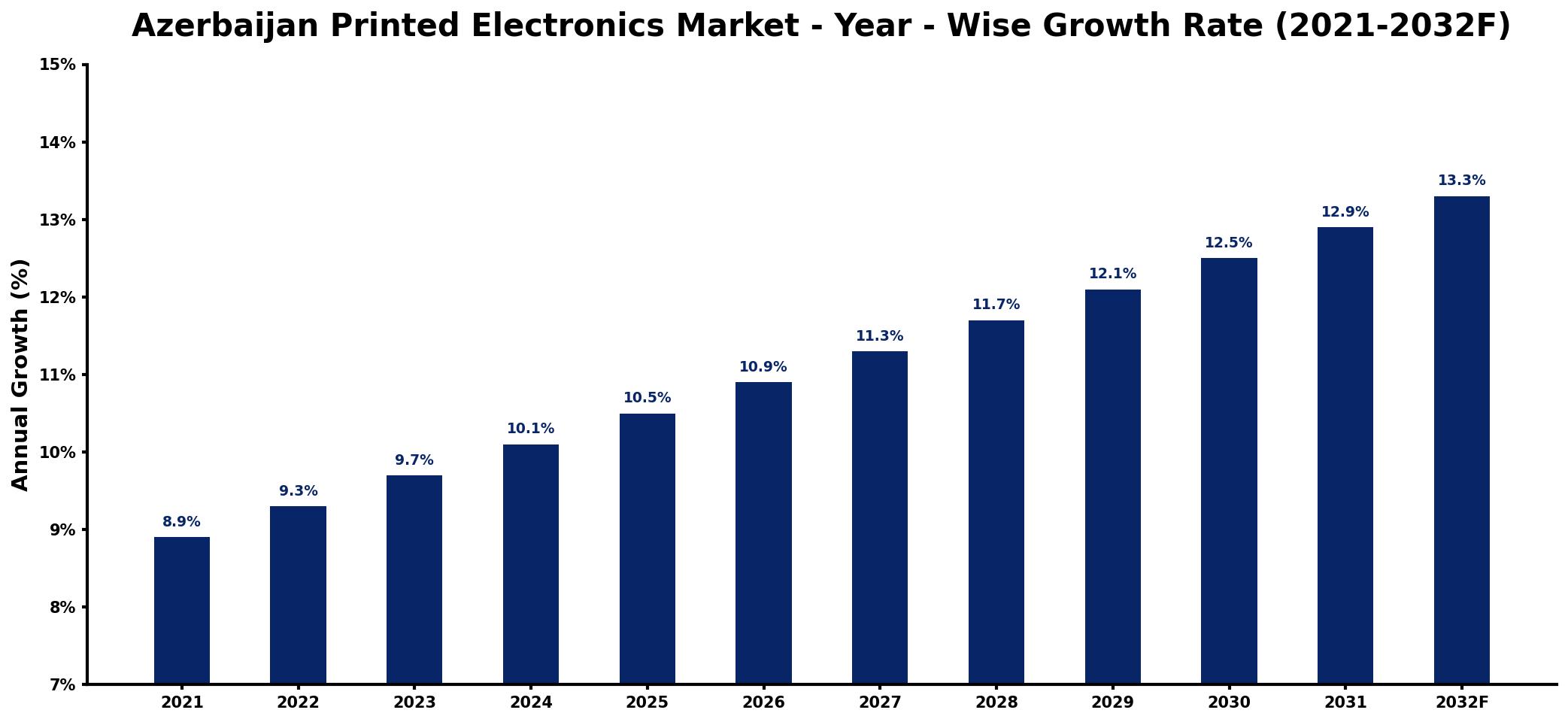
The table below presents the year‑wise growth rates along with the key drivers influencing the market
| Year | Growth Rate | Major Drivers |
| 2021 | 8.9% | Emerging technologies drive investments |
| 2022 | 9.3% | Increased demand for smart packaging |
| 2023 | 9.7% | Growth in wearables market adoption |
| 2024 | 10.1% | Rising interest in sustainable solutions |
| 2025 | 10.5% | Expansion of automotive applications |
| 2026 | 10.9% | Healthcare sector embracing innovation |
| 2027 | 11.3% | growing regional consumption patterns |
| 2028 | 11.7% | Advancements in manufacturing processes |
| 2029 | 12.1% | Integration with Internet of Things |
| 2030 | 12.5% | Government support for innovation initiatives |
| 2031 | 12.9% | Collaboration between industries intensifies |
| 2032 | 13.3% | Global market trends influence growth |
Note: Market size estimations and growth projections presented in this report are based on 6Wresearch's proprietary forecasting methodology, utilizing the latest available industry data, government publications, and primary research inputs.
Azerbaijan Printed Electronics Market Synopsis
The primary force shaping the Azerbaijan Printed Electronics Market is the surging demand for flexible and lightweight electronic solutions. As industries like consumer electronics and healthcare increasingly seek efficient and cost-effective production methods, printed electronics have emerged as a favored alternative.
With ongoing advancements in printing technologies, the market is also benefitting from a wave of innovation that enhances product functionality. This, coupled with substantial investment in research and development initiatives, positions Azerbaijan as a promising hub for printed electronics.
Azerbaijan Printed Electronics Market Key Takeaways
- The market is driven by an increasing demand for flexible electronic devices across various industries.
- Innovations in printing technologies and functional inks are enhancing product capabilities.
- Investment in research and development is crucial for market expansion.
- Challenges regarding material sourcing and product reliability persist, requiring strategic solutions.
- The supportive government policies aim to foster a collaborative environment for market stakeholders.
Evaluation of Restraints in Azerbaijan Printed Electronics Market
Despite its potential, the Azerbaijan Printed Electronics Market faces several restraints that could inhibit growth. A significant barrier is the availability of high-quality conductive materials necessary for the production of printed electronics. Supply chain disruptions can lead to variability in quality, complicating manufacturers' efforts to maintain high standards. Moreover, scaling the production processes from laboratory prototypes to large commercial volumes presents challenges in optimizing equipment and managing yields effectively. Product reliability in varying environmental conditions remains a focal concern, impacting consumer trust and widespread adoption.
Azerbaijan Printed Electronics Market Trends
Current trends within the Azerbaijan Printed Electronics Market highlight an increasing shift towards sustainability and eco-friendly materials in electronics manufacturing. The industry is also witnessing a surge in the integration of Internet of Things (IoT) technologies, propelling demand for advanced sensors and smart packaging solutions. Additive manufacturing processes continue to evolve, enabling more efficient production lines and reducing waste. Furthermore, collaborative efforts between educational institutions and private sectors are fostering a more innovative ecosystem.
Azerbaijan Printed Electronics Market Opportunities
The real growth opportunities in the Azerbaijan Printed Electronics Market lie in niche applications such as wearable technology and smart packaging. These sectors are poised for expansion due to consumer demand for personalized and functional products. Moreover, as healthcare continues to digitize, there is an increasing need for printed sensors and diagnostic devices that offer more flexibility and cost-effectiveness. Investment in local manufacturing capabilities could also bolster the market, reducing reliance on imported materials and fostering economic growth.
Government Initiatives in the Azerbaijan Printed Electronics Market
The Azerbaijani government is actively promoting the printed electronics sector through various initiatives aimed at enhancing research and development. Policies designed to foster innovation in electronics manufacturing include funding programs for R&D, regulatory frameworks that ensure product reliability, and incentives for collaboration among academic institutions and industry players. These initiatives are crucial for building a supportive environment that encourages growth and adoption of new technologies in the printed electronics market.
Future Insights of the Azerbaijan Printed Electronics Market
Looking ahead to 2026-2032, the Azerbaijan Printed Electronics Market is expected to continue its upward trajectory, fueled by technological advancements and the ongoing shift towards electronic device miniaturization. The demand for smart, connected devices is likely to escalate, pushing innovations in printed sensors and energy-harvesting technologies. Furthermore, as Azerbaijan solidifies its position as a regional manufacturing hub for printed electronics, collaboration among stakeholders will be essential in overcoming challenges and optimizing growth strategies.
Azerbaijan Printed Electronics Market Latest Developments (2025 - 2026)
In the recent months, the Azerbaijan Printed Electronics Market has witnessed several notable developments, primarily focused on technological advancements and material improvements. Key players are increasingly investing in additive manufacturing processes, enhancing production efficiency and product quality. Additionally, research institutions are forming strategic partnerships with local manufacturers to accelerate innovation in functional inks and substrates, which is critical for the market's evolution. These trends indicate a vibrant and rapidly advancing sector poised for future success.
Azerbaijan Printed Electronics Market - Key Attractiveness of the Report
- 10 Years of Market Numbers
- Historical Data Starting from 2022 to 2025
- Base Year: 2025
- Forecast Data until 2032
- Key Performance Indicators Impacting the Market
- Major Upcoming Developments and Projects
Key Highlights of the Report:
- Azerbaijan Printed Electronics Market Outlook
- Market Size of Azerbaijan Printed Electronics Market, 2025
- Forecast of Azerbaijan Printed Electronics Market, 2032
- Historical Data and Forecast of Azerbaijan Printed Electronics Revenues & Volume for the Period 2022-2032F
- Azerbaijan Printed Electronics Market Trend Evolution
- Azerbaijan Printed Electronics Market Drivers and Challenges
- Azerbaijan Printed Electronics Price Trends
- Azerbaijan Printed Electronics Porter's Five Forces
- Azerbaijan Printed Electronics Industry Life Cycle
- Historical Data and Forecast of Azerbaijan Printed Electronics Market Revenues & Volume By Material for the Period 2022-2032F
- Historical Data and Forecast of Azerbaijan Printed Electronics Market Revenues & Volume By Ink for the Period 2022-2032F
- Historical Data and Forecast of Azerbaijan Printed Electronics Market Revenues & Volume By Substrate for the Period 2022-2032F
- Historical Data and Forecast of Azerbaijan Printed Electronics Market Revenues & Volume By Technology for the Period 2022-2032F
- Historical Data and Forecast of Azerbaijan Printed Electronics Market Revenues & Volume By Screen for the Period 2022-2032F
- Historical Data and Forecast of Azerbaijan Printed Electronics Market Revenues & Volume By Inkjet for the Period 2022-2032F
- Historical Data and Forecast of Azerbaijan Printed Electronics Market Revenues & Volume By Flexographic for the Period 2022-2032F
- Historical Data and Forecast of Azerbaijan Printed Electronics Market Revenues & Volume By Gravure for the Period 2022-2032F
- Historical Data and Forecast of Azerbaijan Printed Electronics Market Revenues & Volume By Device for the Period 2022-2032F
- Historical Data and Forecast of Azerbaijan Printed Electronics Market Revenues & Volume By Displays for the Period 2022-2032F
- Historical Data and Forecast of Azerbaijan Printed Electronics Market Revenues & Volume By Photovoltaic for the Period 2022-2032F
- Historical Data and Forecast of Azerbaijan Printed Electronics Market Revenues & Volume By Lighting for the Period 2022-2032F
- Historical Data and Forecast of Azerbaijan Printed Electronics Market Revenues & Volume By RFID for the Period 2022-2032F
- Historical Data and Forecast of Azerbaijan Printed Electronics Market Revenues & Volume By Others for the Period 2022-2032F
- Azerbaijan Printed Electronics Import Export Trade Statistics
- Market Opportunity Assessment By Material
- Market Opportunity Assessment By Technology
- Market Opportunity Assessment By Device
- Azerbaijan Printed Electronics Top Companies Market Share
- Azerbaijan Printed Electronics Competitive Benchmarking By Technical and Operational Parameters
- Azerbaijan Printed Electronics Company Profiles
- Azerbaijan Printed Electronics Key Strategic Recommendations






































