Azerbaijan Smart Locks Market Size, Share & Growth Rate
The Azerbaijan Smart Locks Market was estimated at USD 1468 Million in 2025 and is projected to reach USD 2686 Million by 2032, growing at a CAGR of 9.0% from 2026 to 2032. This robust growth trajectory is largely fueled by a rising awareness of home security among consumers and increasing disposable incomes, allowing for greater investment in advanced security solutions. Moreover, technological advancements and the proliferation of IoT devices are further contributing to market expansion, as smart locks offer enhanced convenience and robust security features that resonate with the contemporary consumer.
Azerbaijan Smart Locks Market Year-wise Growth Rate and Key Drivers
This graph highlights how the Azerbaijan Smart Locks Market has steadily grown over the years, supported by major growth factors.
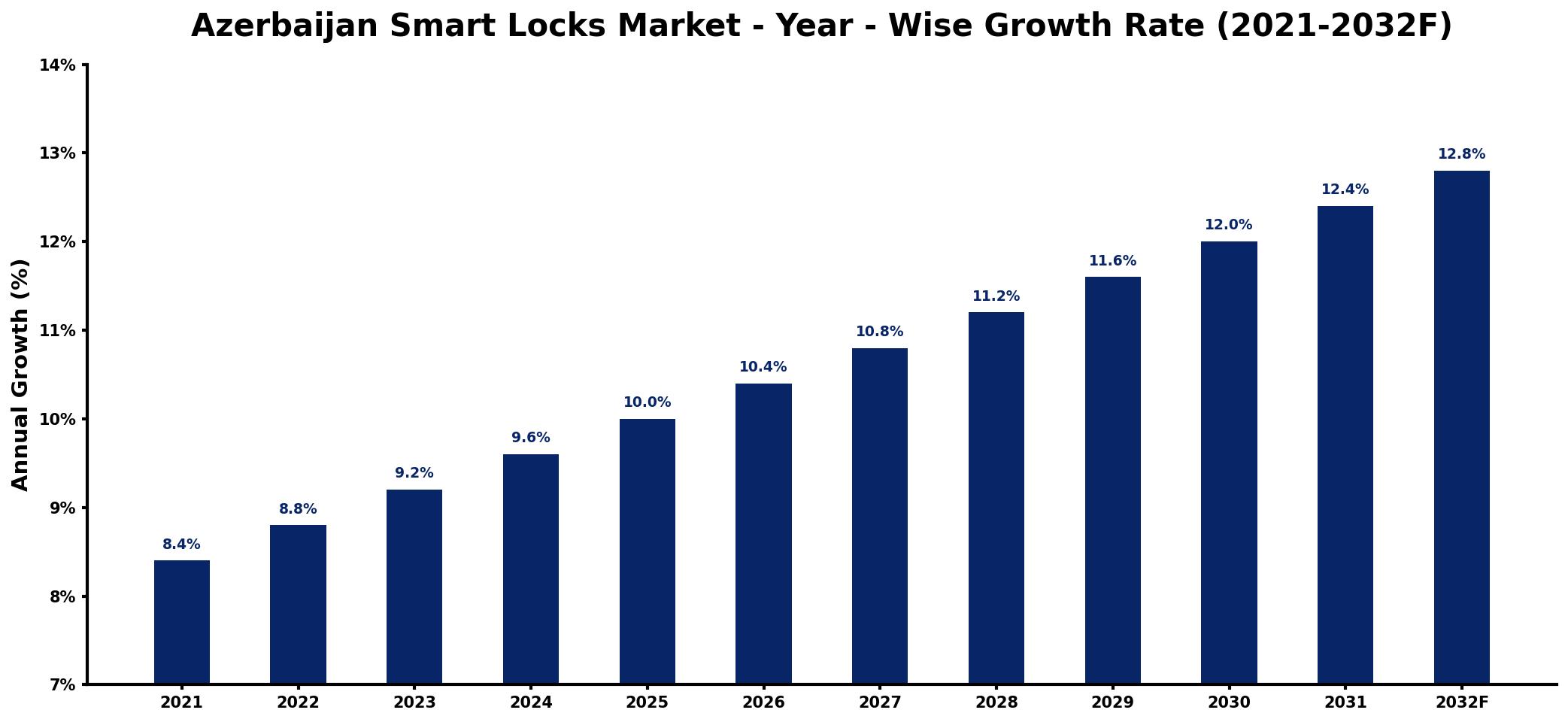
The table below presents the year‑wise growth rates along with the key drivers influencing the market
| Year | Growth Rate | Major Drivers |
| 2021 | 8.4% | Rising consumer security awareness |
| 2022 | 8.8% | Increased urbanization and development |
| 2023 | 9.2% | Growing demand for automation |
| 2024 | 9.6% | Expansion of residential projects |
| 2025 | 10.0% | Surge in technology adoption rates |
| 2026 | 10.4% | increased domestic production output |
| 2027 | 10.8% | Development of IoT infrastructure |
| 2028 | 11.2% | Increase in disposable income levels |
| 2029 | 11.6% | Focus on energy efficiency solutions |
| 2030 | 12.0% | Technological advancements in security |
| 2031 | 12.4% | Heightened interest in remote monitoring |
| 2032 | 12.8% | Enhanced integration with home systems |
Note: Market size estimations and growth projections presented in this report are based on 6Wresearch's proprietary forecasting methodology, utilizing the latest available industry data, government publications, and primary research inputs.
Azerbaijan Smart Locks Market Synopsis
The strongest force shaping the Azerbaijan Smart Locks Market is the increasing demand for enhanced home security solutions. As urbanization accelerates and lifestyles evolve, consumers are seeking products that not only secure their premises but also integrate seamlessly with smart home technology.
This burgeoning market is characterized by a dynamic interplay of local and international players, each offering a variety of products tailored to diverse consumer preferences. The integration of smart locks with home automation systems is becoming increasingly common, further solidifying their position in the modern security landscape of Azerbaijan.
Azerbaijan Smart Locks Market Key Takeaways
- Growing urbanization and increasing disposable incomes are driving demand for smart locks.
- Technological advancements are leading to product innovations, particularly in biometric and cloud-connected features.
- Consumer preferences are shifting towards aesthetically pleasing designs that enhance home décor.
- Government policies support innovation, creating a conducive environment for market growth.
- Limited awareness of smart lock technology presents both challenges and opportunities for educational initiatives.
Evaluation of Restraints in Azerbaijan Smart Locks Market
Despite the positive outlook, several factors restrain the Azerbaijan Smart Locks Market. A significant barrier is the relatively low level of awareness and understanding of smart lock technology among potential consumers. Many individuals harbor concerns regarding privacy and security, which can hinder adoption. Additionally, the absence of standardized regulations creates uncertainty regarding interoperability among different brands, limiting consumer confidence. Lastly, a shortage of skilled technicians for the installation and maintenance of smart locks further complicates market growth. Addressing these issues through educational campaigns and regulatory frameworks will be crucial for unlocking the market's full potential.
Azerbaijan Smart Locks Market Trends
Several key trends are currently shaping the Azerbaijan Smart Locks Market. The integration of smart locks into comprehensive home automation systems is gaining traction, enabling users to remotely access and monitor their security features. Biometric authentication is becoming increasingly popular, providing an additional layer of security that appeals to safety-conscious consumers. Furthermore, the rise of cloud-connected smart locks allows for seamless connectivity and control, enhancing user experience. Design also plays a pivotal role; consumers are gravitating towards sleek, modern aesthetics that complement their living spaces while offering advanced security functionalities.
Azerbaijan Smart Locks Market Opportunities
The market presents numerous investment opportunities, particularly in light of the rising demand for smart home technologies. Urbanization and increased disposable income are propelling consumers towards adopting advanced security solutions that offer convenience and peace of mind. Government initiatives promoting digitalization and smart city projects further bolster this trend, providing fertile ground for companies aiming to enter or expand in the market. The focus on product innovation, coupled with growing consumer interest in smart security solutions, makes this market a promising landscape for investors.
Government Initiatives in the Azerbaijan Smart Locks Market
The Azerbaijani government is actively fostering the growth of the smart locks market through various policies aimed at enhancing innovation and technology development. Initiatives include financial support, such as grants for companies engaged in the smart locks sector, which encourages research and product development. Additionally, the government has emphasized improving cybersecurity standards to ensure that smart lock systems are safe and reliable. By promoting partnerships between local and international firms, the government aims to increase competitiveness and facilitate the dissemination of smart lock technologies throughout Azerbaijan and beyond.
Future Insights of the Azerbaijan Smart Locks Market
Looking ahead to 2026-2032, the Azerbaijan Smart Locks Market is poised for significant growth. The convergence of smart technologies and heightened consumer interest in home automation is likely to amplify demand for smart locks. As economic conditions improve and more households prioritize security, the integration of smart locks with other smart home devices will become even more commonplace. Enhanced public awareness about the benefits of smart locks and ongoing technological advancements will further propel market growth, offering ample opportunities for established players and new entrants alike.
Azerbaijan Smart Locks Market Latest Developments (2025 - 2026)
In recent months, the Azerbaijan Smart Locks Market has seen a notable shift toward increased collaboration between domestic and international companies, enhancing the competitive landscape. New products featuring advanced biometric security options have been introduced, catering to the rising demand for heightened safety measures. There has also been a surge in marketing efforts aimed at educating consumers about the advantages of smart lock technology. Furthermore, technological advancements continue to make smart locks more user-friendly, paving the way for wider adoption among various consumer segments.
Azerbaijan Smart Locks Market - Key Attractiveness of the Report
- 10 Years of Market Numbers
- Historical Data Starting from 2022 to 2025
- Base Year: 2025
- Forecast Data until 2032
- Key Performance Indicators Impacting the Market
- Major Upcoming Developments and Projects
Key Highlights of the Report:
- Azerbaijan Smart Locks Market Outlook
- Market Size of Azerbaijan Smart Locks Market, 2025
- Forecast of Azerbaijan Smart Locks Market, 2032
- Historical Data and Forecast of Azerbaijan Smart Locks Revenues & Volume for the Period 2022-2032F
- Azerbaijan Smart Locks Market Trend Evolution
- Azerbaijan Smart Locks Market Drivers and Challenges
- Azerbaijan Smart Locks Price Trends
- Azerbaijan Smart Locks Porter's Five Forces
- Azerbaijan Smart Locks Industry Life Cycle
- Historical Data and Forecast of Azerbaijan Smart Locks Market Revenues & Volume By Product for the Period 2022-2032F
- Historical Data and Forecast of Azerbaijan Smart Locks Market Revenues & Volume By Deadbolts for the Period 2022-2032F
- Historical Data and Forecast of Azerbaijan Smart Locks Market Revenues & Volume By Lever Handles for the Period 2022-2032F
- Historical Data and Forecast of Azerbaijan Smart Locks Market Revenues & Volume By Padlocks for the Period 2022-2032F
- Historical Data and Forecast of Azerbaijan Smart Locks Market Revenues & Volume By Others for the Period 2022-2032F
- Historical Data and Forecast of Azerbaijan Smart Locks Market Revenues & Volume By Technology for the Period 2022-2032F
- Historical Data and Forecast of Azerbaijan Smart Locks Market Revenues & Volume By Bluetooth for the Period 2022-2032F
- Historical Data and Forecast of Azerbaijan Smart Locks Market Revenues & Volume By Wi-Fi for the Period 2022-2032F
- Historical Data and Forecast of Azerbaijan Smart Locks Market Revenues & Volume By End User for the Period 2022-2032F
- Historical Data and Forecast of Azerbaijan Smart Locks Market Revenues & Volume By Residential for the Period 2022-2032F
- Historical Data and Forecast of Azerbaijan Smart Locks Market Revenues & Volume By Commercial for the Period 2022-2032F
- Azerbaijan Smart Locks Import Export Trade Statistics
- Market Opportunity Assessment By Product
- Market Opportunity Assessment By Technology
- Market Opportunity Assessment By End User
- Azerbaijan Smart Locks Top Companies Market Share
- Azerbaijan Smart Locks Competitive Benchmarking By Technical and Operational Parameters
- Azerbaijan Smart Locks Company Profiles
- Azerbaijan Smart Locks Key Strategic Recommendations






































