Bahrain Microcars Market: Import Trend Analysis
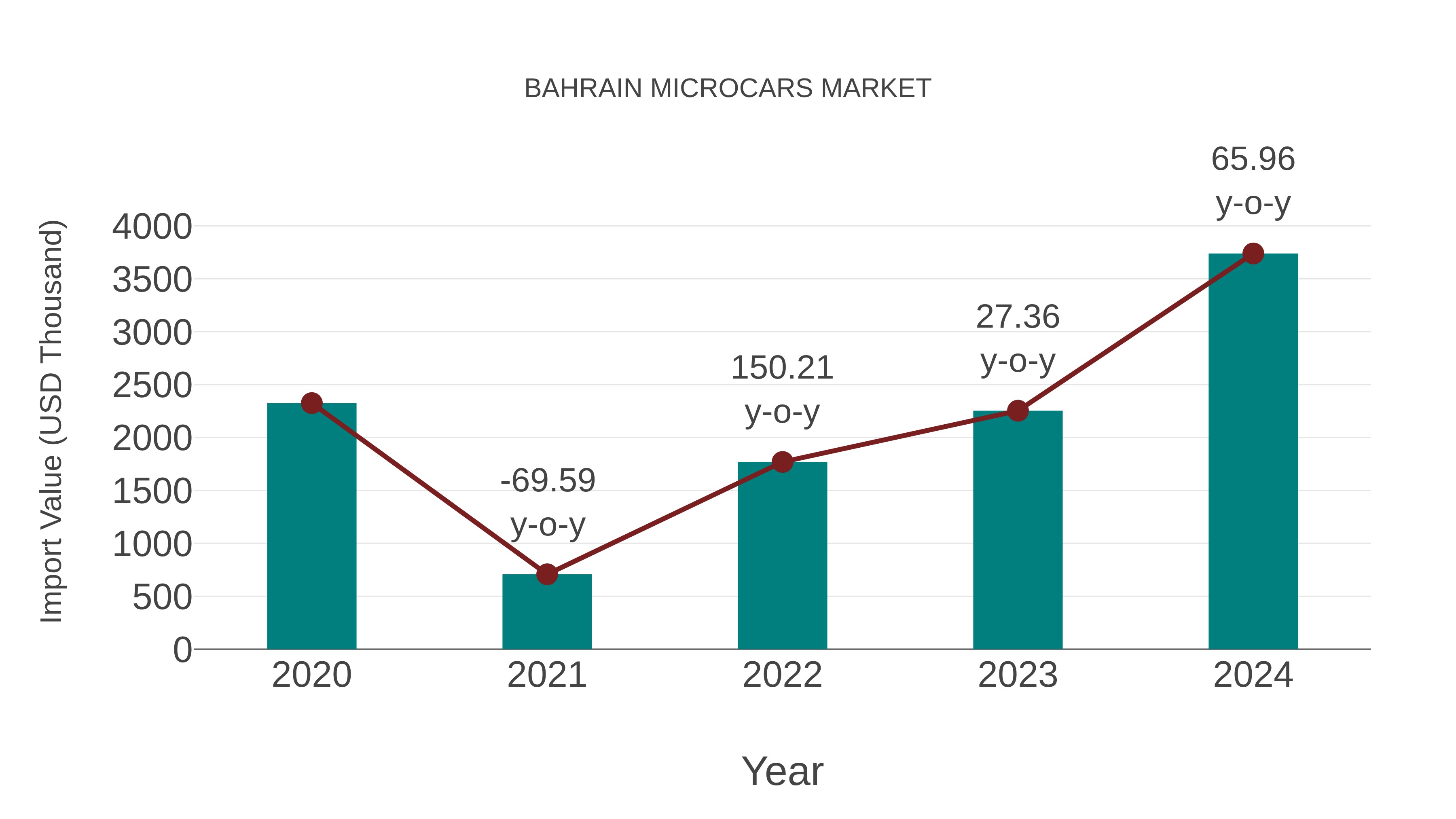
During 2020-2024, the Bahrain microcars market saw a Compound Annual Growth Rate (CAGR) of 12.61%. Notably, in 2023-2024, the year-on-year growth rate spiked to 65.96%. This significant increase in imports during this period can be attributed to the combined effect of these growth rates.
Bahrain Microcars Market Overview
The microcars market in Bahrain is gaining traction as consumers and urban planners look for compact, fuel-efficient, and cost-effective transportation solutions. These small vehicles are especially appealing for navigating the countrys congested city roads and limited parking spaces. Rising fuel prices and environmental concerns are also pushing both private users and businesses toward microcars, particularly electric variants. While currently niche, the market is receiving growing interest from automotive startups and regional importers offering innovative models. Government incentives for low-emission vehicles and increasing urbanization are further boosting microcar demand. As Bahrain advances its smart city infrastructure, microcars are likely to play a key role in sustainable urban mobility.
Trends of the market
The microcars market in Bahrain is gradually expanding as urbanization and environmental concerns increase demand for compact, fuel-efficient vehicles. Microcars offer advantages such as ease of parking, low emissions, and affordability, appealing to city dwellers and young consumers. Government initiatives promoting sustainable transport and electric vehicle adoption further boost market growth. Advances in battery technology and vehicle design enhance performance and range. Consumer preferences are shifting towards eco-friendly mobility solutions. Infrastructure developments, including charging stations, support market expansion. The trend reflects Bahrains focus on modernizing its urban transport ecosystem.
Challenges of the market
The microcars market in Bahrain faces challenges related to limited consumer acceptance due to perceptions of reduced safety and performance compared to conventional vehicles. Infrastructure constraints, such as the availability of charging stations for electric microcars, limit market growth, especially as environmental regulations tighten. Regulatory hurdles concerning vehicle safety standards and emissions also pose difficulties for manufacturers and importers. Additionally, the small market size and competition from more established vehicle categories reduce economies of scale. Import dependencies and associated tariffs increase the final cost to consumers. These challenges collectively hinder the widespread adoption of microcars in Bahrain.
Investment opportunities in the Market
Bahrains microcars market offers investment potential driven by urbanization, rising environmental awareness, and demand for compact, fuel-efficient vehicles. Microcars appeal to city dwellers looking for affordable and easy-to-park transportation options, especially amid traffic congestion concerns. Investors can explore importing and distributing electric and hybrid microcars that align with Bahrains sustainability goals. Government incentives supporting clean transportation further enhance market attractiveness. Additionally, opportunities exist in establishing rental and sharing services tailored to microcars, catering to younger and environmentally conscious consumers. Collaborations with international manufacturers can facilitate local assembly or customization to suit regional preferences. The evolving regulatory framework promoting electric mobility supports long-term growth. This segment presents a sustainable investment avenue amid shifting consumer behaviors.
Government Policy of the market
Bahrain is encouraging the adoption of small, energy-efficient vehicles like microcars through its green mobility initiatives. The government offers import duty reductions and VAT exemptions for vehicles with low carbon emissions. Policies also include preferential parking permits and lower registration fees for electric and hybrid microcars. Public awareness campaigns and sustainability awards have been launched to educate citizens about the benefits of compact urban transportation. The Ministry of Transportation and Telecommunications is working with urban planners to accommodate more charging stations and smaller vehicle lanes. This favorable regulatory climate is designed to reduce urban congestion and align with Bahrain`s climate goals.
Key Highlights of the Report:
- Bahrain Microcars Market Outlook
- Market Size of Bahrain Microcars Market, 2025
- Forecast of Bahrain Microcars Market, 2032
- Historical Data and Forecast of Bahrain Microcars Revenues & Volume for the Period 2022 - 2032F
- Bahrain Microcars Market Trend Evolution
- Bahrain Microcars Market Drivers and Challenges
- Bahrain Microcars Price Trends
- Bahrain Microcars Porter's Five Forces
- Bahrain Microcars Industry Life Cycle
- Historical Data and Forecast of Bahrain Microcars Market Revenues & Volume By Type for the Period 2022 - 2032F
- Historical Data and Forecast of Bahrain Microcars Market Revenues & Volume By One Wheel Drive for the Period 2022 - 2032F
- Historical Data and Forecast of Bahrain Microcars Market Revenues & Volume By Two Wheel Drive for the Period 2022 - 2032F
- Historical Data and Forecast of Bahrain Microcars Market Revenues & Volume By All Wheel Drive for the Period 2022 - 2032F
- Historical Data and Forecast of Bahrain Microcars Market Revenues & Volume By Application for the Period 2022 - 2032F
- Historical Data and Forecast of Bahrain Microcars Market Revenues & Volume By Passenger for the Period 2022 - 2032F
- Historical Data and Forecast of Bahrain Microcars Market Revenues & Volume By Commercial for the Period 2022 - 2032F
- Historical Data and Forecast of Bahrain Microcars Market Revenues & Volume By Engine Capacity for the Period 2022 - 2032F
- Historical Data and Forecast of Bahrain Microcars Market Revenues & Volume By 100cc-250cc for the Period 2022 - 2032F
- Historical Data and Forecast of Bahrain Microcars Market Revenues & Volume By 251cc-500cc for the Period 2022 - 2032F
- Historical Data and Forecast of Bahrain Microcars Market Revenues & Volume By 501cc-700cc for the Period 2022 - 2032F
- Bahrain Microcars Import Export Trade Statistics
- Market Opportunity Assessment By Type
- Market Opportunity Assessment By Application
- Market Opportunity Assessment By Engine Capacity
- Bahrain Microcars Top Companies Market Share
- Bahrain Microcars Competitive Benchmarking By Technical and Operational Parameters
- Bahrain Microcars Company Profiles
- Bahrain Microcars Key Strategic Recommendations






































