Bahrain Power Supply and Charger Market: Import Trend Analysis
The Bahrain power supply and charger market witnessed a significant increase in imports from 2020 to 2024, with a Compound Annual Growth Rate (CAGR) of 31.34%. Notably, the year-on-year growth rate for 20232024 stood at 20.46%, indicating a steady rise in imported products during this period.
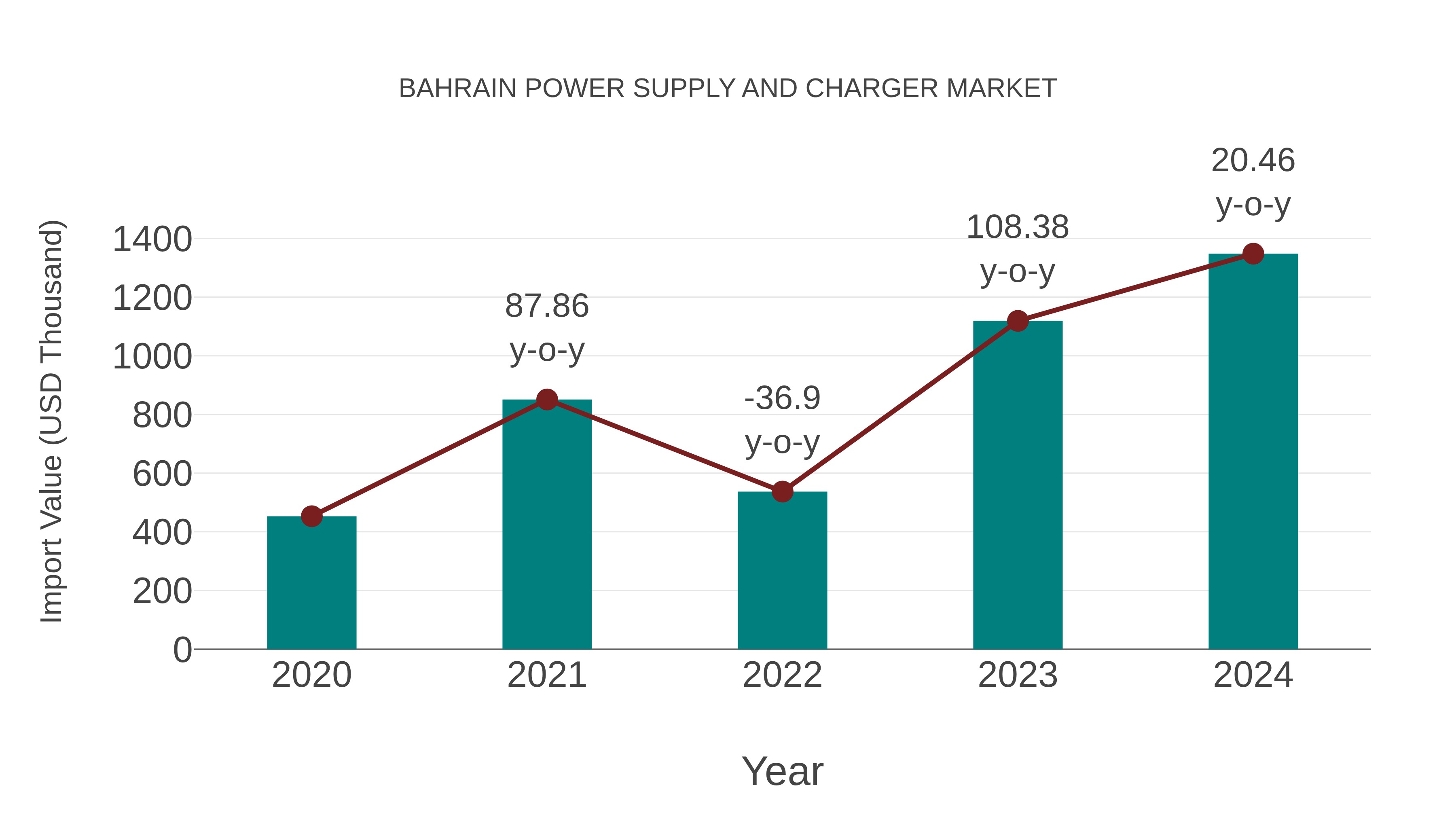
Bahrain Power Supply and Charger Market Overview
Bahrains power supply and charger market is expanding rapidly due to the proliferation of electronic devices such as smartphones, laptops, and tablets. Consumers demand fast-charging, wireless, and multi-port charging solutions, prompting innovation in product offerings. Both OEM and third-party charger brands compete in this space, with strong representation from international manufacturers. In the commercial sector, industrial-grade power supplies are also in demand for telecommunications and IT infrastructure. The growing adoption of smart homes and offices further fuels this markets growth. Regulatory measures focus on quality assurance and consumer safety, ensuring certified products dominate the shelves.
Trends of the market
With the proliferation of consumer electronics and portable gadgets, the Power Supply and Charger Market in Bahrain is experiencing robust demand. Wireless charging technology, fast-charging capabilities, and universal compatibility are key trends defining product development. The rising popularity of electric vehicles (EVs) is also generating demand for home and public EV chargers. Compact, multi-port power supplies are increasingly preferred for both personal and professional use. Manufacturers are also focusing on energy efficiency certifications and recyclable materials to appeal to environmentally conscious consumers. Regulatory compliance and safety certifications continue to influence purchasing decisions in this segment.
Challenges of the market
The power supply and charger market in Bahrain struggles with the rapid pace of technological change, requiring frequent updates to product lines to support new device standards. Compatibility issues between chargers and a wide range of electronic devices cause consumer confusion and returns. There is also intense price competition from low-cost imports, which often compromise quality and safety. Supply chain constraints and dependency on foreign manufacturers lead to occasional stock shortages and delayed product launches. Environmental concerns over e-waste disposal are increasing regulatory pressure to develop recyclable and energy-efficient products, adding to costs. Consumer demand for fast-charging and wireless options necessitates significant R&D investment, which may be difficult for smaller local players.
Investment opportunities in the Market
Bahrains Power Supply and Charger Market is expanding rapidly due to the surge in consumer electronics, industrial automation, and mobile device usage. With remote working and digital connectivity becoming the norm, demand for high-capacity, fast-charging, and energy-efficient chargers is escalating. Investment opportunities include local manufacturing units, particularly for Type-C, wireless, and solar-powered chargers. E-commerce platforms offer scalable distribution, especially for niche and customizable products. There is a strong demand in the B2B sector from schools, offices, and healthcare institutions for multi-port charging stations. Investors can also explore licensing or white-labeling agreements with global brands for Bahrain and the GCC. The market rewards innovation, particularly in foldable, compact, or multi-device chargers. Government incentives for renewable energy solutions further support the solar charger segment. This is a high-turnover market with great scope for both retail and industrial investment.
Government Policy of the market
Bahrains power supply and charger market operates under strict import controls to prevent substandard and unsafe electronic products from entering the local market. All power supply units and chargers must meet electrical conformity standards established by the Gulf Standardization Organization (GSO). The government also mandates proper certification from recognized bodies for voltage safety and fire resistance. Bahrain`s Information and eGovernment Authority facilitates smoother licensing processes for businesses involved in electronics trade. As mobile device and digital gadget use rises, the government supports local retail growth with favorable import duties and streamlined logistics. Environmental initiatives focus on proper e-waste management and encourage retailers to offer recycling options. Policies also ensure clear labeling of wattage, voltage, and country of origin to help consumers make informed decisions. The Telecommunications Regulatory Authority occasionally intervenes to ensure mobile chargers meet compatibility norms. Overall, the market is regulated to protect consumers while promoting innovation and accessibility.
Key Highlights of the Report:
- Bahrain Power Supply and Charger Market Outlook
- Market Size of Bahrain Power Supply and Charger Market, 2025
- Forecast of Bahrain Power Supply and Charger Market, 2032
- Historical Data and Forecast of Bahrain Power Supply and Charger Revenues & Volume for the Period 2022 - 2032F
- Bahrain Power Supply and Charger Market Trend Evolution
- Bahrain Power Supply and Charger Market Drivers and Challenges
- Bahrain Power Supply and Charger Price Trends
- Bahrain Power Supply and Charger Porter's Five Forces
- Bahrain Power Supply and Charger Industry Life Cycle
- Historical Data and Forecast of Bahrain Power Supply and Charger Market Revenues & Volume By Type for the Period 2022 - 2032F
- Historical Data and Forecast of Bahrain Power Supply and Charger Market Revenues & Volume By AC-DC Power Supplies for the Period 2022 - 2032F
- Historical Data and Forecast of Bahrain Power Supply and Charger Market Revenues & Volume By DC-DC Converters for the Period 2022 - 2032F
- Historical Data and Forecast of Bahrain Power Supply and Charger Market Revenues & Volume By End-use Industry for the Period 2022 - 2032F
- Historical Data and Forecast of Bahrain Power Supply and Charger Market Revenues & Volume By Industrial for the Period 2022 - 2032F
- Historical Data and Forecast of Bahrain Power Supply and Charger Market Revenues & Volume By E-Mobility for the Period 2022 - 2032F
- Historical Data and Forecast of Bahrain Power Supply and Charger Market Revenues & Volume By Medical for the Period 2022 - 2032F
- Historical Data and Forecast of Bahrain Power Supply and Charger Market Revenues & Volume By Tools & Garden Devices for the Period 2022 - 2032F
- Historical Data and Forecast of Bahrain Power Supply and Charger Market Revenues & Volume By Consumer Electronics for the Period 2022 - 2032F
- Historical Data and Forecast of Bahrain Power Supply and Charger Market Revenues & Volume By Aerospace & Defense for the Period 2022 - 2032F
- Historical Data and Forecast of Bahrain Power Supply and Charger Market Revenues & Volume By Telecommunication for the Period 2022 - 2032F
- Historical Data and Forecast of Bahrain Power Supply and Charger Market Revenues & Volume By Others for the Period 2022 - 2032F
- Historical Data and Forecast of Bahrain Power Supply and Charger Market Revenues & Volume By Output Power/Voltage for the Period 2022 - 2032F
- Historical Data and Forecast of Bahrain Power Supply and Charger Market Revenues & Volume By Power Supply for the Period 2022 - 2032F
- Historical Data and Forecast of Bahrain Power Supply and Charger Market Revenues & Volume By Chargers for the Period 2022 - 2032F
- Bahrain Power Supply and Charger Import Export Trade Statistics
- Market Opportunity Assessment By Type
- Market Opportunity Assessment By End-use Industry
- Market Opportunity Assessment By Output Power/Voltage
- Bahrain Power Supply and Charger Top Companies Market Share
- Bahrain Power Supply and Charger Competitive Benchmarking By Technical and Operational Parameters
- Bahrain Power Supply and Charger Company Profiles
- Bahrain Power Supply and Charger Key Strategic Recommendations






































