Bangladesh Briquette Market Size, Share & Growth Rate
The Bangladesh Briquette Market was estimated at USD 380 Million in 2025 and is projected to reach USD 524 Million by 2032, growing at a CAGR of 4.7% from 2026 to 2032. This robust growth trajectory is primarily fueled by the increasing awareness of the environmental benefits associated with briquettes, particularly in rural regions where access to clean energy sources remains a significant challenge. Furthermore, the rising costs of traditional fuels, combined with supportive government policies aimed at promoting renewable energy sources, are anticipated to further drive market expansion.
Bangladesh Briquette Market Year-wise Growth Rate and Key Drivers
This graph highlights how the Bangladesh Briquette Market has steadily grown over the years, supported by major growth factors.
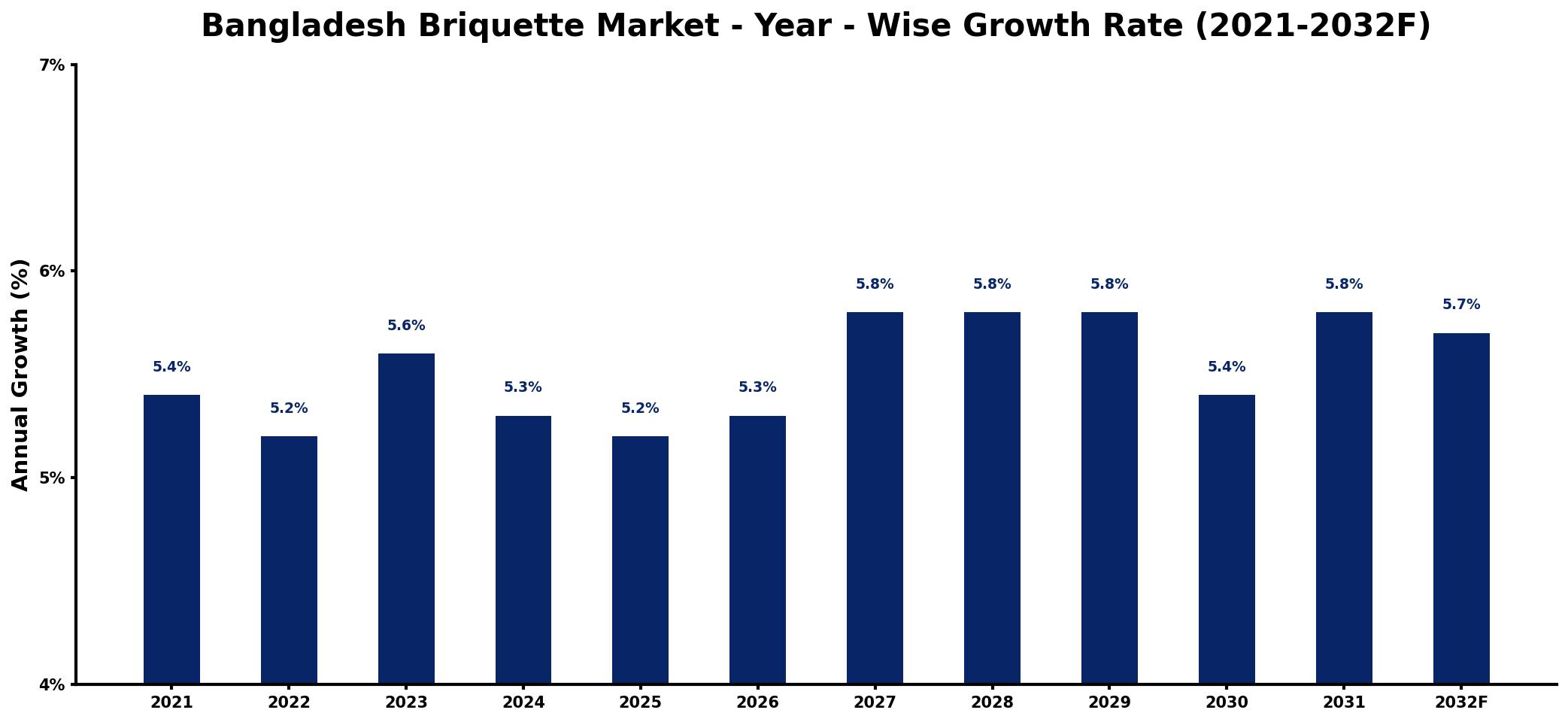
The table below presents the year‑wise growth rates along with the key drivers influencing the market
| Year | Growth Rate | Major Drivers |
| 2021 | 5.4% | Rising demand for clean energy |
| 2022 | 5.2% | Increased investments in renewables |
| 2023 | 5.6% | Expansion of sustainable practices |
| 2024 | 5.3% | Growing interest in eco-friendly solutions |
| 2025 | 5.2% | Enhancement of distribution networks |
| 2026 | 5.3% | Strengthened regulatory support initiatives |
| 2027 | 5.8% | Diversification of energy sources available |
| 2028 | 5.8% | Advancements in production technologies |
| 2029 | 5.8% | Collaboration among industry stakeholders |
| 2030 | 5.4% | Increased consumer awareness initiatives |
| 2031 | 5.8% | Strengthened government incentives programs |
| 2032 | 5.7% | Rising global energy market trends |
Note: Market size estimations and growth projections presented in this report are based on 6Wresearch's proprietary forecasting methodology, utilizing the latest available industry data, government publications, and primary research inputs.
Bangladesh Briquette Market Synopsis
In Bangladesh, the shift towards briquettes is gaining momentum, especially among households seeking affordable and eco-friendly alternatives to conventional fuels. The use of biomass materials such as sawdust and agricultural residues not only provides a reliable energy source but also helps in managing waste, underscoring the dual benefits of briquettes.
The market's growth is also supported by a surge in local manufacturing capabilities, which is critical for meeting the diverse energy needs across the country. As more manufacturers enter the space, the variety and accessibility of briquette options are set to improve, catering to both urban and rural consumers alike.
Bangladesh Briquette Market Key Takeaways
- The market is witnessing a significant transition towards renewable energy, with briquettes emerging as a favored option.
- Government initiatives are paving the way for the briquette industry's development through incentives and subsidies.
- Rising fuel costs are prompting consumers to seek more affordable and sustainable energy solutions.
- Investment opportunities are available for manufacturers and distributors willing to leverage local biomass resources.
- Increasing environmental consciousness is fostering a favorable market outlook for briquette adoption.
Evaluation of Restraints in Bangladesh Briquette Market
Despite the promising growth trajectory, several restraints hinder the full potential of the Bangladesh briquette market. One of the key challenges is the limited awareness and understanding among consumers regarding the advantages of briquettes over traditional fuels. This gap often results in slow adoption rates and reluctance to switch. Additionally, inconsistent quality control among various manufacturers creates disparities in product quality, which can lead to customer dissatisfaction. Moreover, competition from lower-priced traditional fuels makes it difficult for briquette producers to price their products competitively without compromising on profitability.
Bangladesh Briquette Market Trends
The current trends in the Bangladesh briquette market reflect a strong demand for sustainable energy sources. Increasing consumer interest in eco-friendly solutions is driving a surge in briquette usage. Technological advancements are also improving the manufacturing processes, enhancing the quality of briquettes available. Furthermore, partnerships between local farmers and briquette manufacturers are emerging, ensuring a steady supply of raw materials while supporting the agricultural sector.
Bangladesh Briquette Market Opportunities
As the demand for alternative energy sources rises, substantial investment opportunities exist within the Bangladesh briquette market. Setting up manufacturing facilities in strategic locations could capitalize on local agricultural waste, creating a sustainable production cycle. Additionally, establishing robust distribution networks will enable broader access to briquette products, particularly in rural areas. Investors can also benefit from government initiatives aimed at promoting renewable energy, enhancing the overall feasibility of such ventures.
Government Initiatives in the Bangladesh Briquette Market
The Bangladeshi government has taken proactive measures to bolster the briquette market. Through various policies and initiatives, it has implemented tax incentives and subsidies designed to encourage both the production and consumption of briquettes. Furthermore, regulations are in place to uphold the quality and safety standards of briquettes, promoting the adoption of cleaner and more efficient production technologies. These efforts are crucial in reducing the reliance on traditional fuels and addressing environmental issues.
Future Insights of the Bangladesh Briquette Market
Looking ahead to 2026-2032, the Bangladesh Briquette Market is poised for continued growth. The increasing focus on sustainability and reducing carbon footprints among consumers is likely to sustain demand for briquettes. Government support in the form of policies and infrastructure development will also play a crucial role in facilitating this growth. Additionally, the consistent availability of raw materials, coupled with a large rural population reliant on biomass for cooking, creates a strong foundation for market expansion in the foreseeable future.
Bangladesh Briquette Market Latest Developments (2025 - 2026)
In recent months, the Bangladesh briquette market has experienced a notable surge in new manufacturers entering the space, aiming to meet the rising demand for eco-friendly fuel alternatives. Industry stakeholders are increasingly focusing on enhancing production efficiency and product quality. Additionally, collaborations between manufacturers and local agricultural sectors have emerged, facilitating better resource management and raw material sourcing. Overall, these developments indicate a robust direction for the market as it continues to evolve.
Bangladesh Briquette Market - Key Attractiveness of the Report
- 10 Years of Market Numbers
- Historical Data Starting from 2022 to 2025
- Base Year: 2025
- Forecast Data until 2032
- Key Performance Indicators Impacting the Market
- Major Upcoming Developments and Projects
Key Highlights of the Report:
- Bangladesh Briquette Market Outlook
- Market Size of Bangladesh Briquette Market, 2025
- Forecast of Bangladesh Briquette Market, 2032
- Historical Data and Forecast of Bangladesh Briquette Revenues & Volume for the Period 2022-2032F
- Bangladesh Briquette Market Trend Evolution
- Bangladesh Briquette Market Drivers and Challenges
- Bangladesh Briquette Price Trends
- Bangladesh Briquette Porter's Five Forces
- Bangladesh Briquette Industry Life Cycle
- Historical Data and Forecast of Bangladesh Briquette Market Revenues & Volume By Type for the Period 2022-2032F
- Historical Data and Forecast of Bangladesh Briquette Market Revenues & Volume By Spruce for the Period 2022-2032F
- Historical Data and Forecast of Bangladesh Briquette Market Revenues & Volume By Pine for the Period 2022-2032F
- Historical Data and Forecast of Bangladesh Briquette Market Revenues & Volume By Beech for the Period 2022-2032F
- Historical Data and Forecast of Bangladesh Briquette Market Revenues & Volume By Straw for the Period 2022-2032F
- Historical Data and Forecast of Bangladesh Briquette Market Revenues & Volume By Others for the Period 2022-2032F
- Historical Data and Forecast of Bangladesh Briquette Market Revenues & Volume By Application for the Period 2022-2032F
- Historical Data and Forecast of Bangladesh Briquette Market Revenues & Volume By Heating of Residential and Commercial Buildings for the Period 2022-2032F
- Historical Data and Forecast of Bangladesh Briquette Market Revenues & Volume By District Heating and Electricity Production for the Period 2022-2032F
- Historical Data and Forecast of Bangladesh Briquette Market Revenues & Volume By End-Use for the Period 2022-2032F
- Historical Data and Forecast of Bangladesh Briquette Market Revenues & Volume By Pharmaceutical Industry for the Period 2022-2032F
- Historical Data and Forecast of Bangladesh Briquette Market Revenues & Volume By Food for the Period 2022-2032F
- Historical Data and Forecast of Bangladesh Briquette Market Revenues & Volume By Chemical Industry for the Period 2022-2032F
- Historical Data and Forecast of Bangladesh Briquette Market Revenues & Volume By Dye and Pigment for the Period 2022-2032F
- Historical Data and Forecast of Bangladesh Briquette Market Revenues & Volume By Paper Mills for the Period 2022-2032F
- Historical Data and Forecast of Bangladesh Briquette Market Revenues & Volume By Textile Industry for the Period 2022-2032F
- Historical Data and Forecast of Bangladesh Briquette Market Revenues & Volume By Leather Manufacturing for the Period 2022-2032F
- Bangladesh Briquette Import Export Trade Statistics
- Market Opportunity Assessment By Type
- Market Opportunity Assessment By Application
- Market Opportunity Assessment By End-Use
- Bangladesh Briquette Top Companies Market Share
- Bangladesh Briquette Competitive Benchmarking By Technical and Operational Parameters
- Bangladesh Briquette Company Profiles
- Bangladesh Briquette Key Strategic Recommendations






































