Bangladesh Food & Grocery Retail Market Size, Share & Growth Rate
The Bangladesh Food & Grocery Retail Market was estimated at USD 671 Million in 2025 and is projected to reach USD 1125 Million by 2032, growing at a CAGR of 7.7% from 2026 to 2032. This robust growth trajectory is propelled by a burgeoning population and rising disposable incomes, which are stimulating demand across all retail channels. As urbanization accelerates and consumers increasingly seek convenience and quality, the market is expected to expand significantly in the coming years.
Bangladesh Food & Grocery Retail Market Year-wise Growth Rate and Key Drivers
This graph highlights how the Bangladesh Food & Grocery Retail Market has steadily grown over the years, supported by major growth factors.
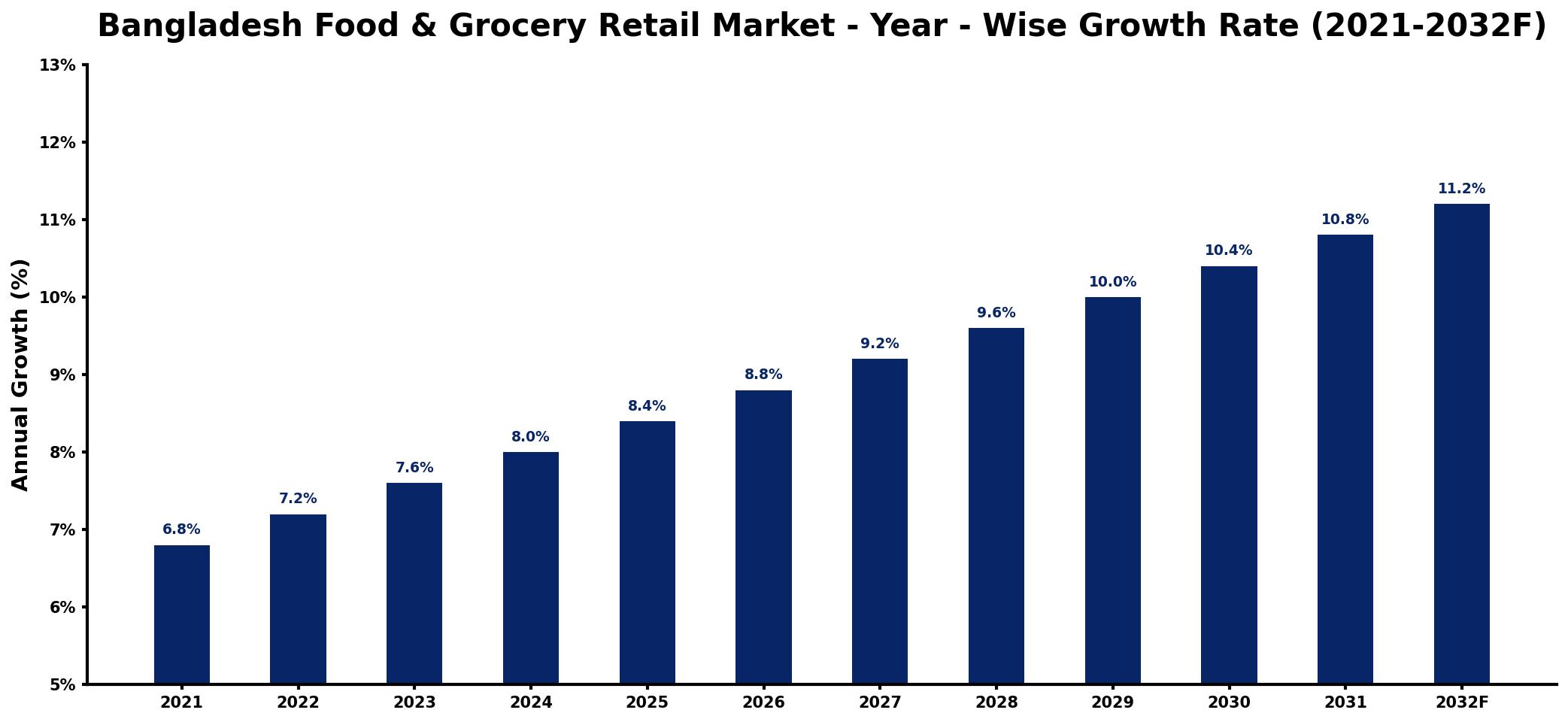
The table below presents the year‑wise growth rates along with the key drivers influencing the market
| Year | Growth Rate | Major Drivers |
| 2021 | 6.8% | Rising urban population density |
| 2022 | 7.2% | Increased disposable income levels |
| 2023 | 7.6% | Expansion of e-commerce platforms |
| 2024 | 8.0% | Growing demand for convenience |
| 2025 | 8.4% | Investment in cold chain logistics |
| 2026 | 8.8% | Development of modern distribution networks |
| 2027 | 9.2% | Adoption of sustainable practices |
| 2028 | 9.6% | Emergence of health conscious consumers |
| 2029 | 10.0% | Diversification of product offerings |
| 2030 | 10.4% | Strengthening of supply chain resilience |
| 2031 | 10.8% | Technological advancements in delivery |
| 2032 | 11.2% | Rising popularity of local brands |
Note: Market size estimations and growth projections presented in this report are based on 6Wresearch's proprietary forecasting methodology, utilizing the latest available industry data, government publications, and primary research inputs.
Bangladesh Food & Grocery Retail Market Synopsis
The food and grocery retail landscape in Bangladesh is undergoing transformative changes, characterized by a vibrant mix of traditional stores and modern retail formats. With a substantial and youthful population, consumer preferences are shifting toward convenience, quality, and an array of product offerings.
As e-commerce gains traction, particularly among tech-savvy younger consumers, retailers are embracing online platforms to meet changing demands. This evolution presents opportunities for growth, as stakeholders innovate to provide a seamless shopping experience across both physical and digital avenues.
- The market is experiencing a significant shift towards online grocery shopping fueled by increasing digital engagement.
- Demand for organic and health-focused products is rising as consumers become more health-conscious.
- Investments in technology for enhanced supply chain management are crucial for retailers aiming to remain competitive.
- Government policies support local producers, creating an environment for sustainable retail practices.
- The markets growth is bolstered by a young population seeking diversity and convenience in food options.
While the Bangladesh Food & Grocery Retail Market exhibits tremendous potential, several real restraints impede its progress. Intense competition among various retailers, particularly with a large number of small, independent outlets, complicates market dynamics. Additionally, logistical challenges such as inadequate cold storage facilities contribute to food wastage and affect supply chain efficiency. Furthermore, fluctuating prices of essential commodities can dissuade consumers from spending. To thrive, businesses must navigate these complexities while adapting to rapid changes in consumer preferences.
The food and grocery retail sector in Bangladesh is witnessing several key trends that shape its future. The rise of e-commerce platforms is one of the most significant developments, driven by heightened internet accessibility and evolving consumer habits. Traditional retailers are also adopting technology to improve customer engagement and operational efficiency. Moreover, there is an increasing demand for health-oriented products, with consumers seeking organic and sustainably sourced items. This trend is further complemented by a growing emphasis on ethical sourcing and environmentally friendly packaging, reflecting the market's transition towards more responsible consumerism.
Significant investment opportunities exist within the Bangladesh Food & Grocery Retail Market, particularly as urbanization and disposable incomes rise. Retailers can explore modern formats such as hypermarkets and convenience stores, which cater to the demands of an increasingly urbanized populace. Furthermore, the growing trend for online shopping opens doors for e-commerce platforms tailored to local tastes and preferences. Investment in private label brands also presents a lucrative avenue, allowing businesses to enhance their market presence and cater to the evolving needs of consumers.
The government of Bangladesh has implemented various initiatives aimed at bolstering the Food & Grocery Retail Market. Policies such as the Food Safety Act ensure the quality and safety of products available to consumers. Additionally, the government supports local agricultural products through subsidies and incentives for small-scale farmers, thereby promoting local sourcing. Import restrictions on certain food items aim to protect domestic producers and encourage self-sufficiency, ensuring a sustainable approach to food retailing.
Looking ahead to 2026-2032, the Bangladesh Food & Grocery Retail Market is set to experience significant advancements and growth. As digital technology continues to evolve, retailers will need to adopt innovative solutions to enhance their service offerings. The focus on health, sustainability, and ethical consumption will likely drive product development and marketing strategies. With a younger, increasingly affluent population, the market's landscape will continue to shift toward convenience, variety, and quality, presenting numerous opportunities for businesses ready to adapt.
Recent developments in the Bangladesh Food & Grocery Retail Market indicate a strong shift towards digital integration. Retailers are launching innovative e-commerce platforms to enhance customer engagement and streamline operations. Additionally, many traditional retailers are beginning to incorporate online ordering and delivery services to meet the rising demand for convenience. Moreover, there is an increasing focus on sustainable practices, with initiatives being introduced to promote environmentally friendly packaging and sourcing.
- 10 Years of Market Numbers
- Historical Data Starting from 2022 to 2025
- Base Year: 2025
- Forecast Data until 2032
- Key Performance Indicators Impacting the Market
- Major Upcoming Developments and Projects
Key Highlights of the Report:
- Bangladesh Food & Grocery Retail Market Outlook
- Market Size of Bangladesh Food & Grocery Retail Market, 2025
- Forecast of Bangladesh Food & Grocery Retail Market, 2032
- Historical Data and Forecast of Bangladesh Food & Grocery Retail Revenues & Volume for the Period 2022-2032F
- Bangladesh Food & Grocery Retail Market Trend Evolution
- Bangladesh Food & Grocery Retail Market Drivers and Challenges
- Bangladesh Food & Grocery Retail Price Trends
- Bangladesh Food & Grocery Retail Porter's Five Forces
- Bangladesh Food & Grocery Retail Industry Life Cycle
- Historical Data and Forecast of Bangladesh Food & Grocery Retail Market Revenues & Volume By Product for the Period 2022-2032F
- Historical Data and Forecast of Bangladesh Food & Grocery Retail Market Revenues & Volume By Fresh Food for the Period 2022-2032F
- Historical Data and Forecast of Bangladesh Food & Grocery Retail Market Revenues & Volume By Frozen Food for the Period 2022-2032F
- Historical Data and Forecast of Bangladesh Food & Grocery Retail Market Revenues & Volume By Food Cupboard for the Period 2022-2032F
- Historical Data and Forecast of Bangladesh Food & Grocery Retail Market Revenues & Volume By Beverages for the Period 2022-2032F
- Historical Data and Forecast of Bangladesh Food & Grocery Retail Market Revenues & Volume By Cleaning & Household for the Period 2022-2032F
- Historical Data and Forecast of Bangladesh Food & Grocery Retail Market Revenues & Volume By Others for the Period 2022-2032F
- Historical Data and Forecast of Bangladesh Food & Grocery Retail Market Revenues & Volume By Distribution Channel for the Period 2022-2032F
- Historical Data and Forecast of Bangladesh Food & Grocery Retail Market Revenues & Volume By Supermarkets & Hypermarkets for the Period 2022-2032F
- Historical Data and Forecast of Bangladesh Food & Grocery Retail Market Revenues & Volume By Convenience Stores for the Period 2022-2032F
- Historical Data and Forecast of Bangladesh Food & Grocery Retail Market Revenues & Volume By Departmental Stores & Clubs for the Period 2022-2032F
- Historical Data and Forecast of Bangladesh Food & Grocery Retail Market Revenues & Volume By Online for the Period 2022-2032F
- Bangladesh Food & Grocery Retail Import Export Trade Statistics
- Market Opportunity Assessment By Product
- Market Opportunity Assessment By Distribution Channel
- Bangladesh Food & Grocery Retail Top Companies Market Share
- Bangladesh Food & Grocery Retail Competitive Benchmarking By Technical and Operational Parameters
- Bangladesh Food & Grocery Retail Company Profiles
- Bangladesh Food & Grocery Retail Key Strategic Recommendations






































