Bangladesh Spices Market Size Growth Rate
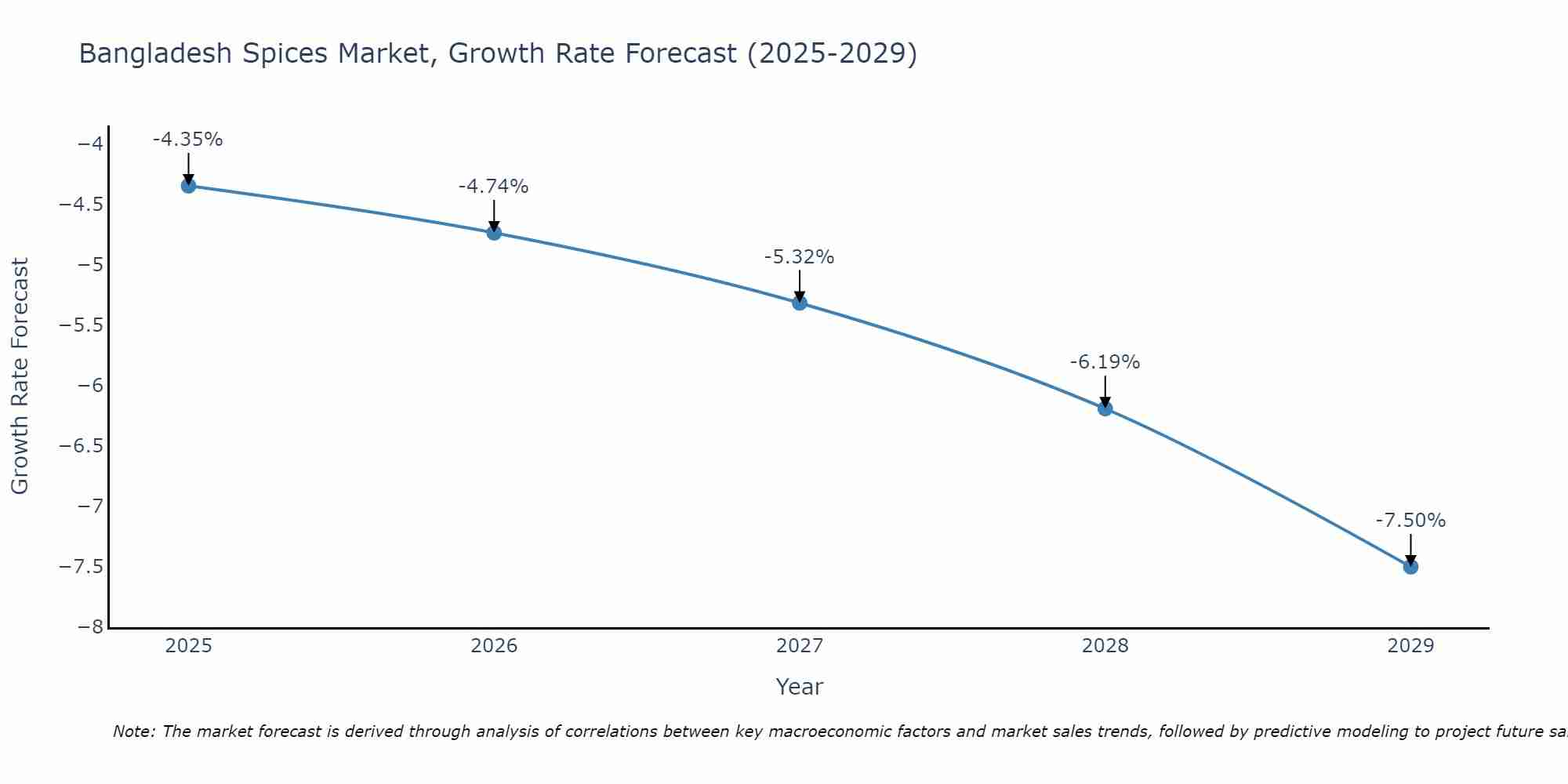
The Bangladesh Spices Market could see a tapering of growth rates over 2025 to 2029. Starting high at -4.35% in 2025, the market steadily declines to -7.50% by 2029.
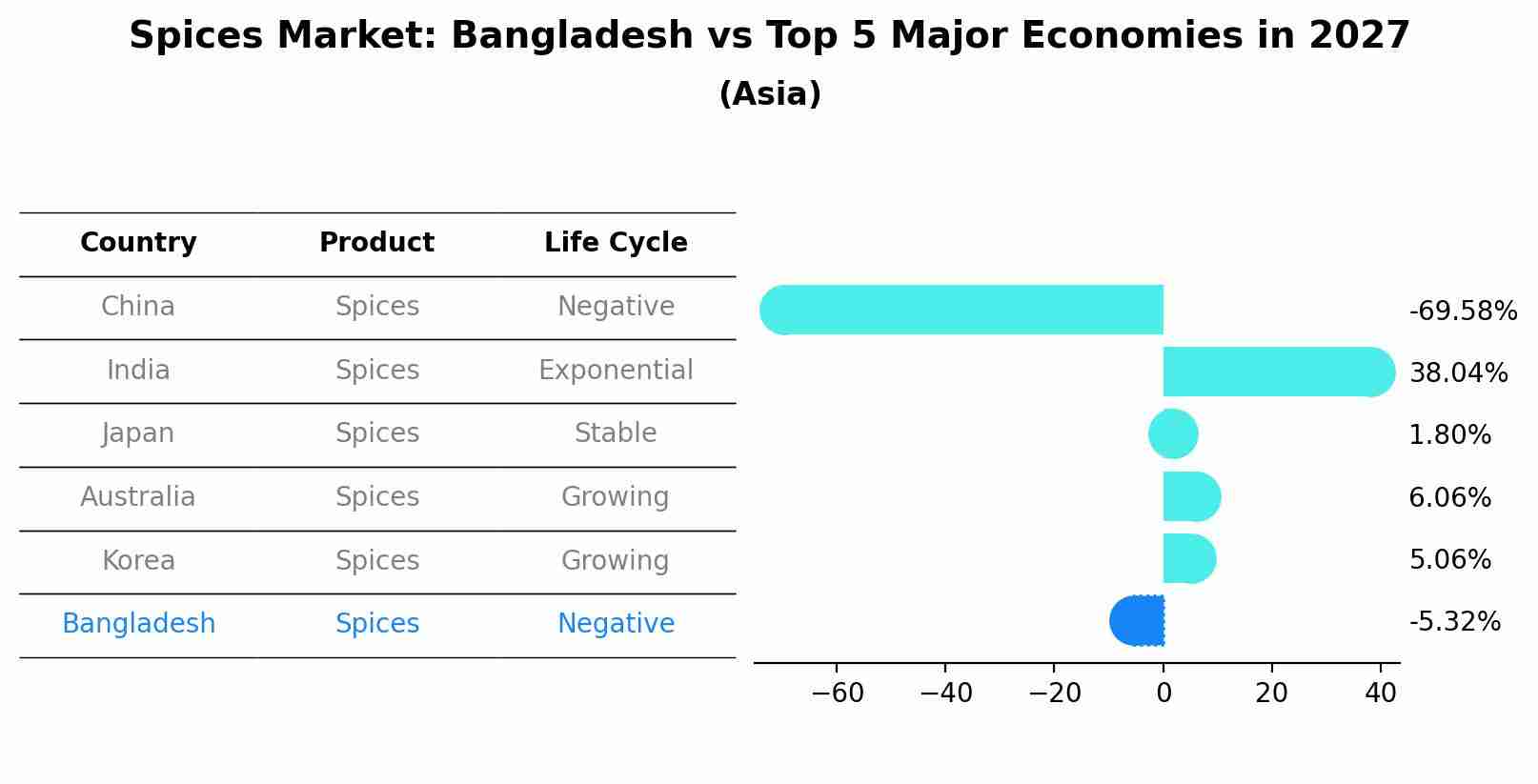
Spices Market: Bangladesh vs Top 5 Major Economies in 2027 (Asia)
The Spices market in Bangladesh is projected to grow at a negative growth rate of -5.32% by 2027, within the Asia region led by China, along with other countries like India, Japan, Australia and South Korea, collectively shaping a dynamic and evolving market environment driven by innovation and increasing adoption of emerging technologies.
Bangladesh Spices Market Growth Rate
According to 6Wresearch internal database and industry insights, the Bangladesh Spices Market is projected to grow at a compound annual growth rate (CAGR) of 7.5% during the forecast period from 2026 to 2032.
Topics Covered in the Bangladesh Spices Market Report
The Bangladesh Spices Market report thoroughly covers the market by product, form, and distribution channel. It provides a detailed and unbiased analysis of ongoing market trends, opportunities, challenges, and market drivers, helping stakeholders align strategies with current and future market dynamics.
India Grow Light Market Highlights
| Report Name | Bangladesh Spices Market |
| Forecast Period | 2026–2032 |
| CAGR | 7.5% |
| Growing Sector | Food & Beverage |
Bangladesh Spices Market Synopsis
The Bangladesh Spices Market has been progressing faster and is expected to witness significant growth in the coming years. The rising demand for organic and natural spices, along with the increasing popularity of traditional Bengali cuisine, are some of the major drivers of this growth.
Evaluation of Growth Drivers in the Bangladesh Spices Market
Below mentioned are some prominent drivers and their impact on the Bangladesh Spices Market dynamics:
| Drivers | Primary Segment Affected | Why It Matters (Evidence) |
| Growing Health Consciousness | By Category (Organic, Conventional) | Consumers are increasingly seeking organic spices due to their perceived health benefits, boosting the demand for organic categories. |
| Increasing Ethnic Food Popularity | By Product (Pepper, Ginger, Turmeric, etc.) | The growing popularity of traditional cuisines is increasing demand for a diverse range of spices. |
| Expansion of Organized Retail and E-Commerce | By Distribution Channel (Store-based, Non-Store-based) | Consumers have easy access of spices due to an increased availability of spices in both offline and online platfroms. |
| Rise in Export Demand | By Product (Pepper, Cardamom, Cumin, etc.) | Country’s export potential is increasing as international demand for Bangladeshi spices rises. |
| Rising Demand for Natural Products | By Form (Powder, Whole, Chopped/Crushed) | Consumers are shifting toward chopped spices due to their perceived naturalness. |
The Bangladesh Spices Market is projected to grow at a CAGR of 7.5% from 2026 to 2032. Here are some important factors that are increasing the demand for organic and natural spices in Bangladesh is the increasing awareness among consumers about the health benefits of consuming chemical-free food products. The traditional Bengali cuisine is known for its rich flavors and use of a variety of spices. Along with these, with the growing popularity of this cuisine globally, the demand for Bangladeshi spices has also increased. This has also opened up new opportunities for local spice manufacturers and exporters to widen their businesses.
Restraints in the Bangladesh Spices Market
Below mentioned are some major restraints and their influence on the Bangladesh Spices Market dynamics:
| Restraints | Primary Segment Affected | What This Means (Evidence) |
| Price Fluctuations and Supply Chain Issues | By Product (Pepper, Ginger, Turmeric) | Price volatility in raw materials and challenges in supply chain management can affect the availability and affordability of spices. |
| Limited Awareness in Rural Areas | By Distribution Channel (Store-based, Non-Store-based) | Lack of awareness and limited retail presence in rural areas could hamper the market's reach to these segments. |
| Competition from Substitutes | By Product (Coriander, Cardamom, Others) | The market faces competition from other low-cost flavoring alternatives such as artificial flavoring agents. |
| Regulatory Challenges | By Category (Organic, Conventional) | Import/export rules & regulations, especially for organic certification, can restrict market access to international markets. |
| Inconsistent Quality and Adulteration | By Product (Cumin, Turmeric, Cardamom) | Adulteration of spices, especially in domestic markets, could damage consumer trust, as well as affect market growth. |
Challenges in the Bangladesh Spices Market
However, the spices market in Bangladesh is not without its challenges. One of the major challenges that is faced by the industry includes the lack of proper infrastructure and technology for processing and packaging of spices. Aside from that, the presence of counterfeit or low-quality spices in the market can affect customers trust.
Bangladesh Spices Market Trends
Below are some major trends that change the dynamics of the Bangladesh Spices Market:
- Premiumization of Spices: There is an increasing trend toward premium spices, especially in urban areas where consumers are willing to pay more for high-quality and organic products.
- Demand for Organic Spices: As health-conscious consumers prioritize natural products over conventional options, there is an increase in the demand for organic and chemical-free spices.
- Spices as Functional Foods: In wellness sector, the demand for spcies is on the rise owing to their medicinal properties.
Major Investment Opportunities in the Bangladesh Spices Market
Below mentioned are some major investment opportunities that are estimated to increase the Bangladesh Spices Market share:
- Local Processing and Packaging Facilities: Setting up local facilities for processing and packaging spices can reduce costs and facilitate export opportunities, particularly in organic categories.
- Product Diversification: Development of new product forms like spice blends, pre-ground, and ready-to-use spice kits can meet the changing preferences of consumer for convenience.
- Increasing Expansion of Distribution Channels: Increased investments in both offline retail outlets and e-commerce platforms can help widen the market reach of spices across urban and rural areas.
Top 5 Leading Players in the Bangladesh Spices Market
Below is the list of prominent companies leading the Bangladesh Spices Market:
1. Acme Agrovet & Biotech Ltd
| Company Name | Acme Agrovet & Biotech Ltd |
|---|---|
| Established Year | 2002 |
| Headquarters | Dhaka, Bangladesh |
| Official Website | Click Here |
Acme Agrovet & Biotech Ltd is one of the leading suppliers of spices in Bangladesh, offering a wide range of quality products, including organic spices.
2. Bangladesh Spice Mills Ltd
| Company Name | Bangladesh Spice Mills Ltd |
|---|---|
| Established Year | 1998 |
| Headquarters | Dhaka, Bangladesh |
| Official Website | - |
Bangladesh Spice Mills Ltd specializes in the processing, packaging, and distribution of a wide variety of traditional and organic spices.
3. Aftab Spices Ltd
| Company Name | Aftab Spices Ltd |
|---|---|
| Established Year | 1985 |
| Headquarters | Dhaka, Bangladesh |
| Official Website | Click Here |
Aftab Spices Ltd is a major player in the Bangladesh spices market, known for its high-quality products and strong distribution networks.
4. Shawkat Spice Ltd
| Company Name | Shawkat Spice Ltd |
|---|---|
| Established Year | 2003 |
| Headquarters | Chittagong, Bangladesh |
| Official Website | - |
Shawkat Spice Ltd is one of the oldest spice companies in Bangladesh, known for its premium-quality pepper, cardamom, cumin, and turmeric.
5. Kazi & Kazi Tea Estate Limited
| Company Name | Kazi & Kazi Tea Estate Limited |
|---|---|
| Established Year | 1993 |
| Headquarters | Khulna, Bangladesh |
| Official Website | Click Here |
Kazi & Kazi Tea Estate Limited also produces and distributes spices, specializing in organic products with a focus on quality.
Government Regulations Introduced in the Bangladesh Spices Market
As per Bangladesh government data, the market is governed by the Bangladesh Standards and Testing Institution (BSTI), which makes sure spices must meet quality and safety standards, particularly for hygiene and contamination, including pesticide residues and heavy metals. Organic spices are further regulated by the Bangladesh Organic Products Certification Agency (BOPCA), which adheres to international organic certification standards. The National Food Safety Framework also monitors the safety of food products, making sure that all imported and domestically produced spices meet health and safety requirements.
Future Insights of the Bangladesh Spices Market
The future outlook of the Bangladesh spices market seems bright, backed by an increase in the demand for organic and natural products. This has resulted in a rise in the production of organic spices by local farmers. In addition, the government's focus on exports is expected to open up new opportunities for the growth of the spices market. Besides this, the changing consumer preferences towards healthy and natural ingredients in food are likely to increase the demand for spices in Bangladesh.
Market Segmentation Analysis
The report offers a comprehensive study of the following market segments and their leading categories:
By Product – Pepper to Lead the Market
According to Harshita, Senior Research Analyst, 6Wresearch, pepper is one of the most widely used spices in Bangladesh and has been a staple in the country's cuisine for centuries. It is widely used to add flavor and heat to dishes, as well as, for its medicinal properties.
By Form – Powder to Lead the Market
In terms of form, Powder is estimated to dominate the market on account of its convenience and ease of use in everyday cooking. Although, Whole and Chopped/Crushed spices are gaining traction for their perceived freshness and flavor retention.
Key Attractiveness of the Report
- 10 Years of Market Numbers
- Historical Data Starting from 2022 to 2025
- Base Year: 2025
- Forecast Data until 2032
- Key Performance Indicators Impacting the Market
- Major Upcoming Developments and Projects
Key Highlights of the Report:
- Bangladesh Spices Market Outlook
- Market Size of Bangladesh Spices Market, 2025
- Forecast of Bangladesh Spices Market, 2032
- Historical Data and Forecast of Bangladesh Spices Revenues & Volume for the Period 2022-2032
- Bangladesh Spices Market Trend Evolution
- Bangladesh Spices Market Drivers and Challenges
- Bangladesh Spices Price Trends
- Bangladesh Spices Porter's Five Forces
- Bangladesh Spices Industry Life Cycle
- Historical Data and Forecast of Bangladesh Spices Market Revenues & Volume By Product for the Period 2022-2032
- Historical Data and Forecast of Bangladesh Spices Market Revenues & Volume By Pepper for the Period 2022-2032
- Historical Data and Forecast of Bangladesh Spices Market Revenues & Volume By Ginger for the Period 2022-2032
- Historical Data and Forecast of Bangladesh Spices Market Revenues & Volume By Cinnamon for the Period 2022-2032
- Historical Data and Forecast of Bangladesh Spices Market Revenues & Volume By Cumin for the Period 2022-2032
- Historical Data and Forecast of Bangladesh Spices Market Revenues & Volume By Turmeric for the Period 2022-2032
- Historical Data and Forecast of Bangladesh Spices Market Revenues & Volume By Cardamom for the Period 2022-2032
- Historical Data and Forecast of Bangladesh Spices Market Revenues & Volume By Coriander for the Period 2022-2032
- Historical Data and Forecast of Bangladesh Pepper Spices Market Revenues & Volume By Others for the Period 2022-2032
- Historical Data and Forecast of Bangladesh Spices Market Revenues & Volume By Form for the Period 2022-2032
- Historical Data and Forecast of Bangladesh Spices Market Revenues & Volume By Powder for the Period 2022-2032
- Historical Data and Forecast of Bangladesh Spices Market Revenues & Volume By Whole for the Period 2022-2032
- Historical Data and Forecast of Bangladesh Spices Market Revenues & Volume By Chopped/Crushed for the Period 2022-2032
- Historical Data and Forecast of Bangladesh Spices Market Revenues & Volume By Category for the Period 2022-2032
- Historical Data and Forecast of Bangladesh Spices Market Revenues & Volume By Organic for the Period 2022-2032
- Historical Data and Forecast of Bangladesh Spices Market Revenues & Volume By Conventional for the Period 2022-2032
- Historical Data and Forecast of Bangladesh Spices Market Revenues & Volume By Distribution Channel for the Period 2022-2032
- Historical Data and Forecast of Bangladesh Spices Market Revenues & Volume By Store based for the Period 2022-2032
- Historical Data and Forecast of Bangladesh Spices Market Revenues & Volume By Non-Store based for the Period 2022-2032
- Bangladesh Spices Import Export Trade Statistics
- Market Opportunity Assessment By Product
- Market Opportunity Assessment By Form
- Market Opportunity Assessment By Category
- Market Opportunity Assessment By Distribution Channel
- Bangladesh Spices Top Companies Market Share
- Bangladesh Spices Competitive Benchmarking By Technical and Operational Parameters
- Bangladesh Spices Company Profiles
- Bangladesh Spices Key Strategic Recommendations
Market Covered
The report provides a detailed analysis of the following market segments:
By Product
- Pepper
- Ginger
- Cinnamon
- Cumin
- Turmeric
- Cardamom
- Coriander
- Others
By Form
- Powder
- Whole
- Chopped/Crushed
By Category
- Organic
- Conventional
By Distribution Channel
- Store Based
- Non-Store Based






































