Bangladesh Three Wheeler Market Size, Share & Growth Rate
The Bangladesh Three Wheeler Market was estimated at USD 268 Million in 2025 and is projected to reach USD 354 Million by 2032, growing at a CAGR of 4.1% from 2026 to 2032. This growth trajectory is fueled by rising urbanization, an increasing population, and a pressing demand for affordable transport solutions that are particularly adept at navigating densely packed urban environments. Additionally, the government's push for green energy adoption is ushering in a new era of electric three-wheelers, further propelling market expansion.
Bangladesh Three Wheeler Market Year-wise Growth Rate and Key Drivers
This graph highlights how the Bangladesh Three Wheeler Market has steadily grown over the years, supported by major growth factors.
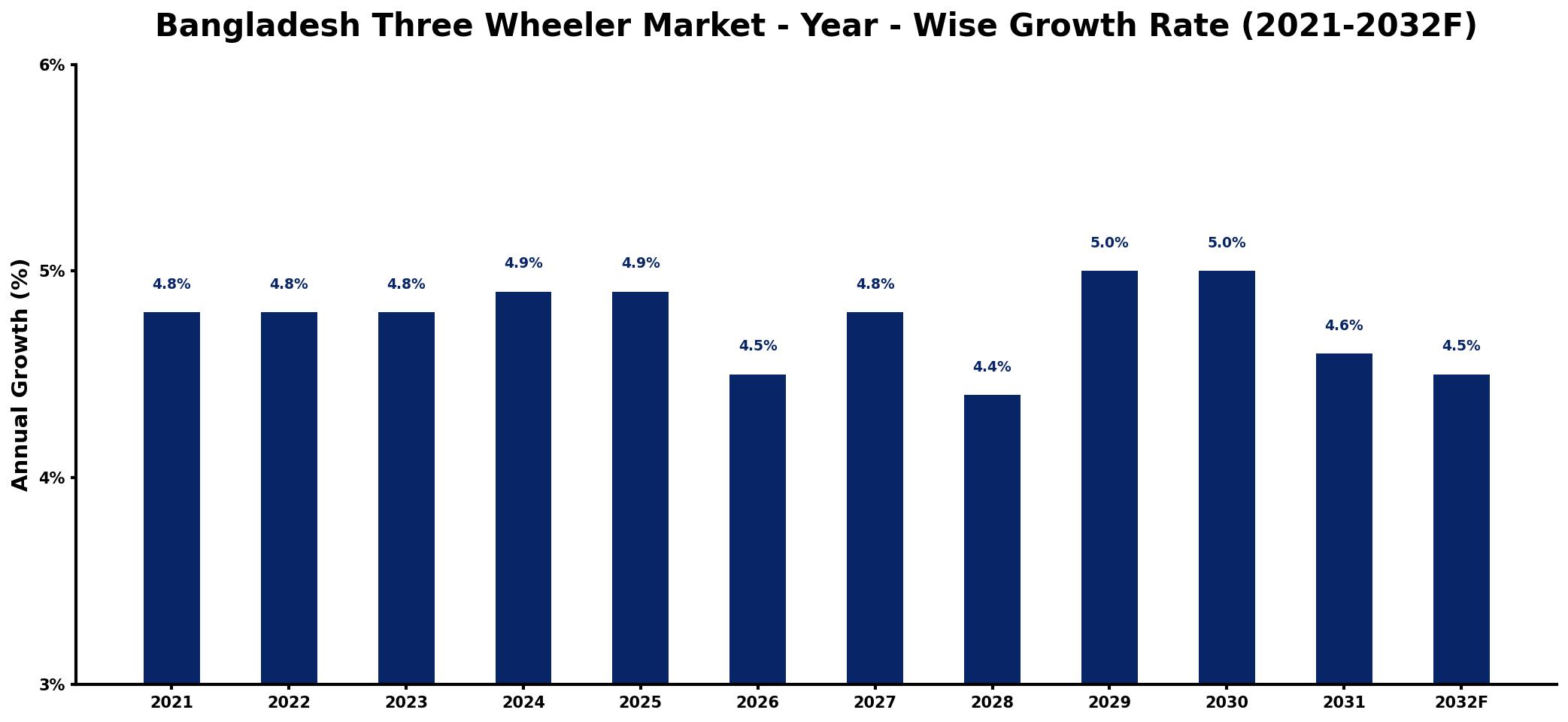
The table below presents the year‑wise growth rates along with the key drivers influencing the market
| Year | Growth Rate | Major Drivers |
| 2021 | 4.8% | Rising urban mobility demand |
| 2022 | 4.8% | Increased fuel price advantages |
| 2023 | 4.8% | Growing logistics and delivery services |
| 2024 | 4.9% | Expansion of rural transportation networks |
| 2025 | 4.9% | Surge in electric vehicle adoption |
| 2026 | 4.5% | Investment in manufacturing facilities |
| 2027 | 4.8% | Enhanced financing options available |
| 2028 | 4.4% | Government incentives for operators |
| 2029 | 5.0% | Diversification of service offerings |
| 2030 | 5.0% | Technological advancements in efficiency |
| 2031 | 4.6% | Rising popularity of shared mobility |
| 2032 | 4.5% | expanding manufacturing base activity |
Note: Market size estimations and growth projections presented in this report are based on 6Wresearch's proprietary forecasting methodology, utilizing the latest available industry data, government publications, and primary research inputs.
Bangladesh Three Wheeler Market Synopsis
While the Bangladesh three-wheeler market has enjoyed steady momentum due to the affordability and convenience of auto-rickshaws, the future presents a more innovative landscape. With the governments regulatory support and growing public interest in eco-friendly transportation, the market is on the cusp of significant transformation, particularly in the electric segment.
As consumer preferences evolve, manufacturers are challenged to improve not only the operational efficiency of three-wheelers but also their comfort and safety. The shift towards stylish, customizable models indicates that consumers are looking for more than just basic functionality; they desire an experience that aligns with modern lifestyles and eco-conscious values.
Bangladesh Three Wheeler Market Key Takeaways
- The market is projected to grow at a CAGR of 4.1% from 2026 to 2032, driven by urbanization and demand for cost-effective transport.
- Electric three-wheelers are gaining traction, supported by government incentives and consumer interest in sustainability.
- Improvements in vehicle safety and comfort features are becoming increasingly important to consumers.
- There is a rising demand for stylish and customizable three-wheelers that appeal to modern aesthetic preferences.
- Investment opportunities exist in manufacturing, financing solutions, and digital platforms for ride-sharing services.
Evaluation of Restraints in Bangladesh Three Wheeler Market
Despite its growth potential, the Bangladesh three-wheeler market faces several constraints. Intense competition among manufacturers often results in aggressive pricing strategies, which can squeeze profit margins. Moreover, fluctuating fuel prices create uncertainty in operational costs for operators, impacting their viability. Regulatory challenges, including stringent vehicle safety and emissions standards, add layers of complexity that manufacturers must navigate. Finally, poor road conditions and inadequate infrastructure can hinder the effective operation of three-wheelers, limiting their reach and acceptance, particularly in rural areas.
Bangladesh Three Wheeler Market Trends
The Bangladesh three-wheeler market is currently influenced by several noteworthy trends. Firstly, there is a significant shift towards electric three-wheelers, spurred by environmental concerns and the government's push for sustainable transport solutions. Secondly, advancements in technology are enhancing vehicle safety features, with manufacturers investing in improved suspension systems and smart safety technologies. Moreover, customization options are becoming increasingly popular, reflecting a consumer desire for vehicles that cater to personal style and comfort. These trends indicate a market that is not only responsive to consumer demands but also aligned with broader socio-economic goals.
Bangladesh Three Wheeler Market Opportunities
Investment opportunities abound in the Bangladesh three-wheeler market as demand for efficient transportation solutions continues to rise. The electric vehicle segment presents a lucrative avenue for investment, particularly in manufacturing and infrastructure development, given the government's favorable policies. Additionally, there is room for innovative financing solutions tailored to individual buyers and small businesses, facilitating access to these vehicles. The burgeoning ride-hailing sector also offers substantial opportunities for technological advancements in fleet management and customer service applications, responding to the evolving needs of consumers.
Government Initiatives in the Bangladesh Three Wheeler Market
The government of Bangladesh plays a crucial role in shaping the three-wheeler market through various policies and initiatives. These include the establishment of stringent vehicle emission and safety standards aimed at reducing environmental impacts and enhancing passenger safety. Additionally, there are tax incentives and subsidies for the purchase of electric three-wheelers, promoting greener alternatives. Regulatory frameworks are also in place to ensure fair pricing and service quality in the ride-hailing segment, fostering consumer protection while encouraging market growth.
Future Insights of the Bangladesh Three Wheeler Market
Looking ahead to 2026-2032, the Bangladesh three-wheeler market is poised for considerable growth, driven by continued urbanization and government support for electric vehicles. The growing middle class, alongside rising fuel costs, is likely to increase the demand for affordable transportation solutions. Moreover, infrastructure improvements will further enhance the reliability and efficiency of three-wheelers, making them an even more attractive option for consumers. As manufacturers adapt to consumer preferences for greener and more comfortable models, the market will likely see a surge in innovative products and services.
Bangladesh Three Wheeler Market Latest Developments (2025 - 2026)
Recent developments in the Bangladesh three-wheeler market indicate a growing focus on sustainability and technological innovation. Several manufacturers have announced initiatives to enhance their electric vehicle offerings, responding to both consumer demand and regulatory incentives. Meanwhile, advancements in ride-sharing technology are paving the way for improved fleet management solutions, aimed at increasing operational efficiencies and customer satisfaction. The integration of smart technologies in vehicles is also becoming a focal point, as companies seek to attract environmentally conscious consumers.
Bangladesh Three Wheeler Market - Key Attractiveness of the Report
- 10 Years of Market Numbers
- Historical Data Starting from 2022 to 2025
- Base Year: 2025
- Forecast Data until 2032
- Key Performance Indicators Impacting the Market
- Major Upcoming Developments and Projects
Key Highlights of the Report:
- Bangladesh Three Wheeler Market Outlook
- Market Size of Bangladesh Three Wheeler Market, 2025
- Forecast of Bangladesh Three Wheeler Market, 2032
- Historical Data and Forecast of Bangladesh Three Wheeler Revenues & Volume for the Period 2022-2032F
- Bangladesh Three Wheeler Market Trend Evolution
- Bangladesh Three Wheeler Market Drivers and Challenges
- Bangladesh Three Wheeler Price Trends
- Bangladesh Three Wheeler Porter's Five Forces
- Bangladesh Three Wheeler Industry Life Cycle
- Historical Data and Forecast of Bangladesh Three Wheeler Market Revenues & Volume By Fuel Type for the Period 2022-2032F
- Historical Data and Forecast of Bangladesh Three Wheeler Market Revenues & Volume By Petrol/CNG for the Period 2022-2032F
- Historical Data and Forecast of Bangladesh Three Wheeler Market Revenues & Volume By Diesel for the Period 2022-2032F
- Historical Data and Forecast of Bangladesh Three Wheeler Market Revenues & Volume By Electric for the Period 2022-2032F
- Historical Data and Forecast of Bangladesh Three Wheeler Market Revenues & Volume By Vehicle Type for the Period 2022-2032F
- Historical Data and Forecast of Bangladesh Three Wheeler Market Revenues & Volume By Passenger Carrier for the Period 2022-2032F
- Historical Data and Forecast of Bangladesh Three Wheeler Market Revenues & Volume By Load Carrier for the Period 2022-2032F
- Bangladesh Three Wheeler Import Export Trade Statistics
- Market Opportunity Assessment By Fuel Type
- Market Opportunity Assessment By Vehicle Type
- Bangladesh Three Wheeler Top Companies Market Share
- Bangladesh Three Wheeler Competitive Benchmarking By Technical and Operational Parameters
- Bangladesh Three Wheeler Company Profiles
- Bangladesh Three Wheeler Key Strategic Recommendations






































