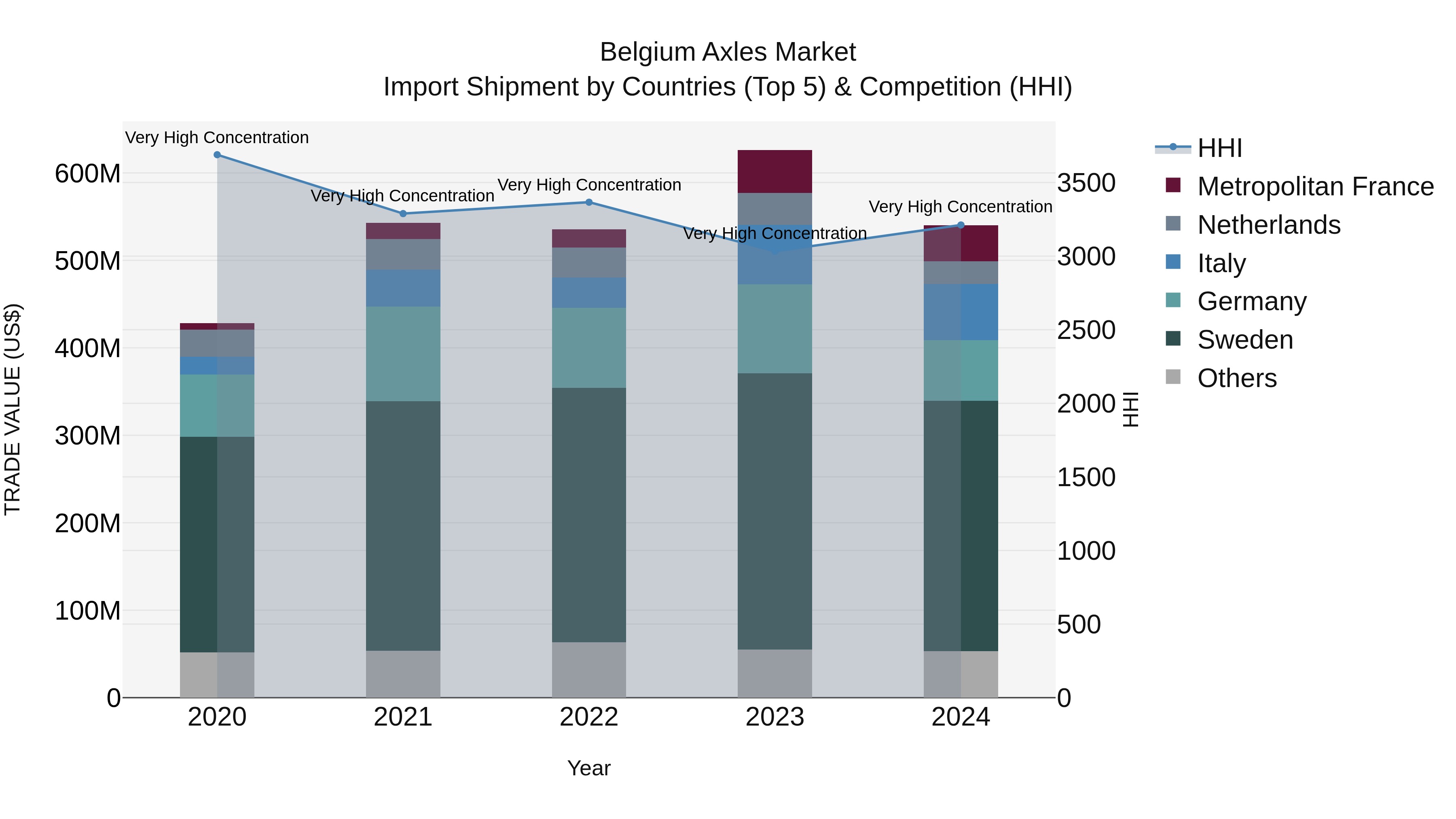
Belgium Axles Market Top 5 Importing Countries and Market Competition (HHI) Analysis
Belgium`s axles import market in 2024 continued to be dominated by top exporting countries such as Sweden, Germany, Italy, Metropolitan France, and the Netherlands. The high Herfindahl-Hirschman Index (HHI) indicates a concentrated market structure. Despite a healthy compound annual growth rate (CAGR) of 5.99% from 2020 to 2024, there was a decline in growth from 2023 to 2024 by -13.7%. This suggests potential shifts or challenges in the market that importers and stakeholders should closely monitor to adapt their strategies accordingly.
Belgium Axles Market Overview
The Belgium Axles Market is experiencing steady growth driven by the automotive and transportation sectors. The market is characterized by a strong demand for axles in commercial vehicles as well as passenger cars. Key players in the market are focusing on innovation and technological advancements to offer lightweight and durable axles that improve fuel efficiency and performance. Additionally, there is a growing trend towards electric vehicles which is expected to further boost the demand for specialized axles. The market is competitive, with companies striving to differentiate themselves through product quality, cost-efficiency, and after-sales services. Government regulations promoting sustainability and safety are also influencing market trends. Overall, the Belgium Axles Market is poised for continued growth and development in the coming years.
Belgium Axles Market Trends and Opportunities
The Belgium Axles Market is witnessing an increasing demand for lightweight and high-strength materials to improve fuel efficiency and reduce emissions in commercial vehicles. Electric and hybrid vehicles are gaining traction in the region, driving the need for advanced axle systems that can support alternative powertrains. Additionally, there is a growing focus on integrating smart technologies such as sensors and connectivity features into axles for real-time monitoring and predictive maintenance. E-commerce growth is also creating opportunities for last-mile delivery vehicles, which require specialized axles for urban transport. Companies in the Belgium Axles Market are investing in research and development to innovate new products that meet these evolving market demands, providing a promising outlook for the industry.
Belgium Axles Market Challenges
In the Belgium Axles Market, some key challenges include intense competition from both domestic and international manufacturers, leading to price pressures and margin erosion. Additionally, fluctuating raw material prices and supply chain disruptions can impact production costs and lead to uncertainty in the market. Regulatory requirements and standards also play a significant role in shaping the industry landscape, requiring companies to constantly adapt and comply with changing guidelines. Moreover, technological advancements and the shift towards electric vehicles pose challenges in terms of innovation and adaptation to new trends in the market. Overall, companies operating in the Belgium Axles Market need to navigate these challenges strategically to maintain competitiveness and sustainable growth in the industry.
Belgium Axles Market Drivers
The Belgium Axles Market is primarily driven by factors such as the growing demand for commercial vehicles due to increasing industrial activities, infrastructure development projects, and expanding e-commerce sector. The focus on sustainability and fuel efficiency is also propelling the market, as manufacturers are increasingly incorporating lightweight materials and advanced technologies in axle systems. Additionally, stringent government regulations regarding vehicle emissions and safety standards are pushing for the adoption of innovative axle solutions. The trend towards electric and hybrid vehicles is another significant driver, as these vehicles require specialized axles to support their unique powertrains. Overall, the Belgium Axles Market is expected to witness steady growth driven by these factors in the coming years.
Belgium Axles Market Government Policy
In Belgium, the government has implemented policies to promote sustainability and innovation in the axles market. These policies include stringent regulations on emissions, fuel efficiency standards, and safety requirements for vehicles equipped with axles. Additionally, the government offers incentives and subsidies to encourage the adoption of energy-efficient and eco-friendly axle technologies. Furthermore, there are initiatives to support research and development in the sector, aiming to enhance the competitiveness of Belgian axle manufacturers in the global market. Overall, the government`s policies in Belgium focus on advancing technological advancements, reducing environmental impact, and fostering growth in the axles market through a combination of regulations and incentives.
Belgium Axles Market Future Outlook
The future outlook for the Belgium Axles Market appears positive, driven by factors such as the growing demand for commercial vehicles, increasing investments in transportation infrastructure, and the emphasis on vehicle efficiency and performance. Technological advancements, such as the development of lightweight and durable axles, are expected to further propel market growth. Additionally, the rising trend towards electric and hybrid vehicles is likely to create new opportunities for axle manufacturers in Belgium. However, challenges such as fluctuating raw material prices and stringent regulations regarding emissions and vehicle safety may pose a threat to market expansion. Overall, with the increasing focus on sustainable transportation solutions, the Belgium Axles Market is expected to witness steady growth in the coming years.
Key Highlights of the Report:
- Belgium Axles Market Outlook
- Market Size of Belgium Axles Market, 2024
- Forecast of Belgium Axles Market, 2031
- Historical Data and Forecast of Belgium Axles Revenues & Volume for the Period 2021- 2031
- Belgium Axles Market Trend Evolution
- Belgium Axles Market Drivers and Challenges
- Belgium Axles Price Trends
- Belgium Axles Porter's Five Forces
- Belgium Axles Industry Life Cycle
- Historical Data and Forecast of Belgium Axles Market Revenues & Volume By Type for the Period 2021- 2031
- Historical Data and Forecast of Belgium Axles Market Revenues & Volume By Live Axle for the Period 2021- 2031
- Historical Data and Forecast of Belgium Axles Market Revenues & Volume By Dead Axle for the Period 2021- 2031
- Historical Data and Forecast of Belgium Axles Market Revenues & Volume By Tandem Axle for the Period 2021- 2031
- Historical Data and Forecast of Belgium Axles Market Revenues & Volume By Application for the Period 2021- 2031
- Historical Data and Forecast of Belgium Axles Market Revenues & Volume By Passenger Vehicles for the Period 2021- 2031
- Historical Data and Forecast of Belgium Axles Market Revenues & Volume By Light Duty Vehicles for the Period 2021- 2031
- Historical Data and Forecast of Belgium Axles Market Revenues & Volume By Heavy Duty Vehicles for the Period 2021- 2031
- Belgium Axles Import Export Trade Statistics
- Market Opportunity Assessment By Type
- Market Opportunity Assessment By Application
- Belgium Axles Top Companies Market Share
- Belgium Axles Competitive Benchmarking By Technical and Operational Parameters
- Belgium Axles Company Profiles
- Belgium Axles Key Strategic Recommendations






































