Belgium Caviar Market Top 5 Importing Countries and Market Competition (HHI) Analysis
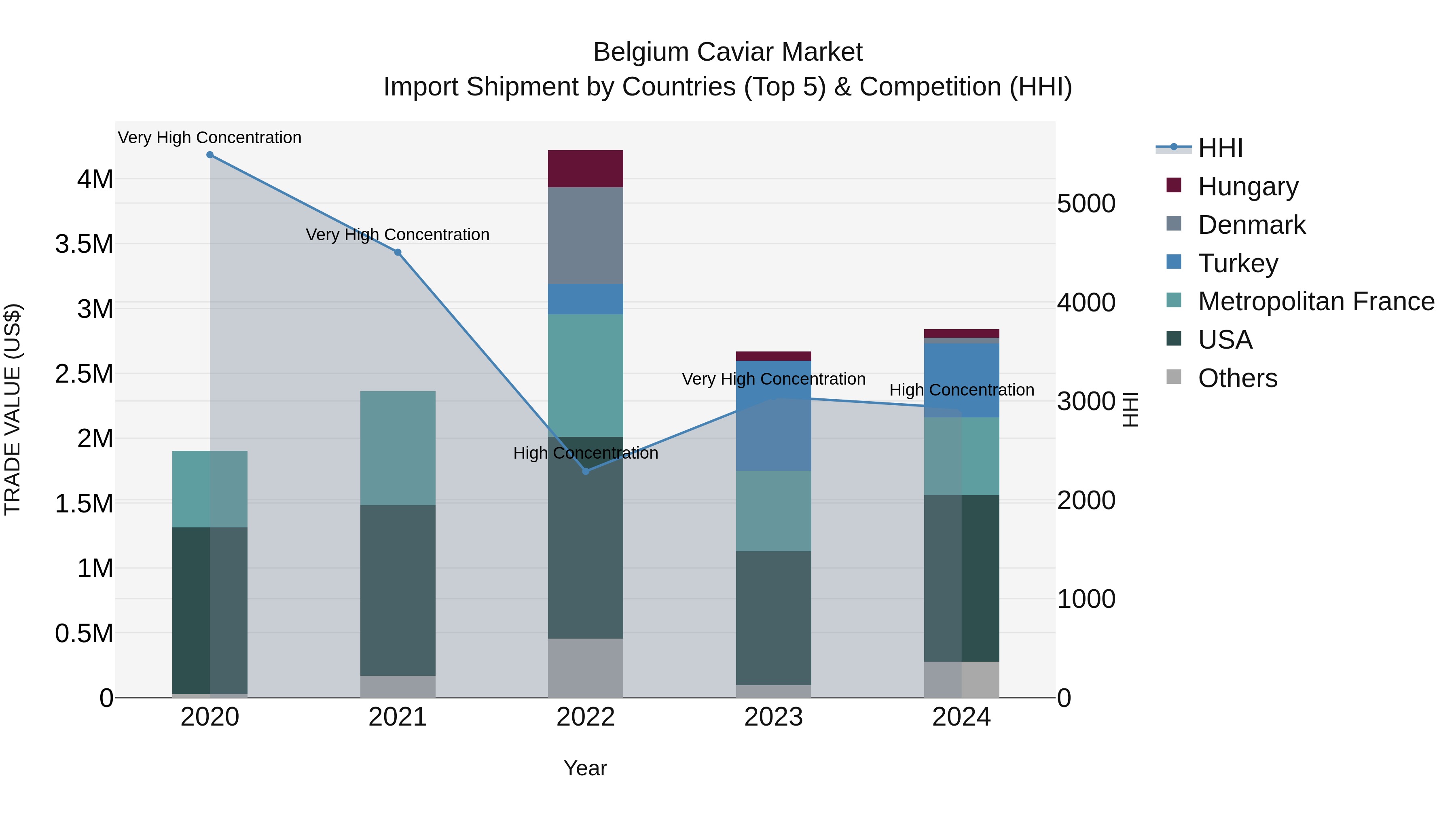
Belgium`s caviar import market continues to thrive in 2024, with significant contributions from the USA, Metropolitan France, Turkey, Italy, and Hungary. Despite a decrease in the Herfindahl-Hirschman Index (HHI) from very high concentration in 2023 to high concentration in 2024, the market remains competitive. The impressive compound annual growth rate (CAGR) of 10.52% from 2020 to 2024 indicates a strong and steady expansion. Furthermore, the growth rate of 6.39% from 2023 to 2024 suggests continued momentum in the caviar import market in Belgium.
Caviar Market: Belgium vs Top 5 Major Economies in 2027 (Europe)
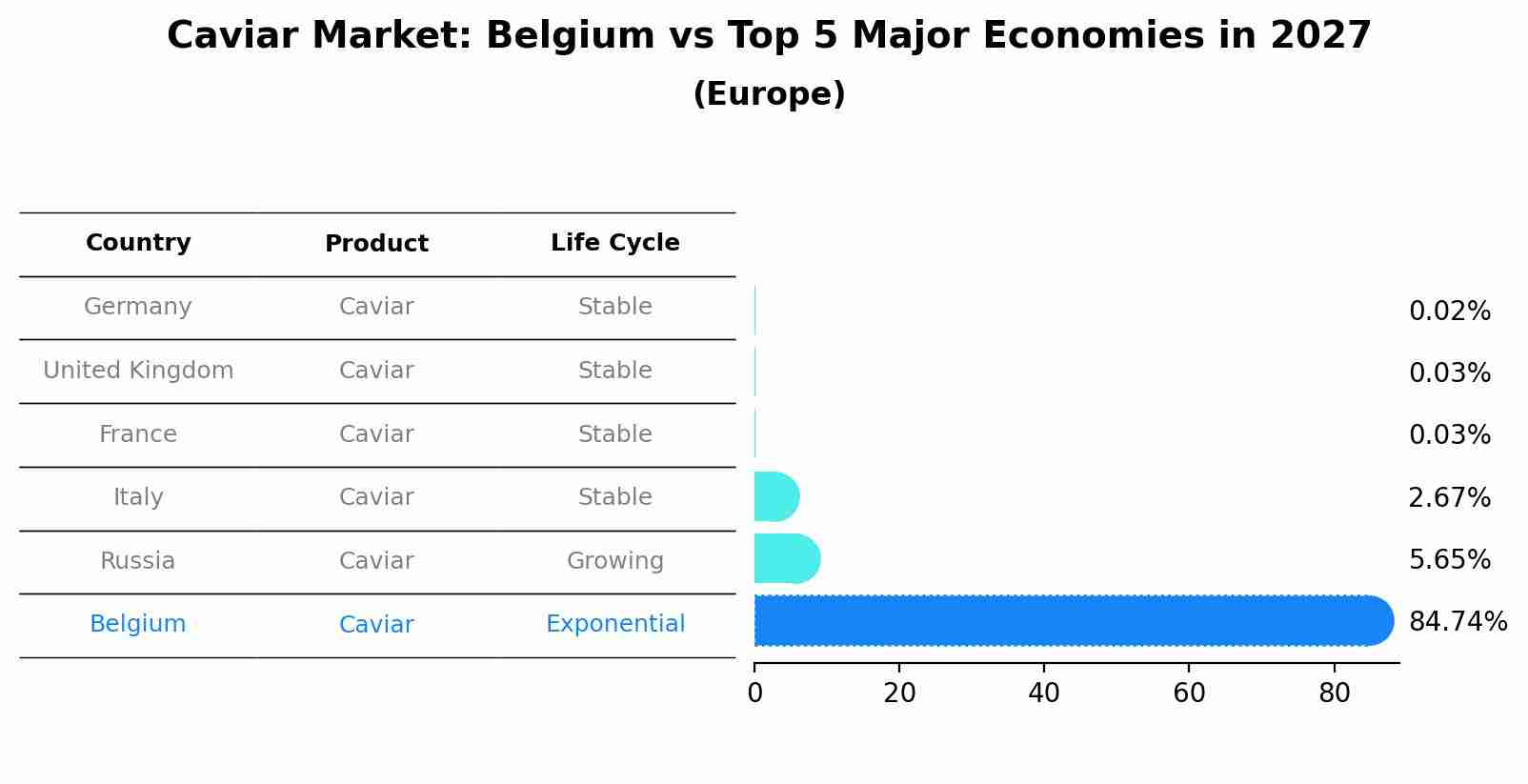
The Caviar market in Belgium is projected to grow at a exponential growth rate of 84.74% by 2027, within the Europe region led by Germany, along with other countries like United Kingdom, France, Italy and Russia, collectively shaping a dynamic and evolving market environment driven by innovation and increasing adoption of emerging technologies.
Belgium Caviar Market Overview
The caviar market in Belgium is niche but growing, fueled by increasing consumer interest in luxury and gourmet foods. The market includes both wild-caught and farmed caviar, with a trend towards sustainable and ethical sourcing. Government regulations on fishing and aquaculture, aimed at protecting sturgeon populations and promoting sustainable practices, are shaping the market landscape. Additionally, the rising popularity of high-end dining and culinary experiences is driving demand for premium caviar products.
Drivers of the market
The caviar market in Belgium is driven by the rising demand for luxury food items and gourmet experiences. Increasing disposable incomes and changing consumer preferences towards exotic and high-quality food products boost the market. The growth of the hospitality and tourism sectors, where caviar is often featured in fine dining, also drives demand. Moreover, sustainable farming practices and the availability of different caviar varieties cater to a broader customer base, supporting market growth.
Challenges of the market
The caviar market in Belgium faces challenges related to sustainability and regulatory compliance. The production of caviar is heavily regulated to protect sturgeon populations, leading to limited supply and high prices. Additionally, there is a growing demand for sustainably sourced and ethically produced caviar, which requires significant investment in aquaculture and sustainable farming practices. The market also contends with competition from lower-cost alternatives and substitutes, which can impact profitability.
Government Policy of the market
The caviar market in Belgium is influenced by stringent regulations related to food safety, sustainability, and species conservation. The government enforces CITES (Convention on International Trade in Endangered Species of Wild Fauna and Flora) regulations to ensure the sustainable sourcing of caviar, protecting sturgeon populations. Policies promoting high standards of quality and traceability in food products, along with initiatives to support sustainable aquaculture practices, have positively impacted the caviar market, ensuring both ecological and economic benefits.
Key Highlights of the Report:
- Belgium Caviar Market Outlook
- Market Size of Belgium Caviar Market, 2024
- Forecast of Belgium Caviar Market, 2031
- Historical Data and Forecast of Belgium Caviar Revenues & Volume for the Period 2021-2031
- Belgium Caviar Market Trend Evolution
- Belgium Caviar Market Drivers and Challenges
- Belgium Caviar Price Trends
- Belgium Caviar Porter`s Five Forces
- Belgium Caviar Industry Life Cycle
- Historical Data and Forecast of Belgium Caviar Market Revenues & Volume By Product for the Period 2021-2031
- Historical Data and Forecast of Belgium Caviar Market Revenues & Volume By Sevruga for the Period 2021-2031
- Historical Data and Forecast of Belgium Caviar Market Revenues & Volume By Osetra for the Period 2021-2031
- Historical Data and Forecast of Belgium Caviar Market Revenues & Volume By Salmon for the Period 2021-2031
- Historical Data and Forecast of Belgium Caviar Market Revenues & Volume By Sushi for the Period 2021-2031
- Historical Data and Forecast of Belgium Caviar Market Revenues & Volume By Others for the Period 2021-2031
- Historical Data and Forecast of Belgium Caviar Market Revenues & Volume By Form for the Period 2021-2031
- Historical Data and Forecast of Belgium Caviar Market Revenues & Volume By Fresh for the Period 2021-2031
- Historical Data and Forecast of Belgium Caviar Market Revenues & Volume By Dried for the Period 2021-2031
- Historical Data and Forecast of Belgium Caviar Market Revenues & Volume By Preserved & Frozen for the Period 2021-2031
- Historical Data and Forecast of Belgium Caviar Market Revenues & Volume By Application for the Period 2021-2031
- Historical Data and Forecast of Belgium Caviar Market Revenues & Volume By Restaurants for the Period 2021-2031
- Historical Data and Forecast of Belgium Caviar Market Revenues & Volume By Household for the Period 2021-2031
- Belgium Caviar Import Export Trade Statistics
- Market Opportunity Assessment By Product
- Market Opportunity Assessment By Form
- Market Opportunity Assessment By Application
- Belgium Caviar Top Companies Market Share
- Belgium Caviar Competitive Benchmarking By Technical and Operational Parameters
- Belgium Caviar Company Profiles
- Belgium Caviar Key Strategic Recommendations






































