Belgium Connected Car Market Top 5 Importing Countries and Market Competition (HHI) Analysis
The connected car import market in Belgium saw a shift in concentration levels from moderate to high in 2024, with the top exporting countries being Japan, Germany, Sweden, Austria, and Metropolitan France. Despite a challenging CAGR of -7.58% from 2020 to 2024, the market experienced a significant decline in growth rate of -28.55% from 2023 to 2024. This indicates a potential slowdown in the import shipments of connected cars to Belgium, highlighting the need for further analysis and strategic planning in the industry.
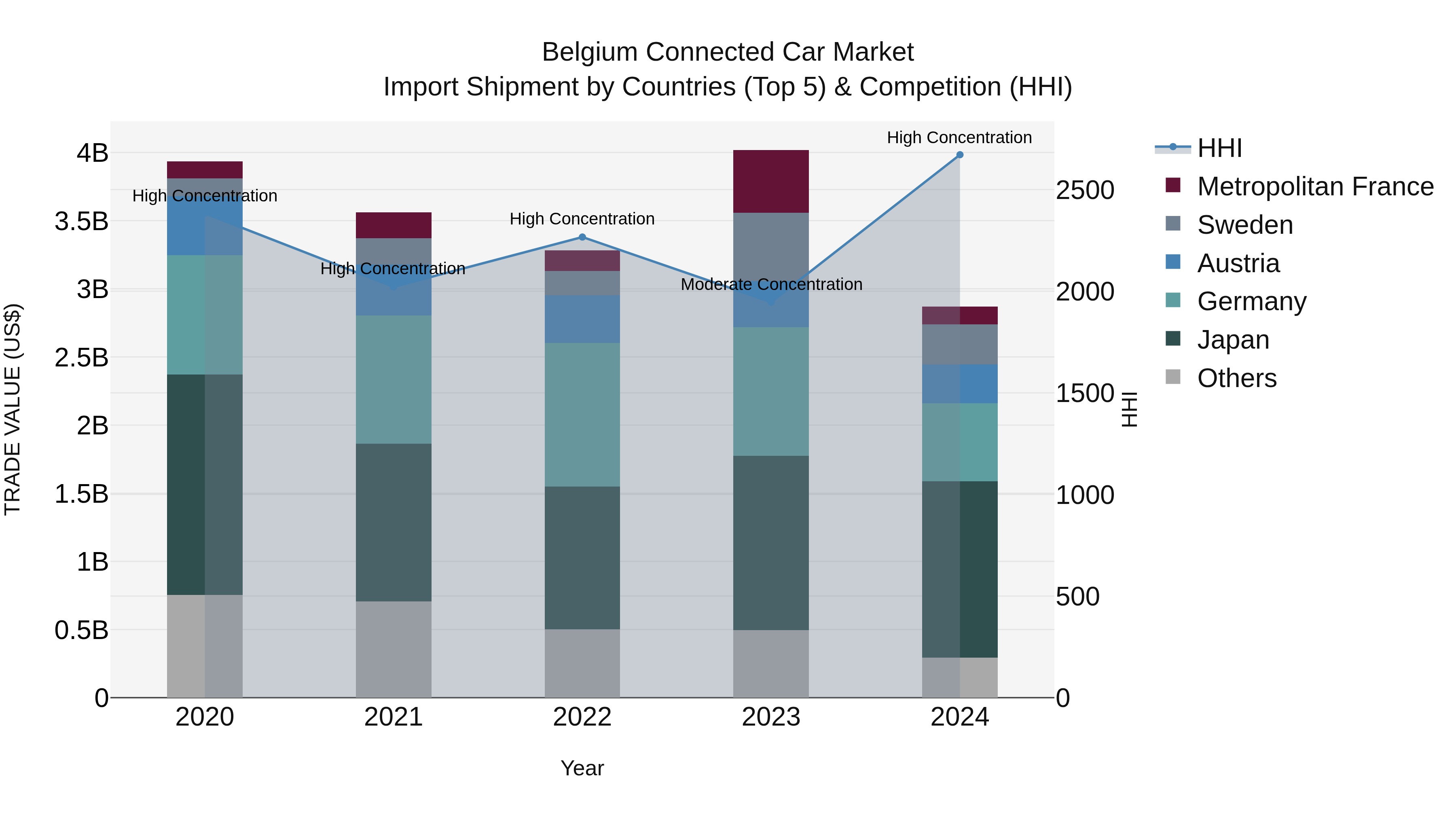
Key Highlights of the Report:
- Belgium Connected Car Market Outlook
- Market Size of Belgium Connected Car Market, 2025
- Forecast of Belgium Connected Car Market, 2032
- Historical Data and Forecast of Belgium Connected Car Revenues & Volume for the Period 2022 - 2032F
- Belgium Connected Car Market Trend Evolution
- Belgium Connected Car Market Drivers and Challenges
- Belgium Connected Car Price Trends
- Belgium Connected Car Porter`s Five Forces
- Belgium Connected Car Industry Life Cycle
- Historical Data and Forecast of Belgium Connected Car Market Revenues & Volume By Technology for the Period 2022 - 2032F
- Historical Data and Forecast of Belgium Connected Car Market Revenues & Volume By 3G for the Period 2022 - 2032F
- Historical Data and Forecast of Belgium Connected Car Market Revenues & Volume By 4G/LTE for the Period 2022 - 2032F
- Historical Data and Forecast of Belgium Connected Car Market Revenues & Volume By 5G for the Period 2022 - 2032F
- Historical Data and Forecast of Belgium Connected Car Market Revenues & Volume By Connectivity Solutions for the Period 2022 - 2032F
- Historical Data and Forecast of Belgium Connected Car Market Revenues & Volume By Integrated for the Period 2022 - 2032F
- Historical Data and Forecast of Belgium Connected Car Market Revenues & Volume By Embedded for the Period 2022 - 2032F
- Historical Data and Forecast of Belgium Connected Car Market Revenues & Volume By Tethered for the Period 2022 - 2032F
- Historical Data and Forecast of Belgium Connected Car Market Revenues & Volume By End Market for the Period 2022 - 2032F
- Historical Data and Forecast of Belgium Connected Car Market Revenues & Volume By Original Equipment Manufacturer (OEMs) for the Period 2022 - 2032F
- Historical Data and Forecast of Belgium Connected Car Market Revenues & Volume By Aftermarket for the Period 2022 - 2032F
- Belgium Connected Car Import Export Trade Statistics
- Market Opportunity Assessment By Technology
- Market Opportunity Assessment By Connectivity Solutions
- Market Opportunity Assessment By End Market
- Belgium Connected Car Top Companies Market Share
- Belgium Connected Car Competitive Benchmarking By Technical and Operational Parameters
- Belgium Connected Car Company Profiles
- Belgium Connected Car Key Strategic Recommendations






































