Belgium Industrial Enzymes Market Top 5 Importing Countries and Market Competition (HHI) Analysis
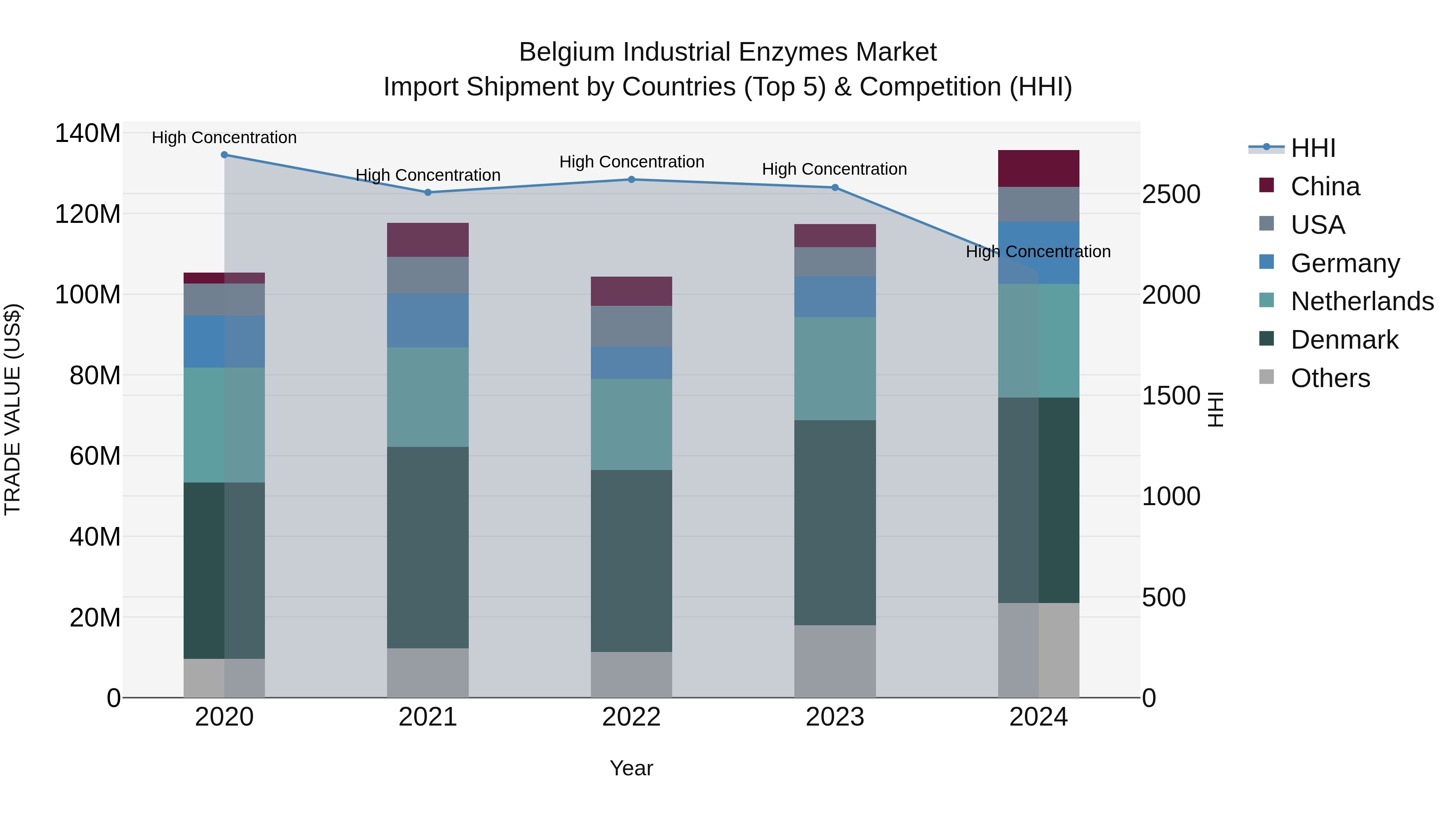
Belgium`s industrial enzymes import market in 2024 continued to be dominated by key exporters such as Denmark, Netherlands, Germany, China, and USA, reflecting a high level of market concentration with a high Herfindahl-Hirschman Index (HHI). The compound annual growth rate (CAGR) from 2020 to 2024 stood at a robust 6.53%, indicating sustained market expansion. Moreover, the notable growth rate of 15.63% from 2023 to 2024 signals a significant uptick in demand for industrial enzymes in Belgium, underscoring the dynamic nature of the market.
Belgium Industrial Enzymes Market Overview
The industrial enzymes market in Belgium is driven by the demand for efficient and sustainable solutions in industries such as food and beverage, textiles, and pharmaceuticals. Industrial enzymes are used to enhance processes, improve product quality, and reduce environmental impact. The market is supported by advancements in enzyme technology and the growing focus on green chemistry. Challenges include the need for cost-effective enzyme production and regulatory compliance.
Drivers of the market
The Belgium industrial enzymes market is driven by the increasing demand for biocatalysts in various industries, including food and beverages, pharmaceuticals, and bioenergy. Advances in enzyme technology that enhance performance and stability contribute to market growth. The focus on sustainable and environmentally friendly production processes also supports the demand for industrial enzymes.
Challenges of the market
The industrial enzymes market in Belgium encounters challenges related to the high cost of enzyme production and the need for ongoing research and development to improve enzyme efficiency. The market is also affected by regulatory requirements related to the use of enzymes in various applications, which can impact production processes and costs. Additionally, competition from alternative technologies and materials can influence market dynamics.
Government Policy of the market
The industrial enzymes market in Belgium is influenced by government policies focused on chemical safety and environmental sustainability. Regulations require industrial enzymes to adhere to strict safety and environmental standards. Belgiums commitment to promoting green technologies drives the development of eco-friendly enzymes that comply with national and EU regulations.
Key Highlights of the Report:
- Belgium Industrial Enzymes Market Outlook
- Market Size of Belgium Industrial Enzymes Market, 2024
- Forecast of Belgium Industrial Enzymes Market, 2031
- Historical Data and Forecast of Belgium Industrial Enzymes Revenues & Volume for the Period 2021-2031
- Belgium Industrial Enzymes Market Trend Evolution
- Belgium Industrial Enzymes Market Drivers and Challenges
- Belgium Industrial Enzymes Price Trends
- Belgium Industrial Enzymes Porter`s Five Forces
- Belgium Industrial Enzymes Industry Life Cycle
- Historical Data and Forecast of Belgium Industrial Enzymes Market Revenues & Volume By Type for the Period 2021-2031
- Historical Data and Forecast of Belgium Industrial Enzymes Market Revenues & Volume By Carbohydrases for the Period 2021-2031
- Historical Data and Forecast of Belgium Industrial Enzymes Market Revenues & Volume By Proteases for the Period 2021-2031
- Historical Data and Forecast of Belgium Industrial Enzymes Market Revenues & Volume By Lipases for the Period 2021-2031
- Historical Data and Forecast of Belgium Industrial Enzymes Market Revenues & Volume By Polymerases & Nucleases for the Period 2021-2031
- Historical Data and Forecast of Belgium Industrial Enzymes Market Revenues & Volume By Application for the Period 2021-2031
- Historical Data and Forecast of Belgium Industrial Enzymes Market Revenues & Volume By Food & Beverages for the Period 2021-2031
- Historical Data and Forecast of Belgium Industrial Enzymes Market Revenues & Volume By Bioethanol for the Period 2021-2031
- Historical Data and Forecast of Belgium Industrial Enzymes Market Revenues & Volume By Feed for the Period 2021-2031
- Historical Data and Forecast of Belgium Industrial Enzymes Market Revenues & Volume By Detergents for the Period 2021-2031
- Historical Data and Forecast of Belgium Industrial Enzymes Market Revenues & Volume By Wastewater for the Period 2021-2031
- Historical Data and Forecast of Belgium Industrial Enzymes Market Revenues & Volume By Soil for the Period 2021-2031
- Historical Data and Forecast of Belgium Industrial Enzymes Market Revenues & Volume By Oil Treatment for the Period 2021-2031
- Belgium Industrial Enzymes Import Export Trade Statistics
- Market Opportunity Assessment By Type
- Market Opportunity Assessment By Application
- Belgium Industrial Enzymes Top Companies Market Share
- Belgium Industrial Enzymes Competitive Benchmarking By Technical and Operational Parameters
- Belgium Industrial Enzymes Company Profiles
- Belgium Industrial Enzymes Key Strategic Recommendations






































