Belgium Mirrorless Camera Market Top 5 Importing Countries and Market Competition (HHI) Analysis
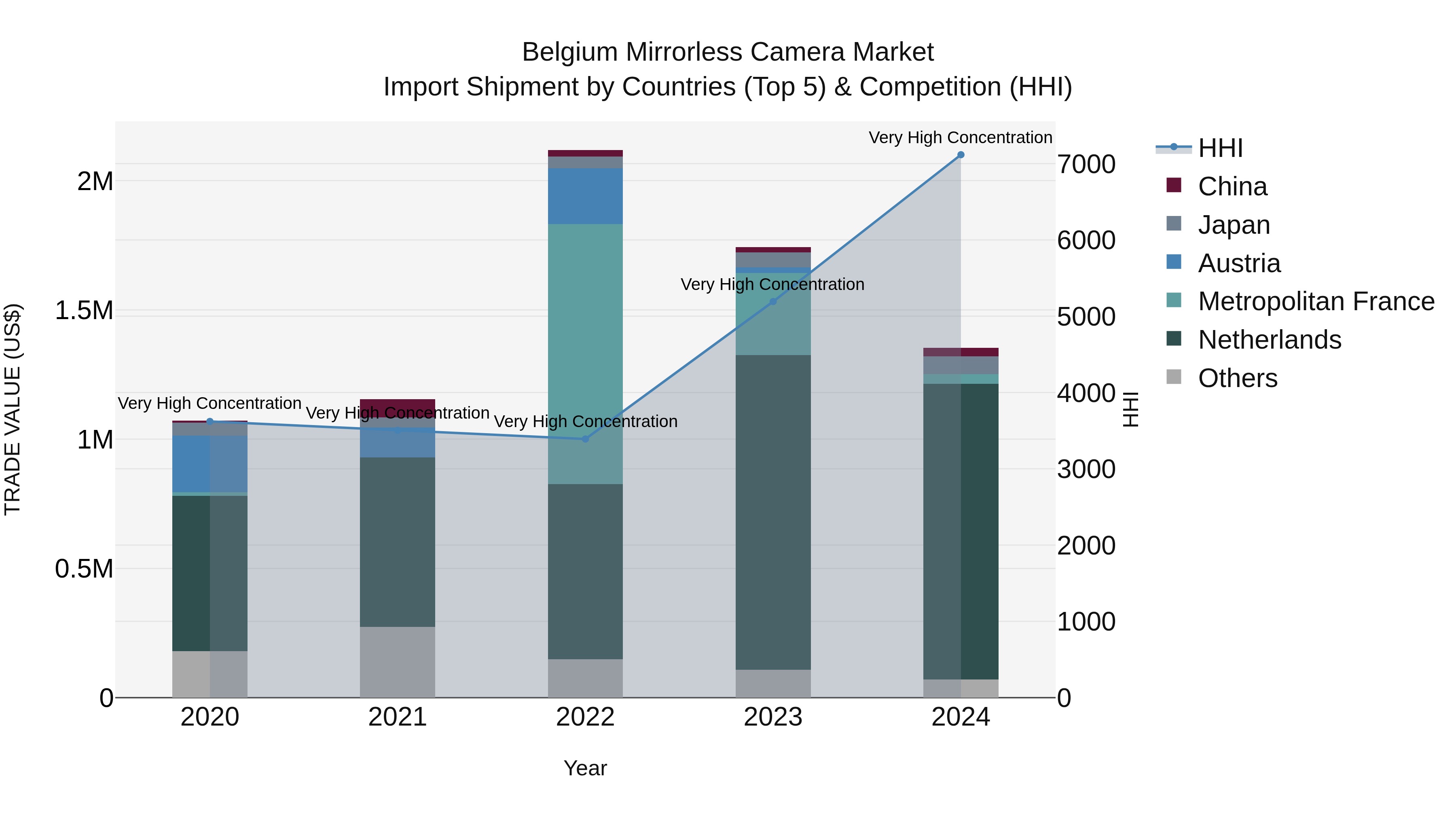
In 2024, Belgium saw a significant volume of mirrorless camera imports mainly coming from top exporting countries such as the Netherlands, Japan, Metropolitan France, China, and Taiwan, Province of China. Despite the high Herfindahl-Hirschman Index (HHI) indicating market concentration, the industry experienced a healthy Compound Annual Growth Rate (CAGR) of 5.99% from 2020 to 2024. However, there was a notable decline in the growth rate from 2023 to 2024 at -22.39%, suggesting potential shifts in market dynamics or consumer preferences.
Belgium Mirrorless Camera Market Overview
The Belgium mirrorless camera market is experiencing steady growth driven by the increasing popularity of mirrorless cameras among photography enthusiasts and professionals. Key factors contributing to this growth include the compact size, advanced features, and improved performance of mirrorless cameras compared to traditional DSLRs. Major players in the market such as Sony, Canon, and Nikon are actively introducing innovative mirrorless camera models to cater to the evolving needs of consumers. Additionally, the rise of social media platforms and the growing trend of vlogging are further fueling the demand for mirrorless cameras in Belgium. With a tech-savvy consumer base and a strong photography culture, the Belgium mirrorless camera market is poised for continued expansion in the coming years.
Belgium Mirrorless Camera Market Trends and Opportunities
The Belgium mirrorless camera market is experiencing significant growth driven by increasing demand for compact, lightweight, and versatile camera options among photography enthusiasts and professionals. Key trends include the rising popularity of mirrorless cameras over traditional DSLRs due to their advanced features, improved performance, and portability. The market is also witnessing a shift towards higher resolution sensors, better low-light performance, and enhanced video capabilities. Opportunities lie in catering to the growing demand for mirrorless cameras with innovative technologies such as improved autofocus systems, in-body image stabilization, and connectivity features like Wi-Fi and Bluetooth. Additionally, there is potential for manufacturers to target niche segments like vlogging and content creation, as well as offering customized solutions for specific photography needs in the Belgium market.
Belgium Mirrorless Camera Market Challenges
In the Belgium Mirrorless Camera Market, one of the main challenges is the strong competition from established brands offering traditional DSLR cameras. Mirrorless cameras are relatively newer technology, and convincing consumers to switch from the familiarity of DSLRs to mirrorless cameras can be a hurdle. Additionally, the perception of mirrorless cameras as being less professional or lower quality compared to DSLRs can also impede market growth. Furthermore, the high initial cost of mirrorless cameras and their accessories can be a barrier for some consumers in Belgium who may already own DSLR equipment. Educating consumers about the benefits and capabilities of mirrorless cameras, as well as offering competitive pricing and promotions, will be crucial for companies to overcome these challenges and gain market share in Belgium.
Belgium Mirrorless Camera Market Drivers
The Belgium Mirrorless Camera Market is primarily being driven by advancements in technology leading to improved camera features such as higher resolution sensors, faster autofocus systems, and enhanced image stabilization. Additionally, the growing popularity of social media platforms and the increasing trend of content creation among consumers are fueling the demand for mirrorless cameras, which offer compact size and high-quality imagery suitable for sharing online. Furthermore, the rise of vlogging and influencer marketing has created a niche market for mirrorless cameras among content creators looking for versatile and portable devices to capture high-quality videos and photos. The competitive pricing of mirrorless cameras compared to traditional DSLRs is also attracting consumers looking for professional-grade photography equipment at a more accessible price point.
Belgium Mirrorless Camera Market Government Policies
In Belgium, government policies related to the mirrorless camera market primarily focus on consumer protection, copyright laws, and environmental regulations. Consumer protection laws ensure that consumers are informed about their rights when purchasing mirrorless cameras, including warranties and return policies. Copyright laws govern the use of images and videos captured with mirrorless cameras, protecting the intellectual property rights of creators. Additionally, environmental regulations aim to reduce the impact of electronic waste generated by mirrorless cameras through proper disposal and recycling measures. Overall, the government in Belgium emphasizes a balanced approach that promotes innovation and competition in the mirrorless camera market while safeguarding consumer interests and environmental sustainability.
Belgium Mirrorless Camera Market Future Outlook
The future outlook for the Belgium Mirrorless Camera Market appears to be promising, driven by the increasing popularity of mirrorless cameras among both amateur and professional photographers. The market is expected to witness growth due to technological advancements such as enhanced image quality, faster autofocus systems, and improved portability compared to traditional DSLR cameras. Additionally, the rising trend of social media influencers and content creators is likely to further fuel the demand for mirrorless cameras in Belgium. As consumers seek more compact and versatile photography equipment, manufacturers are anticipated to introduce innovative features and models to cater to this evolving market. Overall, the Belgium Mirrorless Camera Market is forecasted to experience steady growth in the coming years.
Key Highlights of the Report:
- Belgium Mirrorless Camera Market Outlook
- Market Size of Belgium Mirrorless Camera Market, 2024
- Forecast of Belgium Mirrorless Camera Market, 2031
- Historical Data and Forecast of Belgium Mirrorless Camera Revenues & Volume for the Period 2021- 2031
- Belgium Mirrorless Camera Market Trend Evolution
- Belgium Mirrorless Camera Market Drivers and Challenges
- Belgium Mirrorless Camera Price Trends
- Belgium Mirrorless Camera Porter's Five Forces
- Belgium Mirrorless Camera Industry Life Cycle
- Historical Data and Forecast of Belgium Mirrorless Camera Market Revenues & Volume By Type for the Period 2021- 2031
- Historical Data and Forecast of Belgium Mirrorless Camera Market Revenues & Volume By Built-in or Static Lens for the Period 2021- 2031
- Historical Data and Forecast of Belgium Mirrorless Camera Market Revenues & Volume By Interchangeable Lens for the Period 2021- 2031
- Belgium Mirrorless Camera Import Export Trade Statistics
- Market Opportunity Assessment By Type
- Belgium Mirrorless Camera Top Companies Market Share
- Belgium Mirrorless Camera Competitive Benchmarking By Technical and Operational Parameters
- Belgium Mirrorless Camera Company Profiles
- Belgium Mirrorless Camera Key Strategic Recommendations






































