Belgium Perlite Market Top 5 Importing Countries and Market Competition (HHI) Analysis
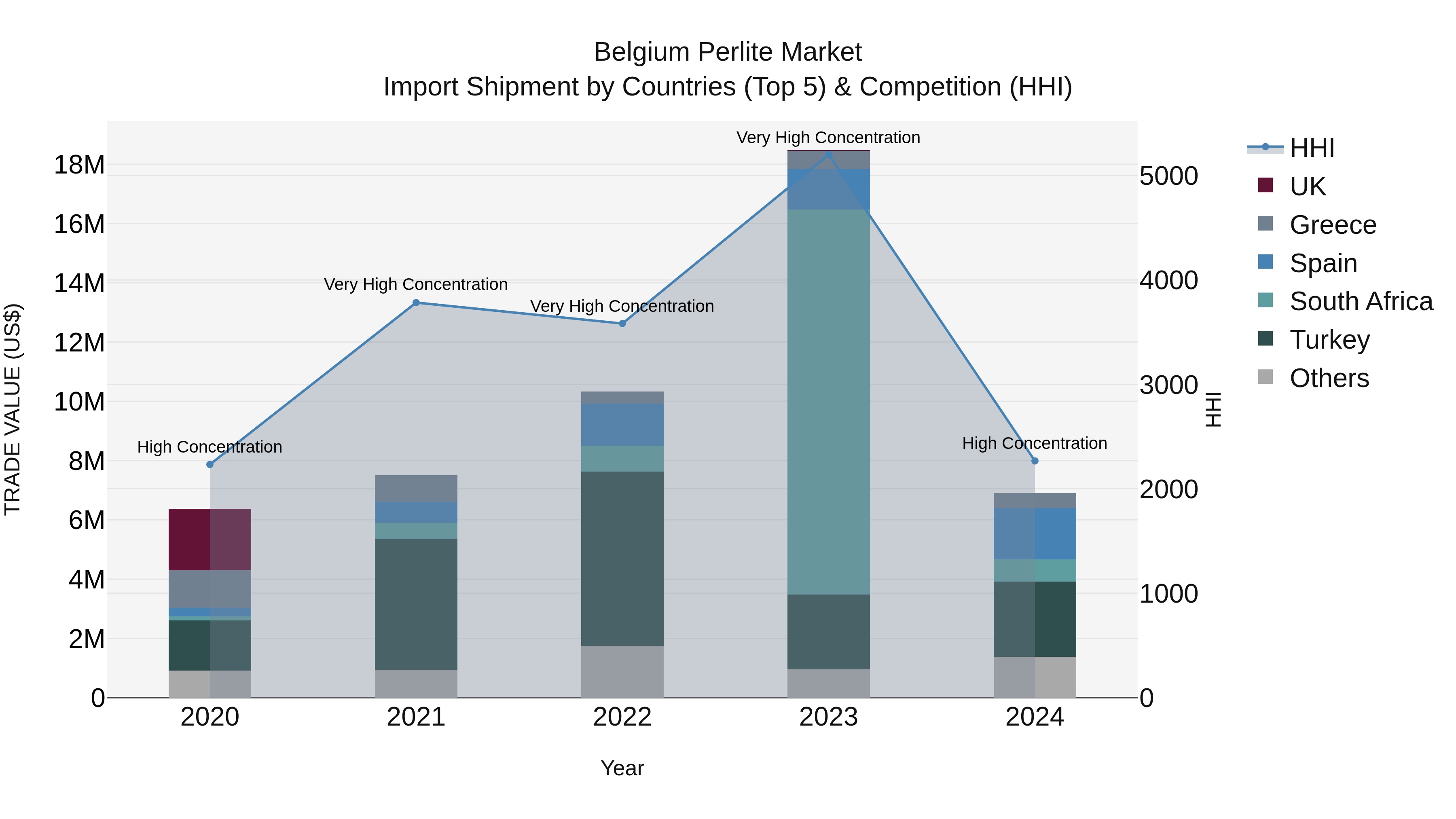
Belgium`s perlite import shipments in 2024 saw a diverse mix of top exporting countries, including Turkey, Spain, South Africa, Metropolitan France, and Greece. The Herfindahl-Hirschman Index (HHI) indicated a shift from very high concentration in 2023 to high concentration in 2024, reflecting a more evenly distributed market. The compound annual growth rate (CAGR) from 2020 to 2024 stood at 2.02%, with a significant decline in growth rate from 2023 to 2024 at -62.62%. This data suggests evolving dynamics in the perlite import market in Belgium, with opportunities for further analysis and strategic planning.
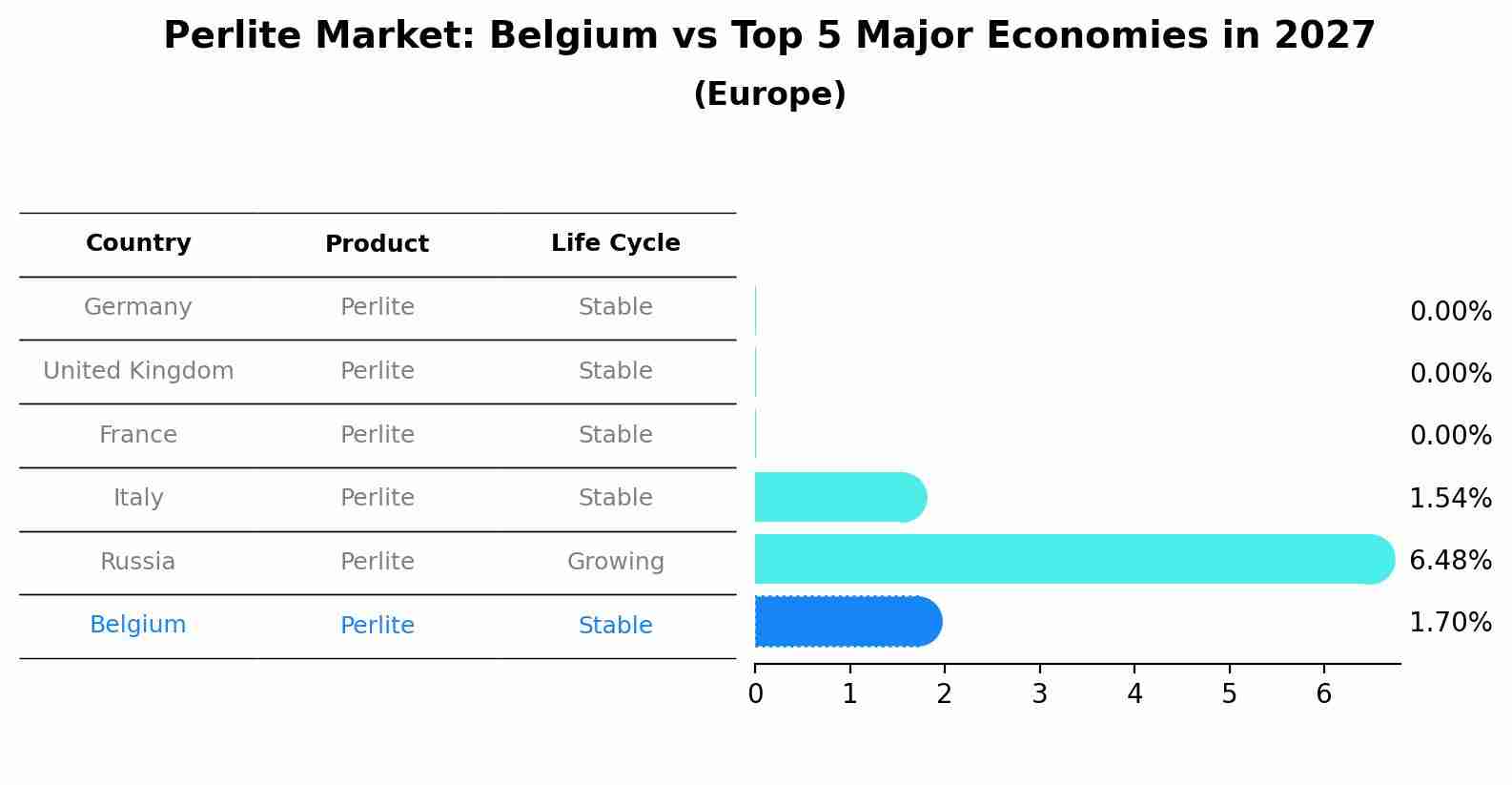
Perlite Market: Belgium vs Top 5 Major Economies in 2027 (Europe)
Belgium's Perlite market is anticipated to experience a stable growth rate of 1.70% by 2027, reflecting trends observed in the largest economy Germany, followed by United Kingdom, France, Italy and Russia.
Belgium Perlite Market Growth Rate
According to 6Wresearch internal database and industry insights, the Belgium Perlite Market is growing at a compound annual growth rate (CAGR) of 5.2% during the forecast period (2026-2032).
Topics Covered in the Belgium Perlite Market Report
The Belgium Perlite Market report thoroughly covers the market by forms, applications, and their usage in various industries. The report provides an unbiased and detailed analysis of ongoing market trends, opportunities/high growth areas, and market drivers, which would help stakeholders devise and align their market strategies according to the current and future market dynamics.
Belgium Perlite Market Highlights
| Report Name | Belgium Perlite Market |
| Forecast period | 2026-2032 |
| CAGR | 5.2% |
| Growing Sector | Construction |
Belgium Perlite Market Synopsis
Belgium Perlite Market will experience substantial expansion as of increased agricultural horticultural and construction requirements for perlite. The construction industry shows increasing demand for perlite as builders prefer to use lightweight materials which also provide fire resistance and insulation properties. The construction industry experiences rising demand for perlite as building professionals focus on sustainable agriculture and eco-friendly construction methods. The market expansion occurs as industrial uses of perlite have increased within filtration and fire-proofing applications.
Evaluation of Growth Drivers in the Belgium Perlite Market
Below mentioned are some growth drivers and their impact on market dynamics:
| Drivers | Primary Segments Affected | Why it matters (evidence) |
| Government Support & Green Initiatives | By Application (Insulation, Fillers) | Government push for sustainable materials drives perlite demand in eco-friendly construction. |
| Agricultural & Horticultural Advancements | By Form (Expanded Perlite, Agroperlite) | Rising demand for soil amendments and improved crop yield spurs perlite usage. |
| Growing Demand for Fire-Proof Materials | By Application (Fire-Proofing) | Perlite's fire-resistant properties are increasing demand for construction for fire-proofing. |
| Expansion in Filtration & Insulation Industries | By Application (Filtration, Insulation) | Perlite’s versatility in filtration and insulation is attracting investment. |
| Rising Demand for Lightweight Materials | By Application (Insulation, Filtration) | Lightweight properties of perlite make it a best choice for insulation and filtration applications. |
Belgium Perlite Market is expected to grow robustly at a CAGR of 5.2% during the forecast period of 2026-2032. The Belgium Perlite Market depends on two main factors which operate together to increase perlite demand through government backing of sustainable materials. Perlite usage in soil amendments and better crop production results from agricultural and horticultural developments. Construction projects require fire-proof materials which lead to increased use of perlite resources. Perlite shows its ability to serve multiple purposes through its applications in filtration and insulation systems while the market expands as of increased need for lightweight materials used in insulation and filtration products.
Evaluation of Restraints in the Belgium Perlite Market
Below mentioned are some major restraints and their influence on market dynamics:
| Restraints | Primary Segments Affected | What this means (evidence) |
| High Production & Processing Costs | By Form (Expanded Perlite, Agroperlite) | High production costs limit the widespread use of perlite, especially in cost-sensitive applications. |
| Limited Raw Material Availability | By Form (All Forms of Perlite) | Fluctuations in raw material availability can impact production volumes and pricing stability. |
| Competition from Alternative Materials | By Application (Insulation, Filtration, Fire-Proofing) | The availability of cheaper alternatives to perlite in insulation and filtration could limit its adoption. |
| Environmental Impact of Mining Practices | By Form (All Forms of Perlite) | More concerns regarding the effect of perlite on environment is affecting market expansion. |
| Lack of Awareness in Certain Sectors | By Application (Agriculture, Fire-Proofing) | Less knowledge of perlite’s benefits in some industries could slow down its market penetration. |
Belgium Perlite Market Challenges
Belgium Perlite Market encounters multiple obstacles which stem from the expensive production costs that result from expanding perlite processing facilities. The raw material price fluctuations will create pricing instability throughout the entire operation. The market expansion will face restrictions as perlite processing requires specialized equipment that requires high levels of expertise. The market shares face competition from alternative materials which include vermiculite and synthetic substitutes that serve insulation and filtration functions.
Belgium Perlite Market Trends
Some major trends contributing to the Belgium Perlite Market Growth are:
- Demand for Lightweight Construction Materials: There is a growing demand in the market for durable, lightweight and efficient building materials which is increasing the need for perlite.
- Sustainable Agriculture: There is a growing demand among consumers for sustainable farming practices which is enhancing the adoption of perlite in soil conditioning and moisture retention.
- Expansion of Fireproofing Applications: The demand for perlite is being increased due to growing demand for fire-resistant materials in construction and industrial sector.
Investment Opportunities in the Belgium Perlite Industry
Here are some investment opportunities in the Belgium Perlite Industry:
- Demand for Eco-friendly Construction Materials: The growing demand for sustainability can be met easily by creating perlite-based insulation and fire-resistant materials.
- Agriculture & Horticulture Applications: There is a significant opportunity for growth in increasing the usage of perlite in agricultural sectors for soil conditioning and crop yield improvement.
- Filtration Industry: Investing in expanding perlite-based filtration materials for water treatment and industrial filtration can cater to the growing demand in these industries.
Top 5 Leading Players in the Belgium Perlite Market
Here are some top companies contributing to the Belgium Perlite Market Share:
1. Dicalite Europe (Dicalite Management Group)
| Company Name | Dicalite Europe (Dicalite Management Group) |
| Headquarters | Ghent, Belgium |
| Established | 1950s |
| Website | Click Here |
Dicalite Europe is the dominant force in the Belgian perlite market. Its facility in the Port of Ghent is the largest producer of perlite filter aids and fillers in Europe and one of the largest in the world, with a capacity of 50,000 metric tons per year.
2. Imerys (Imerys Belgium)
| Company Name | Imerys (Imerys Belgium) |
| Headquarters | Brussels/Ghent, Belgium |
| Established | 1880 |
| Website | Click Here |
Imerys significantly bolstered its leadership in Belgium following its January 2025 acquisition of Chemviron’s European perlite business. This move integrated established production lines and specialized filtration assets into Imerys’s global portfolio. In Belgium, Imerys provides high-purity perlite solutions for life sciences and industrial filtration.
3. Etex Group
| Company Name | Etex Group |
| Headquarters | Zaventem, Belgium |
| Established | 1905 |
| Website | Click Here |
Etex is a global building materials giant headquartered in Belgium that integrates perlite into a wide variety of its lightweight construction products. Through its specialized brands like Promat, Etex uses expanded perlite as a core component in fireproof boards, high-temperature insulation, and lightweight plasters.
4. Nestaan
| Company Name | Nestaan |
| Headquarters | Blandain (Tournai), Belgium |
| Established | 1980 |
| Website | - |
Nestaan is a key regional player specializing in the exfoliation (expansion) of volcanic minerals for the construction and horticultural sectors. While traditionally known for its vermiculite production, Nestaan has expanded its capabilities to provide granular expanded perlite for thermal and acoustic insulation.
5. Knauf Performance Materials
| Company Name | Knauf Performance Materials |
| Headquarters | Brussels/Antwerp, Belgium |
| Established | 1932 |
| Website | - |
Knauf is a major player in the Belgian perlite market through its "Performance Materials" division, which focuses on engineered mineral solutions. They provide perlite-based products for the horticultural sector (soil amendments and hydroponic substrates) and the construction industry (dry floor screeds and perlite-based levelling materials).
Government Regulations in the Belgium Perlite Market
According to Belgian Government Data, it has established multiple rules that promote the use of sustainable construction materials which include perlite. The country provides financial support through subsidies and grants to promote the adoption of environmentally friendly insulation materials in green building projects. The European Union's fire-resistant material regulations and sustainable building standards together promote the use of perlite, which is a natural and non-toxic material, in construction projects.
Future Insights of the Belgium Perlite Market
The Belgium Perlite Market shows a positive outlook which forecasts continuous market growth during the entire prediction period. The market will continue to benefit from the rising demand for eco-friendly and sustainable materials in construction and agriculture. The growing use of perlite for industrial purposes which includes filtration and fireproofing will drive industry expansion. The market will experience growth as government policies that support green building practices and sustainability efforts.
Market Segmentation Analysis
The report offers a comprehensive study of the subsequent market segments and their leading categories.
Expanded Perlite to Dominate the Market – By Form
According to Guneet Kaur, Senior Research Analyst at 6Wresearch, the market for expanded perlite exists as its various applications in insulation and horticulture and construction make it valuable to multiple industries. Its lightweight nature and insulating capabilities combined with its environmental advantages make it the top choice for industrial and commercial applications.
Fillers to Dominate the Market – By Application
The fillers application will become the market leader because perlite improves the physical properties of plastics and paints. The non-toxic lightweight material creates products which perform better and last longer which leads to high demand across all industries.
Key attractiveness of the Report
- 10 Years Market Numbers.
- Historical Data Starting from 2022 to 2025.
- Base Year: 2025.
- Forecast Data until 2032.
- Key Performance Indicators Impacting the Market.
- Major Upcoming Developments and Projects.
Key Highlights of the Report:
- Belgium Perlite Market Outlook
- Market Size of Belgium Perlite Market, 2025
- Forecast of Belgium Perlite Market, 2032
- Historical Data and Forecast of Belgium Perlite Revenues & Volume for the Period 2022 - 2032F
- Belgium Perlite Market Trend Evolution
- Belgium Perlite Market Drivers and Challenges
- Belgium Perlite Price Trends
- Belgium Perlite Porter`s Five Forces
- Belgium Perlite Industry Life Cycle
- Historical Data and Forecast of Belgium Perlite Market Revenues & Volume By Form for the Period 2022 - 2032F
- Historical Data and Forecast of Belgium Perlite Market Revenues & Volume By Expanded Perlite for the Period 2022 - 2032F
- Historical Data and Forecast of Belgium Perlite Market Revenues & Volume By Agroperlite for the Period 2022 - 2032F
- Historical Data and Forecast of Belgium Perlite Market Revenues & Volume By Vapex for the Period 2022 - 2032F
- Historical Data and Forecast of Belgium Perlite Market Revenues & Volume By Other for the Period 2022 - 2032F
- Historical Data and Forecast of Belgium Perlite Market Revenues & Volume By Application for the Period 2022 - 2032F
- Historical Data and Forecast of Belgium Perlite Market Revenues & Volume By Fillers for the Period 2022 - 2032F
- Historical Data and Forecast of Belgium Perlite Market Revenues & Volume By Fire-Proofing for the Period 2022 - 2032F
- Historical Data and Forecast of Belgium Perlite Market Revenues & Volume By Insulation for the Period 2022 - 2032F
- Historical Data and Forecast of Belgium Perlite Market Revenues & Volume By Filtration for the Period 2022 - 2032F
- Historical Data and Forecast of Belgium Perlite Market Revenues & Volume By Abrasives for the Period 2022 - 2032F
- Historical Data and Forecast of Belgium Perlite Market Revenues & Volume By Other for the Period 2022 - 2032F
- Belgium Perlite Import Export Trade Statistics
- Market Opportunity Assessment By Form
- Market Opportunity Assessment By Application
- Belgium Perlite Top Companies Market Share
- Belgium Perlite Competitive Benchmarking By Technical and Operational Parameters
- Belgium Perlite Company Profiles
- Belgium Perlite Key Strategic Recommendations






































