Belgium Propane Market Top 5 Importing Countries and Market Competition (HHI) Analysis
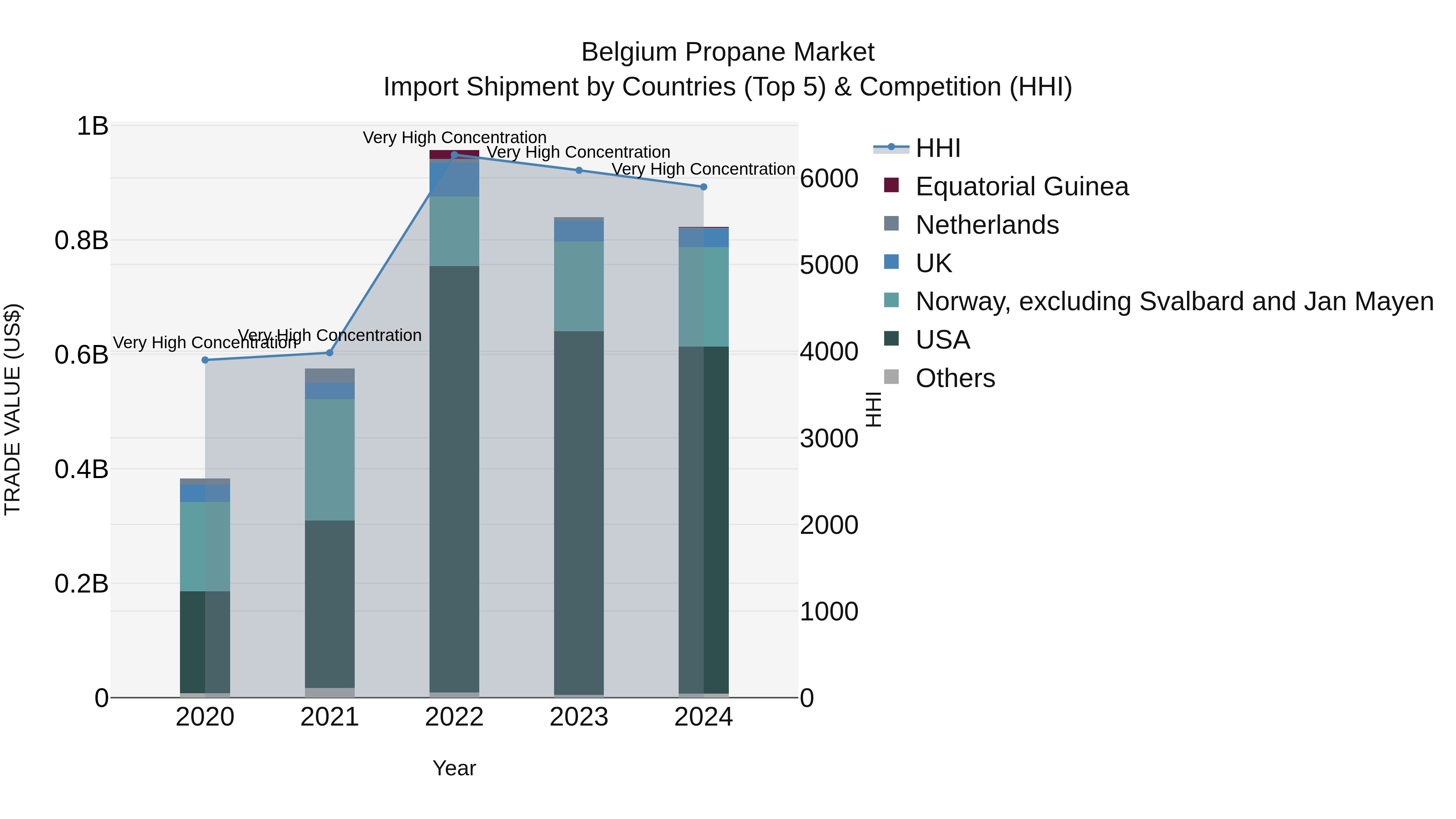
In 2024, Belgium continued to rely on a diverse range of countries for its propane imports, with top suppliers including the USA, Norway (excluding Svalbard and Jan Mayen), UK, Sweden, and Metropolitan France. Despite this diversity, the market remained highly concentrated, as indicated by the high Herfindahl-Hirschman Index (HHI). The industry also showed significant growth potential, with a strong compound annual growth rate (CAGR) of 21.07% from 2020 to 2024. However, there was a slight decline in growth rate from 2023 to 2024, with a rate of -2.06%, suggesting a potential slowdown in the market.
Propane Market: Belgium vs Top 5 Major Economies in 2027 (Europe)
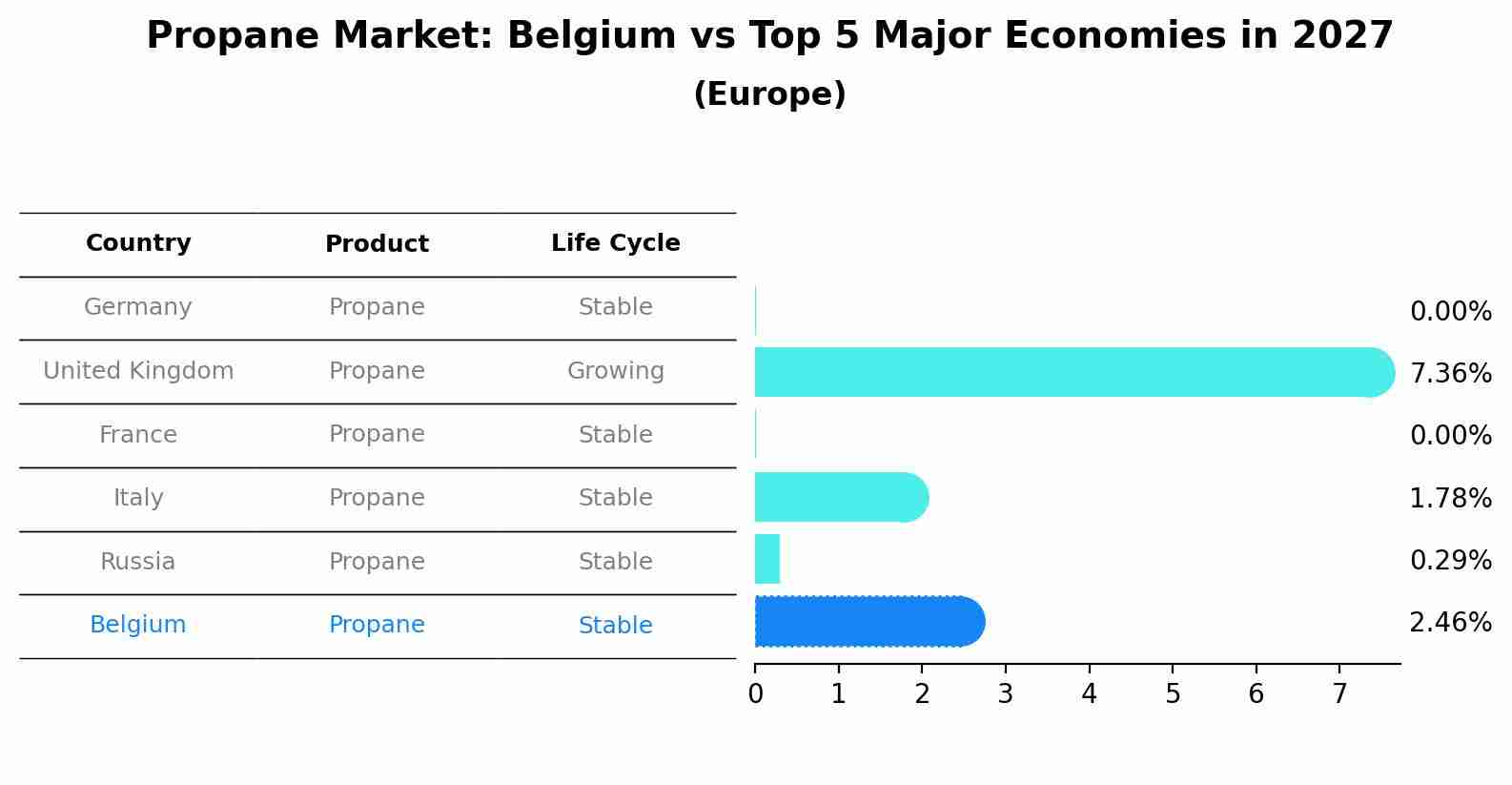
In the Europe region, the Propane market in Belgium is projected to expand at a stable growth rate of 2.46% by 2027. The largest economy is Germany, followed by United Kingdom, France, Italy and Russia.
Belgium Propane Market Overview
The Belgium Propane Market includes the supply, distribution, and usage of propane gas. Propane is used for heating, cooking, and as fuel in various industrial processes.
Drivers of the market
The propane market in Belgium is influenced by the increasing demand for clean and efficient energy sources. Propane is widely used in residential heating, industrial applications, and as a fuel for vehicles. The shift towards more sustainable energy solutions and the development of infrastructure for propane distribution and storage contribute to market growth. Additionally, the rising awareness of environmental issues and the need for lower emissions fuel solutions drive the demand for propane in various sectors.
Challenges of the market
The propane market in Belgium encounters challenges related to fluctuating global prices and supply chain issues. Environmental regulations and the push for alternative energy sources can also impact demand. Additionally, there are concerns about safety and infrastructure for the distribution and storage of propane.
Government Policy of the market
In Belgium, government policies for the propane market emphasize environmental protection and safety. Regulations are in place to ensure the safe storage, transportation, and use of propane. The government also supports the use of propane as a cleaner alternative to other fossil fuels, offering incentives for adopting propane in residential and industrial applications. There are strict emission standards and safety protocols to mitigate environmental and health risks associated with propane use.
Key Highlights of the Report:
- Belgium Propane Market Outlook
- Market Size of Belgium Propane Market, 2024
- Forecast of Belgium Propane Market, 2031
- Historical Data and Forecast of Belgium Propane Revenues & Volume for the Period 2021-2031
- Belgium Propane Market Trend Evolution
- Belgium Propane Market Drivers and Challenges
- Belgium Propane Price Trends
- Belgium Propane Porter`s Five Forces
- Belgium Propane Industry Life Cycle
- Historical Data and Forecast of Belgium Propane Market Revenues & Volume By Applications for the Period 2021-2031
- Historical Data and Forecast of Belgium Propane Market Revenues & Volume By Industrial for the Period 2021-2031
- Historical Data and Forecast of Belgium Propane Market Revenues & Volume By Commercial for the Period 2021-2031
- Historical Data and Forecast of Belgium Propane Market Revenues & Volume By Residential for the Period 2021-2031
- Historical Data and Forecast of Belgium Propane Market Revenues & Volume By Transportation for the Period 2021-2031
- Historical Data and Forecast of Belgium Propane Market Revenues & Volume By Agriculture for the Period 2021-2031
- Historical Data and Forecast of Belgium Propane Market Revenues & Volume By Chemicals and Refineries for the Period 2021-2031
- Belgium Propane Import Export Trade Statistics
- Market Opportunity Assessment By Applications
- Belgium Propane Top Companies Market Share
- Belgium Propane Competitive Benchmarking By Technical and Operational Parameters
- Belgium Propane Company Profiles
- Belgium Propane Key Strategic Recommendations






































