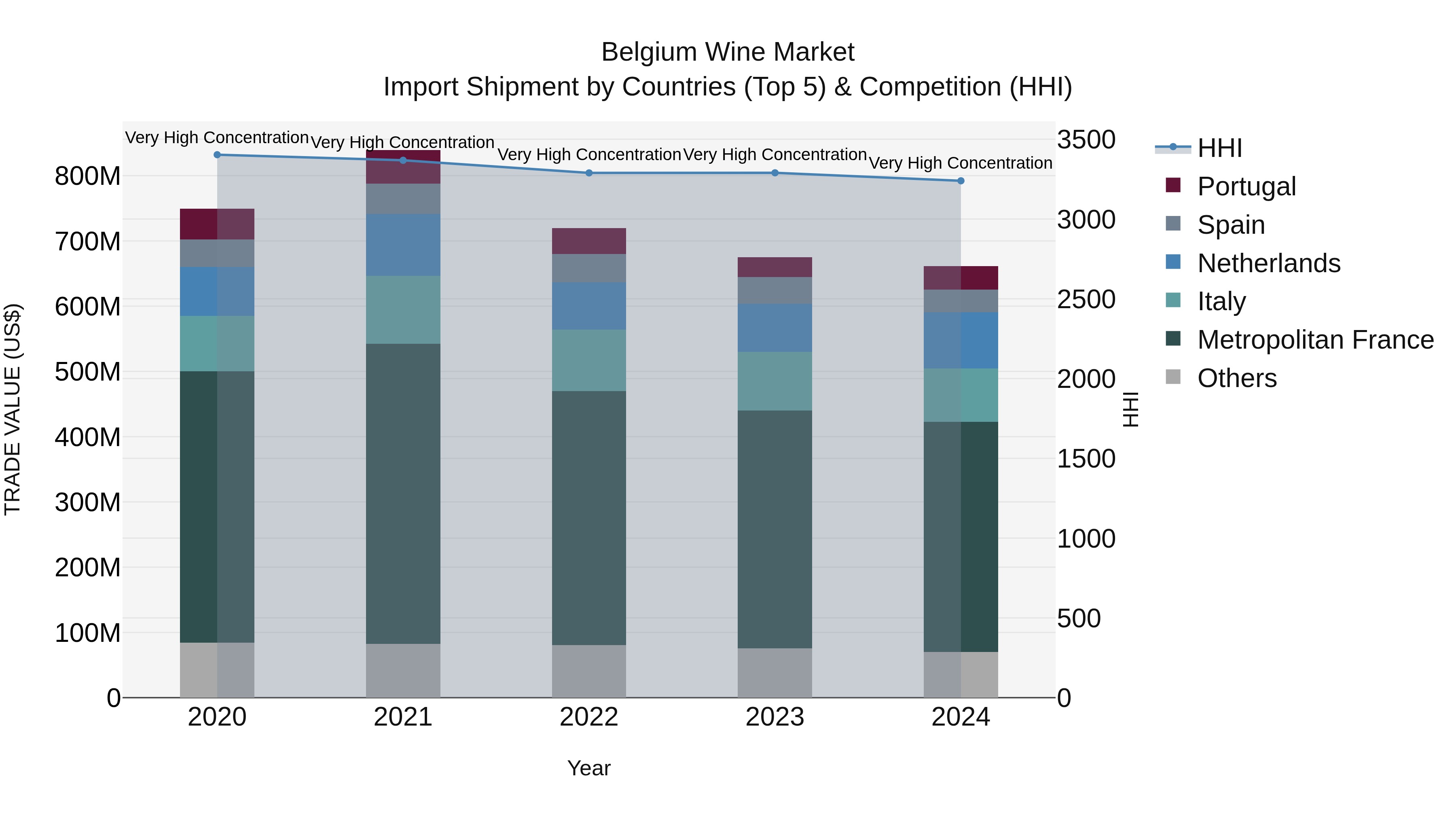
Belgium Wine Market Top 5 Importing Countries and Market Competition (HHI) Analysis
Despite a declining compound annual growth rate (CAGR) over the past four years, Belgium continues to import a significant amount of wine, with Metropolitan France, Netherlands, Italy, Portugal, and Spain being the top exporting countries in 2024. The high Herfindahl-Hirschman Index (HHI) indicates a concentrated market, potentially presenting challenges for smaller wine producers looking to enter the Belgian market. The slight decrease in the growth rate from 2023 to 2024 may signal a need for strategic marketing and distribution efforts to maintain or increase market share in the competitive Belgian wine import market.
Belgium Wine Market Growth Rate
According to 6Wresearch internal database and industry insights, the Belgium Wine Market is projected to grow at a compound annual growth rate (CAGR) of 5.8% during the forecast period (2026–2032).
Five-Years Growth Trajectory of the Belgium Wine Market with Core Drivers
Below is the evaluation of the year-wise growth rate along with key drivers:
| Years | Estimated Annual Growth (%) | Growth Drivers |
| 2021 | 3.5 | Increased interest in premium wines, especially among millennials, and higher imports from key wine regions. |
| 2022 | 4.1 | Growth in wine tourism and events, boosting awareness and consumption. |
| 2023 | 4.3 | Rise of online wine sales, offering convenient purchasing options. |
| 2024 | 4.6 | Higher demand for organic and biodynamic wines, driven by health-conscious consumers. |
| 2025 | 4.9 | Growing popularity of wine pairings in dining, enhancing overall wine consumption. |
Topics Covered in the Belgium Wine Market Report
The Belgium Wine Market report thoroughly covers the market by Product Types, Colors and Distribution Channels. The report provides an unbiased and detailed analysis of ongoing market trends, opportunities/high-growth areas, and market drivers that will help stakeholders devise and align strategies according to current and future market dynamics.
Belgium Wine Market Highlights
| Report Name | Belgium Wine Market |
| Forecast period | 2026–2032 |
| CAGR | 5.8% |
| Growing Sector | Food and Beverage |
Belgium Wine Market Synopsis
Belgium Wine Industry is expected to witness a steady growth owing to the consumption of premium and organic wines, along with the demand for wine-based experiences such as wine tasting and tourism. Besides that, retail expansion and the prevalent trend of purchasing wine on the internet are some other drivers of this market. Moreover, the country’s long wine-drinking history coupled with the growing palate for foreign wines are also huge contributors.
Evaluation of Growth Drivers in the Belgium Wine Market
Below are some prominent drivers and their influence on the Belgium Wine Market dynamics:
| Drivers | Primary Segments Affected | Why it Matters |
| Rising interest in premium wines | By Product Types | Millennials are choosing higher-quality wines, driving premium wine sales. |
| Growth of wine tourism and events | By Distribution Channel | Wine events and tourism are raising awareness and boosting consumption in retail and foodservice. |
| Expansion of online wine sales | By Distribution Channel | Online wine shopping is growing, making it easier for consumers to find different wines. |
| Demand for organic and biodynamic wines | By Product Types | Health-conscious consumers are turning to organic and biodynamic wines, fueling growth in these categories. |
The Belgium Wine Market Size is projected to grow at a CAGR of 5.8% during the forecast period (2026–2032). A surge in demand for top-notch premium, organic, and biodynamic wines is a factor behind the growth. The ongoing rise of online wine retail and wine tourism is increasing consumption and also making wine more accessible. In addition, the country being a major wine importer has a positive effect on the market, which is gradually growing in both retail and foodservice sectors. The craving for the best wines, in combination with the transformation of consumer preferences, leads to market enlargement and moreover, it enhances Belgium’s role in the global wine trade.
Evaluation of Restraints in the Belgium Wine Market
Below are some major restraints and their influence on the Belgium Wine Market dynamics:
| Restraints | Primary Segments Affected | What this Means |
| Price sensitivity for premium wines | By Product Types | High prices for premium wines may push budget-conscious consumers towards more affordable options. |
| Limited awareness of wine categories | By Product Types | Limited awareness of wine types like organic or biodynamic wines may slow their growth. |
| Import dependencies | By Product Types | Dependence on imports can cause supply issues, especially with changing trade regulations. |
| Weather-related disruptions in wine production | By Product Types | Climate changes can affect wine production in key regions, disrupting supply. |
Belgium Wine Market Challenges
The Belgium Wine Market encounters issues like the consumers price sensitivity, particularly in the premium wine segment which hinder with the overall growth of the market. In addition, lack of consumer knowledge about new wine types such as organic and biodynamic wines may also impede their entry into the market. On top of that, weather changes in traditional wine-producing countries also affect supply consistency, making it harder to meet demand.
Belgium Wine Market Trends
Several key trends are shaping the growth of the Belgium Wine Market which include:
- Shift to premium wines: Consumers are spending more on high-quality wines, boosting premium segments like still and sparkling wines.
- Wine tourism and events: Growing wine tourism and events are increasing consumption and awareness.
- Online wine sales: Consumers are choosing online shopping for easier access to a variety of wines.
- Demand for organic wines: Health-conscious trends are driving the popularity of organic wines as sustainable options.
Investment Opportunities in the Belgium Wine Market
Some notable investment opportunities in the Belgium Wine Market include:
- Expand online wine retail: Invest in e-commerce platforms to meet the rising demand for online wine shopping and offer a wider selection.
- Develop organic wine offerings: Increase organic and biodynamic wine options to appeal to health-conscious and sustainable consumers.
- Invest in wine tourism and events: Build wine tourism infrastructure and host events to boost consumption and brand visibility.
- Improve wine distribution logistics: Enhance logistics and cold chain services to better store wine, reduce spoilage, and ensure a consistent year-round supply.
Top 5 Leading Players in the Belgium Wine Market
Some leading players operating in the Belgium Wine Market Share include:
1. Cave de Tain
| Company Name | Cave de Tain |
| Established Year | 1933 |
| Headquarters | Belgium |
| Official Website | Click Here |
Cave de Tain is a major wine producer and distributor, offering a wide range of wines, including premium and organic varieties, to Belgian consumers.
2. Delhaize
| Company Name | Delhaize |
| Established Year | 1867 |
| Headquarters | Belgium |
| Official Website | Click Here |
Delhaize is one of the leading supermarket chains in Belgium, offering a vast selection of wines, including imported and premium wines.
3. Carrefour Belgium
| Company Name | Carrefour Belgium |
| Established Year | 1958 |
| Headquarters | Belgium |
| Official Website | Click Here |
Carrefour Belgium operates numerous retail stores, providing a wide assortment of wines from local and international producers, with a focus on organic and premium options.
4. E.Leclerc
| Company Name | E.Leclerc |
| Established Year | 1949 |
| Headquarters | Belgium |
| Official Website | Click Here |
E.Leclerc offers a broad wine selection, from budget-friendly to high-end wines, focusing on both domestic and international wine imports.
5. Wijnhuis
| Company Name | Wijnhuis |
| Established Year | 1992 |
| Headquarters | Belgium |
| Official Website | Click Here |
Wijnhuis specializes in the retail and distribution of wines, offering a variety of options from across the globe, with an emphasis on fine wines and exclusive labels.
Government Regulations Introduced in the Belgium Wine Market
According to Belgian Government data, various regulations impact the wine industry, including the Federal Agency for the Safety of the Food Chain (FASFC), puts strict labeling and quality standards for all wines sold in Belgium. The European Union also offers financial support to organic wine producers, making sure of compliance with sustainable production standards. Additionally, the Belgium Ministry of Agriculture help improve wine production by providing grants for new technologies and sustainable practices.
Future Insights of the Belgium Wine Market
The Belgium Wine Market is set to experience constant growth, mainly due to the customer preference for high-quality wines and online wine shopping gaining more traction. Additionally, the market will be aided by the flourishing wine tourism, improved transportation, and increasing demand for organic wines. One of the health trends that will affect consumer behaviour will be the switch towards organic and biodynamic wines, which will contribute to the overall Belgium Wine Market growth.
Market Segmentation Analysis
The report offers a comprehensive study of the following market segments and their leading categories:
By Product Types – Still Wine to Lead the Market
According to Priya, Senior Research Analyst, 6Wresearch, still wine is expected to dominate the Belgium Wine Market, driven by its widespread consumption across households, restaurants, and foodservice establishments.
By Colors – Red Wine to Lead the Market
Red wines are the most popular in Belgium due to their versatility in pairing with food, particularly in dining and foodservice sectors. Belgian consumers favor red wines for their rich flavors and pairing compatibility with a wide range of dishes, including meats and cheeses.
By Distribution Channel – Offline to Lead the Market
Offline channels, including supermarkets, specialty stores, and restaurants, lead the market due to their wide accessibility and in-person shopping experience. While online wine sales are growing, physical retail and dining establishments remain the primary channels for wine consumption in Belgium.
Key Attractiveness of the Report
- 10 Years of Market Numbers.
- Historical Data Starting from 2022 to 2025.
- Base Year: 2025.
- Forecast Data until 2032.
- Key Performance Indicators Impacting the Market.
- Major Upcoming Developments and Projects.
Key Highlights of the Report:
- Belgium Wine Market Outlook
- Market Size of Belgium Wine Market, 2025
- Forecast of Belgium Wine Market, 2032
- Historical Data and Forecast of Belgium Wine Revenues & Volume for the Period 2022-2032
- Belgium Wine Market Trend Evolution
- Belgium Wine Market Drivers and Challenges
- Belgium Wine Price Trends
- Belgium Wine Porter`s Five Forces
- Belgium Wine Industry Life Cycle
- Historical Data and Forecast of Belgium Wine Market Revenues & Volume By Product Types for the Period 2022-2032
- Historical Data and Forecast of Belgium Wine Market Revenues & Volume By Still Wine for the Period 2022-2032
- Historical Data and Forecast of Belgium Wine Market Revenues & Volume By Sparkling Wine for the Period 2022-2032
- Historical Data and Forecast of Belgium Wine Market Revenues & Volume By Dessert Wine for the Period 2022-2032
- Historical Data and Forecast of Belgium Wine Market Revenues & Volume By Fortified Wine for the Period 2022-2032
- Historical Data and Forecast of Belgium Wine Market Revenues & Volume By Colors for the Period 2022-2032
- Historical Data and Forecast of Belgium Wine Market Revenues & Volume By Red Wine for the Period 2022-2032
- Historical Data and Forecast of Belgium Wine Market Revenues & Volume By Rose Wine for the Period 2022-2032
- Historical Data and Forecast of Belgium Wine Market Revenues & Volume By White Wine for the Period 2022-2032
- Historical Data and Forecast of Belgium Wine Market Revenues & Volume By Other Colors for the Period 2022-2032
- Historical Data and Forecast of Belgium Wine Market Revenues & Volume By Distribution Channel for the Period 2022-2032
- Historical Data and Forecast of Belgium Wine Market Revenues & Volume By Offline for the Period 2022-2032
- Historical Data and Forecast of Belgium Wine Market Revenues & Volume By Online for the Period 2022-2032
- Belgium Wine Import Export Trade Statistics
- Market Opportunity Assessment By Product Types
- Market Opportunity Assessment By Colors
- Market Opportunity Assessment By Distribution Channel
- Belgium Wine Top Companies Market Share
- Belgium Wine Competitive Benchmarking By Technical and Operational Parameters
- Belgium Wine Company Profiles
- Belgium Wine Key Strategic Recommendations
Markets Covered
The report offers a comprehensive study of the following market segments:
By Product Types
- Still Wine
- Sparkling Wine
- Dessert Wine
- Fortified Wine
By Colors
- Red Wine
- Rose Wine
- White Wine
- Other Colors
By Distribution Channel
- Offline
- Online






































