Bhutan Flour Market Size Growth Rate
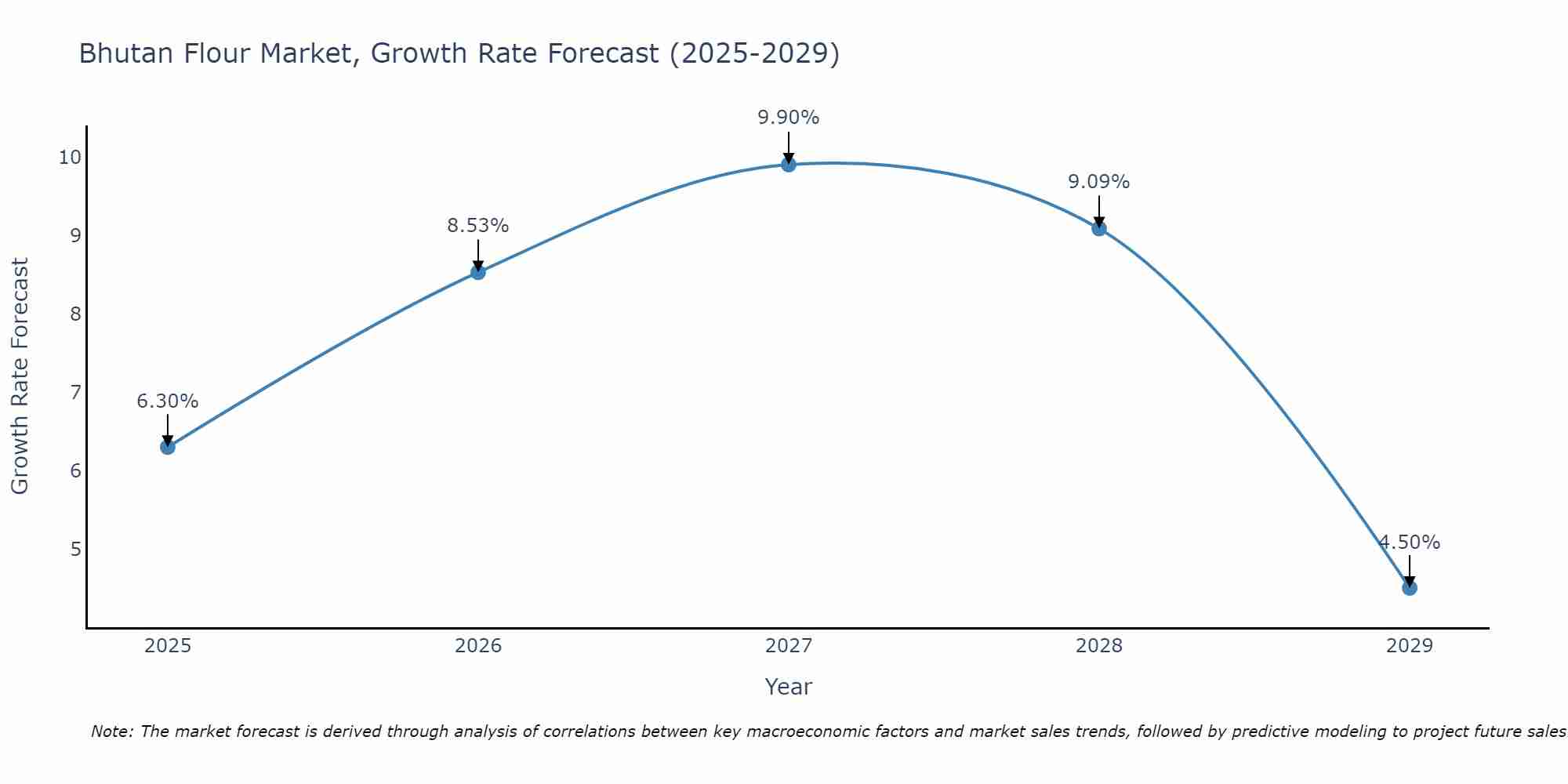
The Bhutan Flour Market is projected to witness mixed growth rate patterns during 2025 to 2029. Starting at 6.30% in 2025, the market peaks at 9.90% in 2027, and settles at 4.50% by 2029.
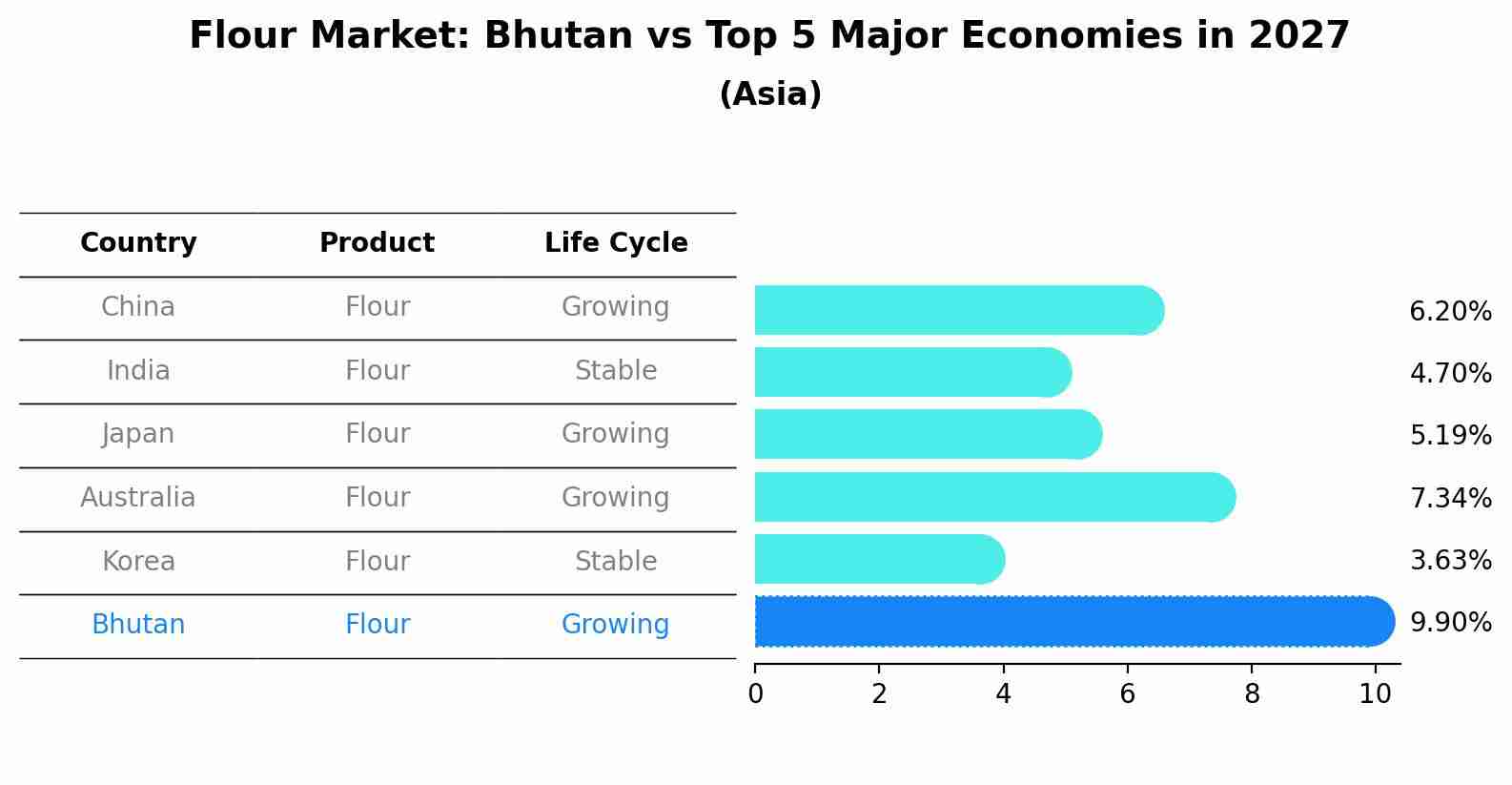
Flour Market: Bhutan vs Top 5 Major Economies in 2027 (Asia)
In the Asia region, the Flour market in Bhutan is projected to expand at a growing growth rate of 9.90% by 2027. The largest economy is China, followed by India, Japan, Australia and South Korea.
Bhutan Flour Market Growth Rate
According to 6Wresearch internal database and industry insights, The Bhutan Flour Market is projected to grow at a compound annual growth rate (CAGR) of 4.5% during the forecast period (2025–2029).
| Report Name | Bhutan Flour Market |
| Forecast period | 2025–2029 |
| CAGR | 4.5% |
| Growing Sector | Bread & Bakery Processing and Household Consumption |
Five-Year Growth Trajectory of the Bhutan Flour Market with Core Drivers
Below mentioned are the evaluation of year-wise growth rate along with key drivers:
| Years | Est. Annual Growth | Growth Drivers |
| 2020 | 3.2 | Demand stability from rural households under important food security programs |
| 2021 | 3.5 | Increasing bakery outlets and government support for domestic milling units |
| 2022 | 4.1 | Rising tourism-led demand for bakery and confectionery products |
| 2023 | 4.3 | Rise in packaged food consumption and modern retail expansion |
| 2024 | 4.4 | Technological growth in milling and flour fortification practices |
Topics Covered in the Bhutan Flour Market Report
The Bhutan Flour Market report thoroughly covers the market by raw material, applications, and technology. The market report provides an unbiased and detailed analysis of ongoing market trends, opportunities/high growth areas, and market drivers, which would help stakeholders to devise and align their market strategies according to the current and future market dynamics.
Bhutan Flour Market Synopsis
Bhutan Flour Market is anticipated to get major growth due to the increasing demand for ready-to-eat and bakery products, along with advancements in the local milling sector. Flour serves as a staple in both rural and urban regions, majorly used for bakery, noodles, and animal feed production. The government’s concentration on self-sufficiency and modernization of agro-processing facilities persist to increase domestic flour production and decrease import reliability. Additionally, increased health awareness is increasing demand for fortified and organic flour varieties.
Evaluation of Growth Drivers in the Bhutan Flour Market
Below mentioned are some prominent drivers and their influence on the market dynamics:
| Drivers | Primary Segments Affected | Why It Matters (Evidence) |
| Urbanization and Lifestyle Changes | Bread & Bakery, Noodles & Pasta | Urban migration has risen demand for convenience-based food products utilising refined flour. |
| Tourism and Hospitality Growth | Bread & Bakery, Wafers & Biscuits | Increase in flour utilisation in commercial kitchens due to Tourism recovery propels consumption of bakery goods. |
| Government Agro-Processing Support | All segments | Policies encouraging agro-industries promotes domestic flour production with financial incentives. |
| Rising Animal Feed Demand | Animal Feed | Increasing poultry and livestock sectors raises maize and wheat flour consumption in feed mills. |
| Fortified Food Awareness | Bread & Bakery, Noodles | Increase market growth due to consumer choice for fortified wheat flour with iron and folic acid |
The Bhutan Flour Market size is projected to grow at a CAGR of 4.5% during the forecast period of 2025–2029. Flour consumption in Bhutan is steadily increasing as households and bakeries want premium quality, fortified flour options. The expansion of small-scale mills, along with government initiatives to solidify food processing, is creating major market opportunities. Moreover, the country’s increasing concentration on food self-sufficiency and the deployment of modern milling solutions are bolstering efficient local production. Increasing demand for value-added flour products, such as fortified and organic variants, further complements market advancement.
Evaluation of Restraints in the Bhutan Flour Market
Below mentioned are some major restraints and their influence on the market dynamics:
| Restraints | Primary Segments Affected | What This Means (Evidence) |
| High Transportation Costs | All Segments | Bhutan’s hilly terrain raises logistics prices, impacting price competitiveness of flour products. |
| Limited Milling Capacity | Industrial & Commercial | Small mills face challenges in aligning with consistent quality and high-volume needs. |
| Dependence on Imports | Wheat & Maize-based Products | Dependency on imported wheat exposes the market to worldwide price volatility. |
| Energy Supply Constraints | All Segments | Irregular electricity in rural areas affects the ongoing milling operations. |
| Stringent Quality Standards | Industrial Bakeries | Compliance with food safety standards raises production prices for local manufacturers. |
Bhutan Flour Market Challenges
Despite the market’s expansion, the Bhutan Flour Market goes through structural challenges such as reliability on imported raw wheat from India, high transportation price due to Bhutan’s mountainous topography, and the dominance of unorganized milling units. Small mills often struggle to keep through consistent product quality, while larger players goes through increasing energy and maintenance prices. Moreover, the transition toward low-gluten and organic products demands equipment upgrades and new processing techniques.
Bhutan Flour Market Trends
Several prominent trends reshaping the market growth include:
- Fortified and Functional Flours: Rising health awareness is bolstering need for flour enriched with vitamins, minerals, and fiber to address nutrition deficiencies.
- Automation in Milling Technology: Deployment of modern milling technologies to augment flour quality, consistency, and yield is getting traction among organized players.
- Rise of Ready-to-Eat Products: Increased growth of bakery, noodles, and snack products has majorly raised the industrial need for wheat flour.
- Sustainable Packaging: The introduction of eco-friendly paper-based packaging for flour meets with Bhutan’s sustainability goals.
Investment Opportunities in the Bhutan Flour Industry
Some prominent investment opportunities in the market include:
- Organic Flour Production Units: Create certified organic flour mills offering to urban health-conscious consumers and high-quality bakery outlets.
- Fortified Flour Expansion: Allocate money in production facilities with micronutrient fortification technology to align with growing nutritional standards.
- Retail Brand Development: Develop national flour brands that target retail chains and online grocery platforms in urban Bhutan.
Top 5 Leading Players in the Bhutan Flour Market
Some leading players operating in the Bhutan Flour Market include:
1. Bhutan Agro Industries Limited (BAIL)
| Company Name | Bhutan Agro Industries Limited (BAIL) |
| Established Year | 1993 |
| Headquarters | Thimphu, Bhutan |
| Official Website | - |
BAIL is a government-backed agro-processing company focusing in flour and food products, ensuring food security via sustainable agro-industrial production.
2. Tashi Group (Tashi Commercial Corporation Ltd.)
| Company Name | Tashi Group (Tashi Commercial Corporation Ltd.) |
| Established Year | 1959 |
| Headquarters | Phuentsholing, Bhutan |
| Official Website | Click Here |
A major conglomerate functioning food processing and flour milling divisions, Tashi Group creates premium quality wheat and maize flour for both domestic and export markets.
3. Yangphel Agro Mills
| Company Name | Yangphel Agro Mills |
| Established Year | 2005 |
| Headquarters | Paro, Bhutan |
| Official Website | Click Here |
Yangphel Agro Mills concentrates on advanced milling and packaging technology, producing fortified and organic flours for bakeries and households.
4. Bhutan Millers Pvt. Ltd.
| Company Name | Bhutan Millers Pvt. Ltd. |
| Established Year | 2010 |
| Headquarters | Gelephu, Bhutan |
| Official Website | - |
Bhutan Millers Pvt. Ltd. functions multiple small-scale mills producing refined wheat and maize flour for regional distribution chains.
5. Karma Feeds & Flour Industries
| Company Name | Karma Feeds & Flour Industries |
| Established Year | 2014 |
| Headquarters | Samdrup Jongkhar, Bhutan |
| Official Website | - |
The company creates multi-purpose flours and animal feed products, incorporating sustainable raw material sourcing with developed processing systems.
Government Regulations Introduced in the Bhutan Flour Market
According to Bhutanese government data, numerous programs have been introduced to solidify domestic food security and decrease import reliability. The “National Food and Nutrition Security Policy” encourages local grain milling and promotes the fortification of staple foods. Additionally, the “Economic Development Policy (EDP) 2021” encourages agro-based industries by catering tax incentives for flour milling startups. The Bhutan Standards Bureau (BSB) also introduced quality benchmarks for flour safety and nutritional labeling. For example, the government also created and launched the “Flour Mill Upgradation Grant Scheme” in 2023 to aid small mills in advancing production systems.
Future Insights of the Bhutan Flour Market
The Bhutan Flour Market Growth is anticipated to raise substantially in the upcoming years, bolstered by the growth in bakery consumption, increasing disposable incomes, and supportive government initiatives encouraging local manufacturing. Technological advancements in flour fortification, automation, and packaging are predicted to augment product competitiveness. Moreover, rising consumer choice for high-quality, organic, and fortified flour varieties will redefine the market arena by 2029.
Market Segmentation Analysis
The report offers a comprehensive study of the subsequent market segments and their leading categories.
Wheat Flour to Dominate the Market – By Raw Material
According to Parth, Senior Research Analyst at 6Wresearch, wheat-based flour holds the largest Bhutan Flour Market Share due to its versatility in bakery, noodles, and household cooking applications. The government’s concentration on increasing domestic wheat cultivation through the “Wheat Self-Sufficiency Program” has further encouraged the segment’s growth.
Bread & Bakery Products to Dominate – By Applications
The Bread & Bakery Products segment leads the Bhutan Flour Industry owing to the growing bakery culture in urban Bhutan and the expansion of cafes and confectionery shops.
Dry Technology to Dominate – By Technology
Dry milling technology dominates the market as it permits cost-effective and large-scale production with minimal water consumption. It is mainly chosen by small and medium-scale mills for its simplicity, energy efficiency, and versatility to Bhutan’s lack of water resources.
Key Attractiveness of the Report
- 10 Years of Market Numbers.
- Historical Data Starting from 2021 to 2024.
- Base Year: 2024.
- Forecast Data until 2029.
- Key Performance Indicators Impacting the Market.
- Major Upcoming Developments and Projects.
Key Highlights of the Report:
- Bhutan Flour Market Outlook
- Market Size of Bhutan Flour Market, 2024
- Forecast of Bhutan Flour Market, 2029
- Historical Data and Forecast of Bhutan Flour Revenues & Volume for the Period 2019-2029
- Bhutan Flour Market Trend Evolution
- Bhutan Flour Market Drivers and Challenges
- Bhutan Flour Price Trends
- Bhutan Flour Porter`s Five Forces
- Bhutan Flour Industry Life Cycle
- Historical Data and Forecast of Bhutan Flour Market Revenues & Volume By Raw Material for the Period 2019-2029
- Historical Data and Forecast of Bhutan Flour Market Revenues & Volume By Wheat for the Period 2019-2029
- Historical Data and Forecast of Bhutan Flour Market Revenues & Volume By Rice for the Period 2019-2029
- Historical Data and Forecast of Bhutan Flour Market Revenues & Volume By Maize for the Period 2019-2029
- Historical Data and Forecast of Bhutan Flour Market Revenues & Volume By Others for the Period 2019-2029
- Historical Data and Forecast of Bhutan Flour Market Revenues & Volume By Applications for the Period 2019-2029
- Historical Data and Forecast of Bhutan Flour Market Revenues & Volume By Bread & Bakery Products for the Period 2019-2029
- Historical Data and Forecast of Bhutan Flour Market Revenues & Volume By Noodles & Pasta for the Period 2019-2029
- Historical Data and Forecast of Bhutan Flour Market Revenues & Volume By Animal Feed for the Period 2019-2029
- Historical Data and Forecast of Bhutan Flour Market Revenues & Volume By Wafers, Crackers, & Biscuits for the Period 2019-2029
- Historical Data and Forecast of Bhutan Flour Market Revenues & Volume By Non-Food Application for the Period 2019-2029
- Historical Data and Forecast of Bhutan Flour Market Revenues & Volume By Others for the Period 2019-2029
- Historical Data and Forecast of Bhutan Flour Market Revenues & Volume By Technology for the Period 2019-2029
- Historical Data and Forecast of Bhutan Flour Market Revenues & Volume By Dry Technology for the Period 2019-2029
- Historical Data and Forecast of Bhutan Flour Market Revenues & Volume By Wet Technology for the Period 2019-2029
- Bhutan Flour Import Export Trade Statistics
- Market Opportunity Assessment By Raw Material
- Market Opportunity Assessment By Applications
- Market Opportunity Assessment By Technology
- Bhutan Flour Top Companies Market Share
- Bhutan Flour Competitive Benchmarking By Technical and Operational Parameters
- Bhutan Flour Company Profiles
- Bhutan Flour Key Strategic Recommendations
Market Covered
The report offers a comprehensive study of the subsequent market segments:
By Raw Material
- Wheat
- Rice
- Maize
- Others
By Applications
- Bread & Bakery Products
- Noodles & Pasta
- Animal Feed
- Wafers, Crackers, & Biscuits
- Non-Food Applications
- Others
By Technology
- Dry Technology
- Wet Technology






































