Bolivia Kegs Market Top 5 Importing Countries and Market Competition (HHI) Analysis
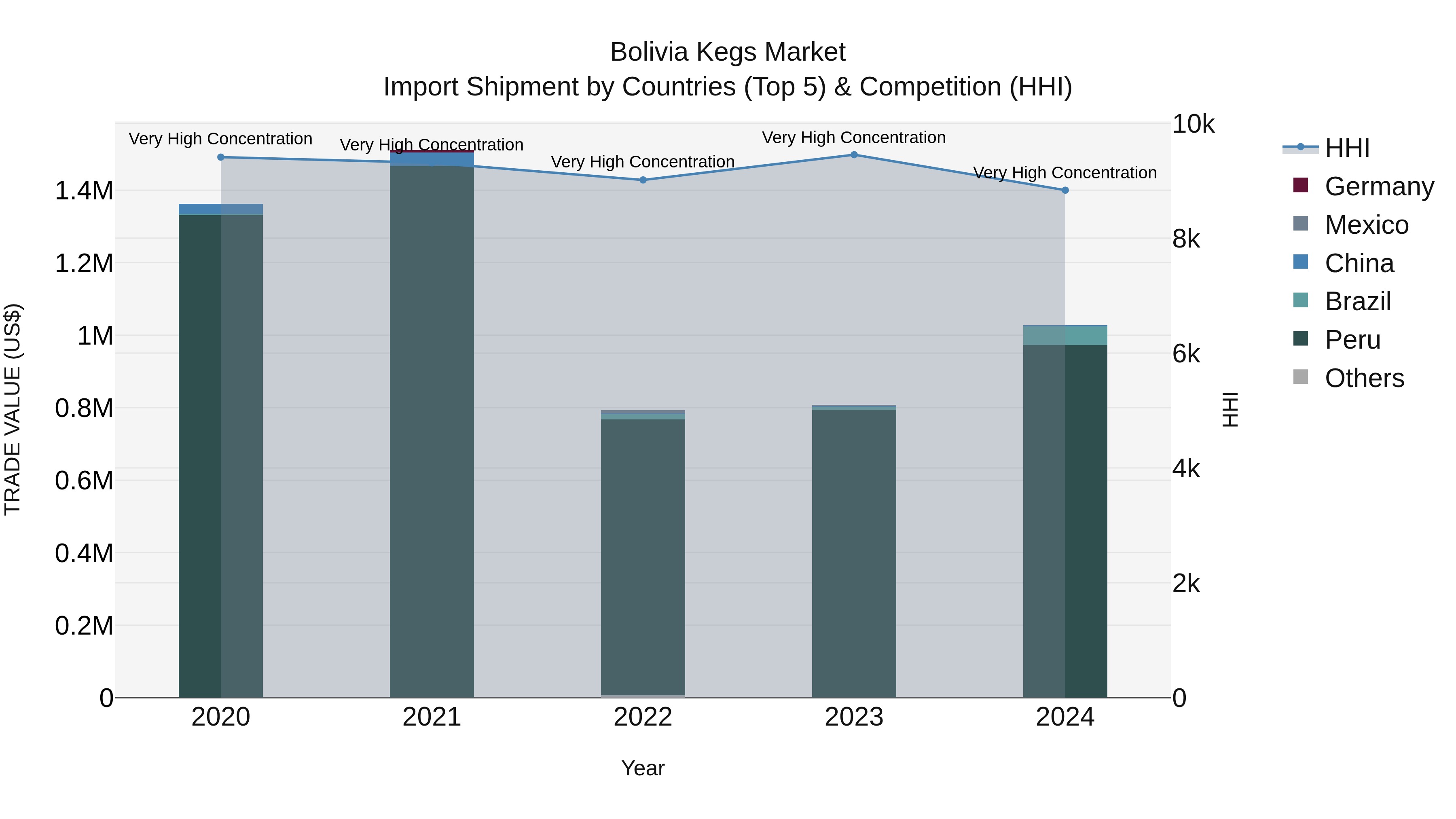
Bolivia kegs import market in 2024 saw significant contributions from key exporting countries such as Peru, Brazil, China, Canada, and Argentina. Despite a negative compound annual growth rate (CAGR) of -6.82% from 2020 to 2024, the market experienced a notable growth spurt of 27.25% from 2023 to 2024. The high Herfindahl-Hirschman Index (HHI) indicates a concentrated market, suggesting potential challenges and opportunities for stakeholders in the kegs import industry in Bolivia.
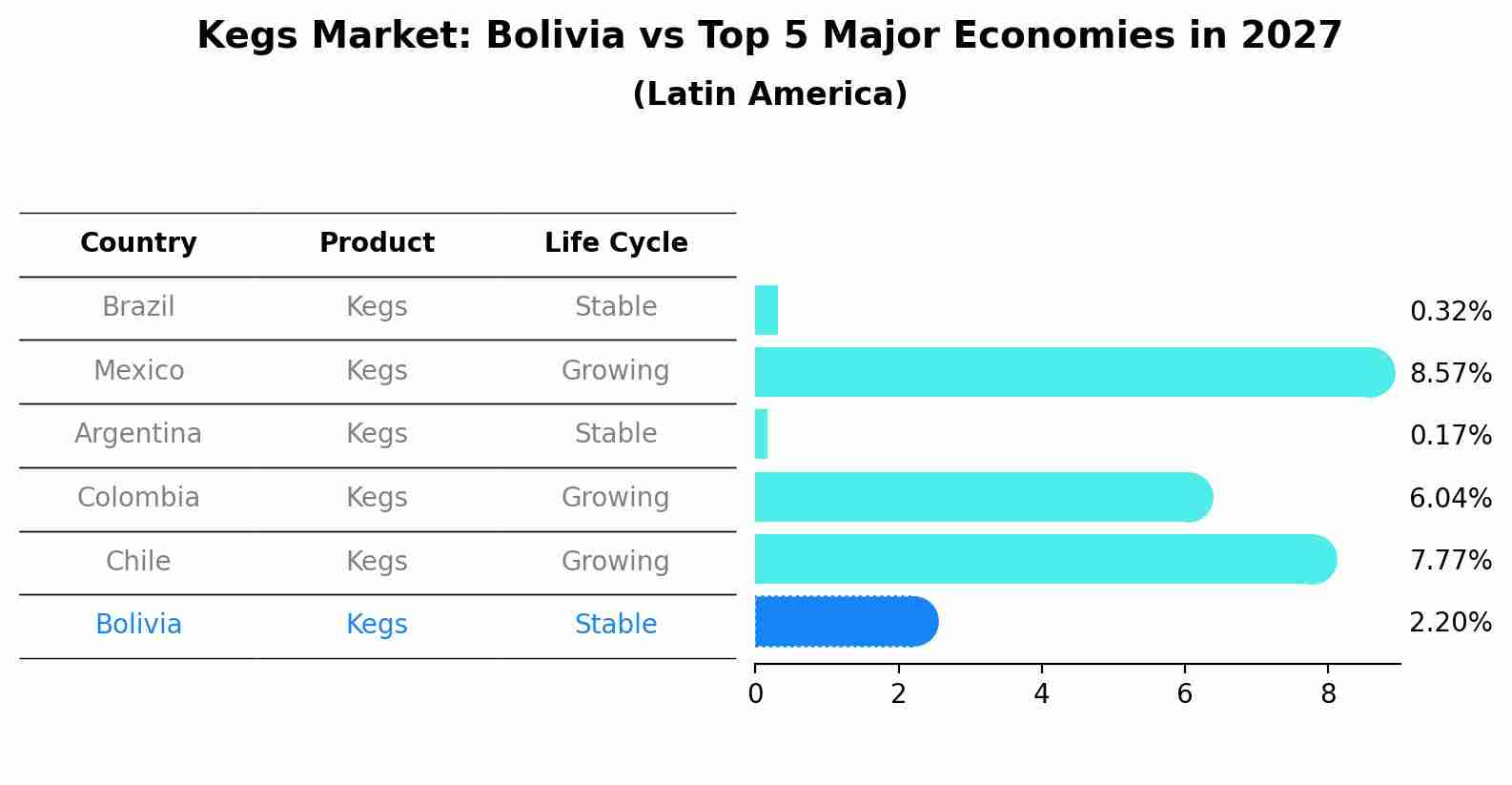
Kegs Market: Bolivia vs Top 5 Major Economies in 2027 (Latin America)
By 2027, the Kegs market in Bolivia is anticipated to reach a growth rate of 2.20%, as part of an increasingly competitive Latin America region, where Brazil remains at the forefront, supported by Mexico, Argentina, Colombia and Chile, driving innovations and market adoption across sectors.
Bolivia Kegs Market Overview
The kegs market in Bolivia is witnessing growth due to the rising consumption of beverages such as beer and soft drinks. Kegs are used for storing and transporting beverages in bulk, preserving their freshness and quality. The expanding hospitality and tourism industries are key drivers for this market.
Drivers of the market
The kegs market in Bolivia is supported by the increasing demand for efficient and sustainable packaging solutions for beverages, including beer, cider, and soft drinks. Kegs offer advantages such as improved shelf life, reduced waste, and ease of transportation. As Bolivias beverage industry grows and the focus on sustainability and efficiency increases, the demand for kegs rises. Additionally, advancements in keg technologies and a focus on enhancing product quality and convenience contribute to market growth.
Challenges of the market
The kegs market in Bolivia faces challenges such as high costs of production and transportation. There is also a need for investment in better manufacturing technology and infrastructure to improve the durability and quality of kegs. Additionally, competition from alternative packaging solutions and fluctuating raw material prices can affect market growth
Government Policy of the market
Government policies may regulate the production and use of kegs to ensure safety and quality. Policies could also support local manufacturers and promote the use of sustainable materials.
Key Highlights of the Report:
- Bolivia Kegs Market Outlook
- Market Size of Bolivia Kegs Market, 2024
- Forecast of Bolivia Kegs Market, 2031
- Historical Data and Forecast of Bolivia Kegs Revenues & Volume for the Period 2021-2031
- Bolivia Kegs Market Trend Evolution
- Bolivia Kegs Market Drivers and Challenges
- Bolivia Kegs Price Trends
- Bolivia Kegs Porter`s Five Forces
- Bolivia Kegs Industry Life Cycle
- Historical Data and Forecast of Bolivia Kegs Market Revenues & Volume By Material for the Period 2021-2031
- Historical Data and Forecast of Bolivia Kegs Market Revenues & Volume By Plastic for the Period 2021-2031
- Historical Data and Forecast of Bolivia Kegs Market Revenues & Volume By Tin for the Period 2021-2031
- Historical Data and Forecast of Bolivia Kegs Market Revenues & Volume By Stainless Steel for the Period 2021-2031
- Historical Data and Forecast of Bolivia Kegs Market Revenues & Volume By Capacity for the Period 2021-2031
- Historical Data and Forecast of Bolivia Kegs Market Revenues & Volume By Up to 20 Liter for the Period 2021-2031
- Historical Data and Forecast of Bolivia Kegs Market Revenues & Volume By 20 Liter to 40 Liter for the Period 2021-2031
- Historical Data and Forecast of Bolivia Kegs Market Revenues & Volume By 40 Liter to 60 Liter for the Period 2021-2031
- Historical Data and Forecast of Bolivia Kegs Market Revenues & Volume By Above 60 Liter for the Period 2021-2031
- Historical Data and Forecast of Bolivia Kegs Market Revenues & Volume By End Use for the Period 2021-2031
- Historical Data and Forecast of Bolivia Kegs Market Revenues & Volume By Alcoholic Beverages for the Period 2021-2031
- Historical Data and Forecast of Bolivia Kegs Market Revenues & Volume By Non-Alcoholic Beverages for the Period 2021-2031
- Historical Data and Forecast of Bolivia Kegs Market Revenues & Volume By Cooking Oil for the Period 2021-2031
- Historical Data and Forecast of Bolivia Kegs Market Revenues & Volume By Chemicals for the Period 2021-2031
- Historical Data and Forecast of Bolivia Kegs Market Revenues & Volume By Others for the Period 2021-2031
- Historical Data and Forecast of Bolivia Kegs Market Revenues & Volume By Distribution Channel for the Period 2021-2031
- Historical Data and Forecast of Bolivia Kegs Market Revenues & Volume By Supermarket/Hypermarket for the Period 2021-2031
- Historical Data and Forecast of Bolivia Kegs Market Revenues & Volume By Commercial Liquor Store for the Period 2021-2031
- Historical Data and Forecast of Bolivia Kegs Market Revenues & Volume By Others for the Period 2021-2031
- Bolivia Kegs Import Export Trade Statistics
- Market Opportunity Assessment By Material
- Market Opportunity Assessment By Capacity
- Market Opportunity Assessment By End Use
- Market Opportunity Assessment By Distribution Channel
- Bolivia Kegs Top Companies Market Share
- Bolivia Kegs Competitive Benchmarking By Technical and Operational Parameters
- Bolivia Kegs Company Profiles
- Bolivia Kegs Key Strategic Recommendations






































