Botswana Cocoa and Chocolate Market Growth Rate Analysis (2025 - 2031)
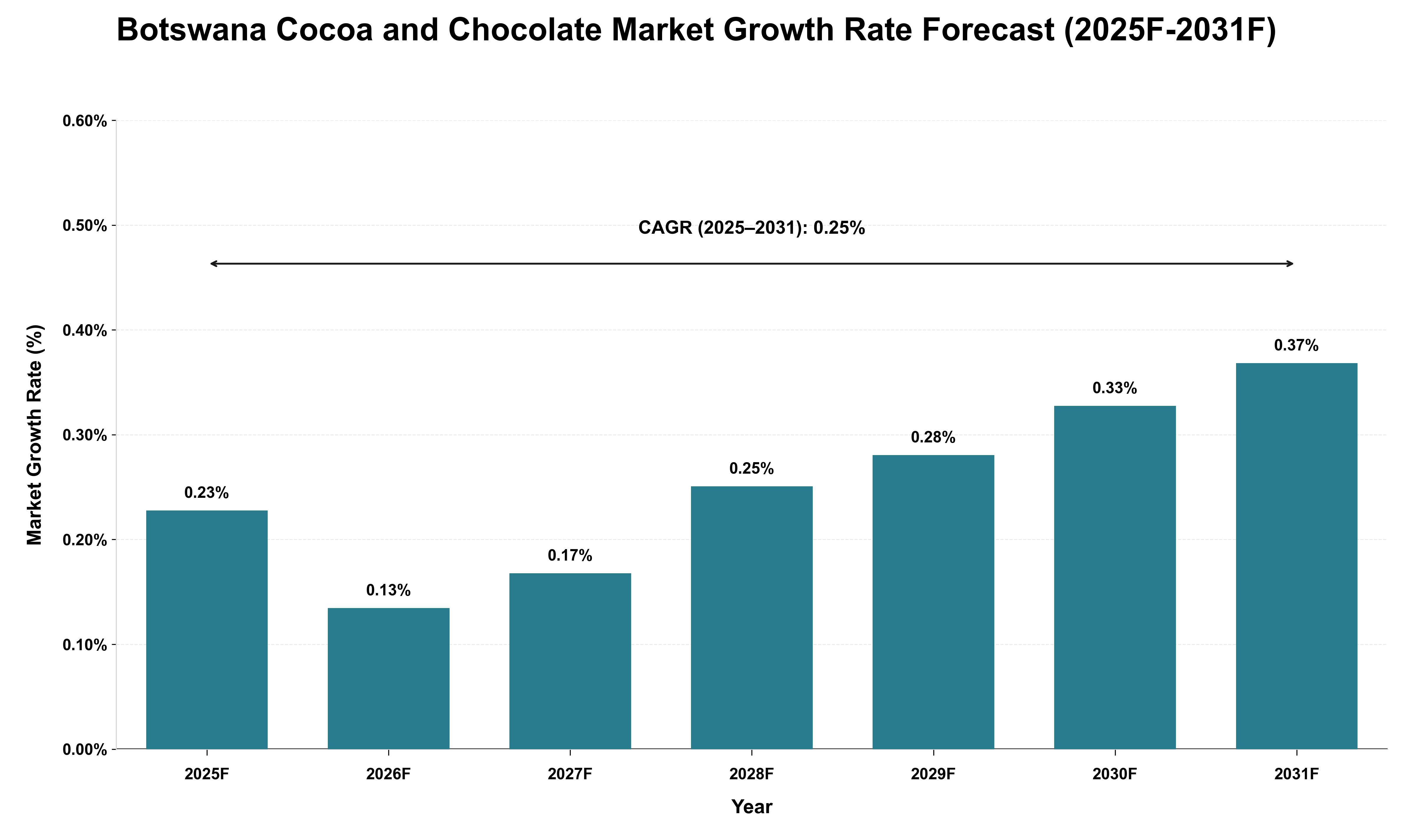
The forecasted growth trajectory for Botswana's cocoa and chocolate market will exhibit a gradual acceleration, as indicated by the increasing annual growth rates from 2025 to 2031. Starting at 0.23% in 2025, the market is expected to experience a slight deceleration in 2026 before rebounding to reach 0.37% by 2031. This pattern suggests that import dependencies will play a crucial role, particularly as Botswana relies on external sources for raw cocoa and related products. The anticipated rise in growth rates may reflect an expanding consumer base and evolving preferences towards chocolate products, which could stimulate import flows. Additionally, cyclical trends in global cocoa prices and trade agreements may further influence these dynamics, potentially enhancing Botswana's position within regional trade networks as demand for chocolate continues to evolve across various demographics.
Key Highlights of the Report:
- Botswana Cocoa and Chocolate Market Outlook
- Market Size of Botswana Cocoa and Chocolate Market, 2024
- Forecast of Botswana Cocoa and Chocolate Market, 2031
- Historical Data and Forecast of Botswana Cocoa and Chocolate Revenues & Volume for the Period 2021-2031
- Botswana Cocoa and Chocolate Market Trend Evolution
- Botswana Cocoa and Chocolate Market Drivers and Challenges
- Botswana Cocoa and Chocolate Price Trends
- Botswana Cocoa and Chocolate Porter`s Five Forces
- Botswana Cocoa and Chocolate Industry Life Cycle
- Historical Data and Forecast of Botswana Cocoa and Chocolate Market Revenues & Volume By Type for the Period 2021-2031
- Historical Data and Forecast of Botswana Cocoa and Chocolate Market Revenues & Volume By Dark Chocolate for the Period 2021-2031
- Historical Data and Forecast of Botswana Cocoa and Chocolate Market Revenues & Volume By Milk Chocolate for the Period 2021-2031
- Historical Data and Forecast of Botswana Cocoa and Chocolate Market Revenues & Volume By Filled Chocolate for the Period 2021-2031
- Historical Data and Forecast of Botswana Cocoa and Chocolate Market Revenues & Volume By White Chocolate for the Period 2021-2031
- Historical Data and Forecast of Botswana Cocoa and Chocolate Market Revenues & Volume By Application for the Period 2021-2031
- Historical Data and Forecast of Botswana Cocoa and Chocolate Market Revenues & Volume By Food & Beverage for the Period 2021-2031
- Historical Data and Forecast of Botswana Cocoa and Chocolate Market Revenues & Volume By Cosmetics for the Period 2021-2031
- Historical Data and Forecast of Botswana Cocoa and Chocolate Market Revenues & Volume By Pharmaceuticals for the Period 2021-2031
- Historical Data and Forecast of Botswana Cocoa and Chocolate Market Revenues & Volume By Nature for the Period 2021-2031
- Historical Data and Forecast of Botswana Cocoa and Chocolate Market Revenues & Volume By Conventional for the Period 2021-2031
- Historical Data and Forecast of Botswana Cocoa and Chocolate Market Revenues & Volume By Organic for the Period 2021-2031
- Historical Data and Forecast of Botswana Cocoa and Chocolate Market Revenues & Volume By Distribution Channel for the Period 2021-2031
- Historical Data and Forecast of Botswana Cocoa and Chocolate Market Revenues & Volume By Offline for the Period 2021-2031
- Historical Data and Forecast of Botswana Cocoa and Chocolate Market Revenues & Volume By E-commerce for the Period 2021-2031
- Botswana Cocoa and Chocolate Import Export Trade Statistics
- Market Opportunity Assessment By Type
- Market Opportunity Assessment By Application
- Market Opportunity Assessment By Nature
- Market Opportunity Assessment By Distribution Channel
- Botswana Cocoa and Chocolate Top Companies Market Share
- Botswana Cocoa and Chocolate Competitive Benchmarking By Technical and Operational Parameters
- Botswana Cocoa and Chocolate Company Profiles
- Botswana Cocoa and Chocolate Key Strategic Recommendations






































