Brazil Base Oil Market Top 5 Importing Countries and Market Competition (HHI) Analysis
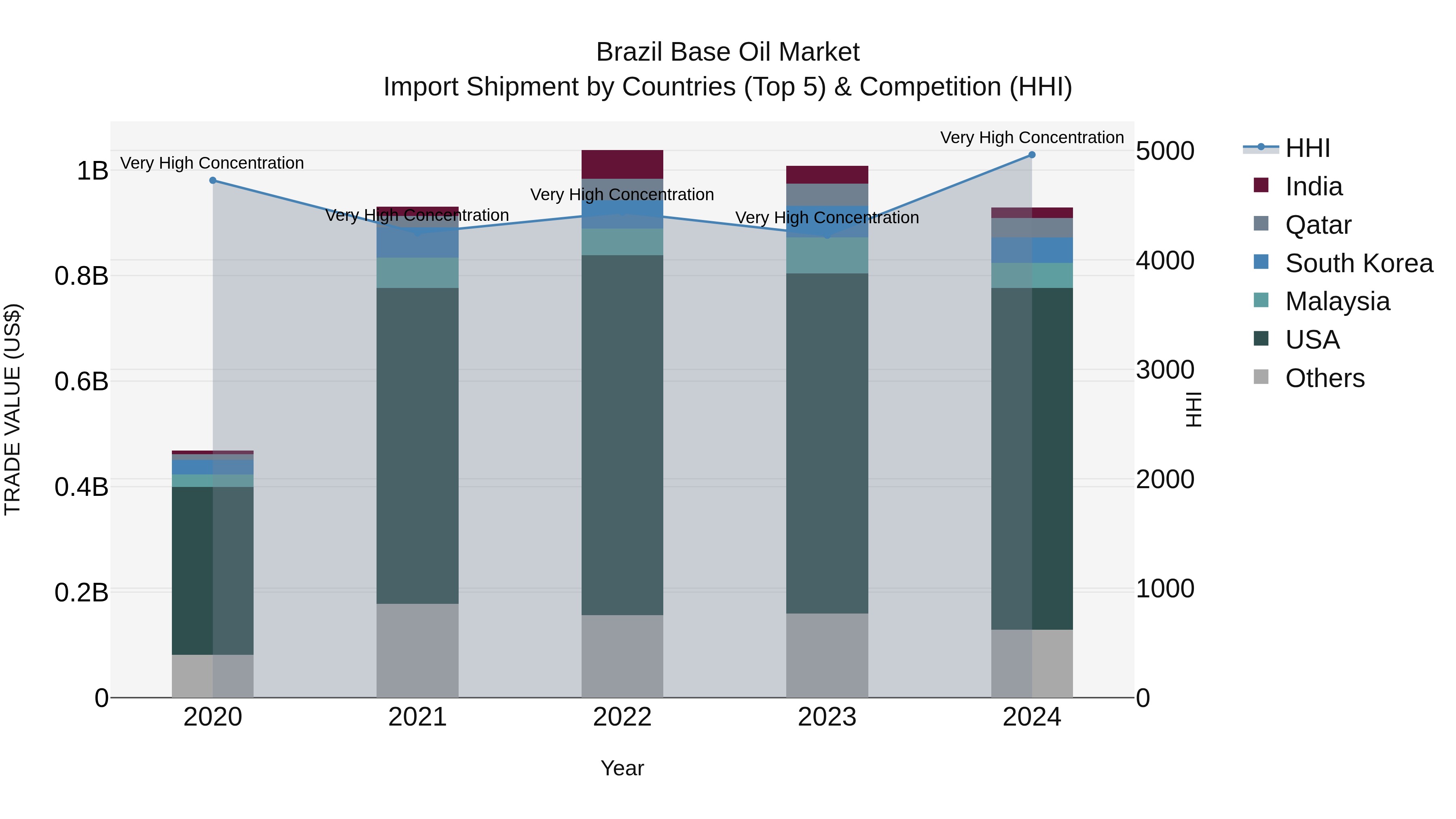
Brazil`s base oil import shipments in 2024 continued to be dominated by key exporting countries such as the USA, South Korea, Malaysia, Bahrain, and Qatar. Despite a high Herfindahl-Hirschman Index (HHI) indicating market concentration, the compound annual growth rate (CAGR) from 2020 to 2024 was strong at 18.68%. However, there was a slight decline in growth rate from 2023 to 2024, with a -7.81% decrease. The market dynamics suggest a competitive landscape with potential shifts in trade patterns in the base oil industry.
Brazil Base Oil Market Overview
The Brazil base oil market is witnessing steady growth driven by the expanding automotive and industrial sectors. The country`s robust economic growth and increasing demand for lubricants in various industries are key factors driving market expansion. Additionally, stringent regulations mandating the use of high-quality base oils in lubricant formulations are further boosting market growth. The market is characterized by the presence of major players and a competitive landscape, leading to innovations in product offerings and pricing strategies. The growing trend towards synthetic and bio-based base oils is expected to further propel market growth in the coming years. Overall, the Brazil base oil market is poised for continued expansion, driven by increasing industrial activities and technological advancements in the sector.
Brazil Base Oil Market Trends and Opportunities
The Brazil Base Oil Market is experiencing growth due to the increasing demand for lubricants in various industries such as automotive, manufacturing, and construction. The trend towards the use of high-quality base oils for improved performance and efficiency is driving market growth. Additionally, the focus on sustainability and environmental regulations is creating opportunities for bio-based and recycled base oils in the market. The shift towards synthetic base oils to meet the growing demand for advanced lubricants is another key trend. With the expanding automotive industry and infrastructure development projects in Brazil, there is a significant opportunity for base oil manufacturers to innovate and offer products that align with industry trends and regulations, thus positioning themselves for success in the market.
Brazil Base Oil Market Challenges
In the Brazil base oil market, several challenges are faced, including fluctuating crude oil prices, increasing competition from imported base oils, and regulatory uncertainties. The volatility in crude oil prices directly impacts the cost of base oils, leading to uncertainties in pricing and profit margins for market players. The influx of imported base oils, especially from countries with lower production costs, poses a significant challenge for local manufacturers in Brazil. Additionally, the regulatory landscape in Brazil can be complex and subject to changes, which creates uncertainty and compliance challenges for base oil producers. Addressing these challenges requires market players to adapt quickly, innovate in production processes, and establish strong relationships with suppliers and regulatory bodies to ensure competitiveness and compliance in the Brazil base oil market.
Brazil Base Oil Market Drivers
The Brazil Base Oil Market is primarily driven by the increasing demand for lubricants in various industries such as automotive, manufacturing, and construction. The growth of these industries, coupled with the rising automotive sales in the country, is fueling the demand for base oils as a key component in lubricant production. Additionally, the increasing focus on energy efficiency and sustainability is leading to the development of high-performance base oils that offer better fuel economy and reduced emissions. Furthermore, the expanding aftermarket for automotive lubricants and the growing awareness about the importance of regular maintenance are also driving the demand for base oils in Brazil. Overall, the market is expected to continue growing as industries strive for improved efficiency and performance in their operations.
Brazil Base Oil Market Government Policy
In Brazil, government policies related to the Base Oil Market are primarily aimed at promoting domestic production, reducing dependency on imports, and ensuring environmental sustainability. The government has implemented measures such as tax incentives for local production, import tariffs on foreign base oil products, and regulations to promote the use of environmentally friendly base oils. Additionally, there are initiatives in place to encourage investment in research and development for the production of high-quality base oils in the country. These policies are designed to support the growth of the domestic base oil industry, enhance energy security, and minimize the environmental impact of base oil production and consumption in Brazil.
Brazil Base Oil Market Future Outlook
The Brazil Base Oil Market is expected to witness steady growth in the coming years due to increasing demand from end-use industries such as automotive, industrial machinery, and chemicals. The country`s expanding automotive sector, coupled with growing industrial activities, will drive the demand for base oils used in lubricants and greases. Additionally, the government`s initiatives to promote sustainable practices and the adoption of high-performance lubricants are likely to further boost market growth. However, challenges such as fluctuating crude oil prices and environmental concerns regarding the disposal of used oils may impact market dynamics. Overall, the Brazil Base Oil Market is anticipated to experience moderate growth, with key players focusing on product innovation and strategic partnerships to maintain a competitive edge.
Key Highlights of the Report:
- Brazil Base Oil Market Outlook
- Market Size of Brazil Base Oil Market, 2024
- Forecast of Brazil Base Oil Market, 2031
- Historical Data and Forecast of Brazil Base Oil Revenues & Volume for the Period 2021 - 2031
- Brazil Base Oil Market Trend Evolution
- Brazil Base Oil Market Drivers and Challenges
- Brazil Base Oil Price Trends
- Brazil Base Oil Porter's Five Forces
- Brazil Base Oil Industry Life Cycle
- Historical Data and Forecast of Brazil Base Oil Market Revenues & Volume By Group for the Period 2021 - 2031
- Historical Data and Forecast of Brazil Base Oil Market Revenues & Volume By Group I for the Period 2021 - 2031
- Historical Data and Forecast of Brazil Base Oil Market Revenues & Volume By Group II for the Period 2021 - 2031
- Historical Data and Forecast of Brazil Base Oil Market Revenues & Volume By Group III for the Period 2021 - 2031
- Historical Data and Forecast of Brazil Base Oil Market Revenues & Volume By Group IV for the Period 2021 - 2031
- Historical Data and Forecast of Brazil Base Oil Market Revenues & Volume By Group V for the Period 2021 - 2031
- Historical Data and Forecast of Brazil Base Oil Market Revenues & Volume By Application for the Period 2021 - 2031
- Historical Data and Forecast of Brazil Base Oil Market Revenues & Volume By Automotive Oil for the Period 2021 - 2031
- Historical Data and Forecast of Brazil Base Oil Market Revenues & Volume By Industrial Oil for the Period 2021 - 2031
- Historical Data and Forecast of Brazil Base Oil Market Revenues & Volume By Hydraulic Oil for the Period 2021 - 2031
- Historical Data and Forecast of Brazil Base Oil Market Revenues & Volume By Grease for the Period 2021 - 2031
- Historical Data and Forecast of Brazil Base Oil Market Revenues & Volume By Metalworking Fluid for the Period 2021 - 2031
- Brazil Base Oil Import Export Trade Statistics
- Market Opportunity Assessment By Group
- Market Opportunity Assessment By Application
- Brazil Base Oil Top Companies Market Share
- Brazil Base Oil Competitive Benchmarking By Technical and Operational Parameters
- Brazil Base Oil Company Profiles
- Brazil Base Oil Key Strategic Recommendations






































