Brazil Cornmeal Market Top 5 Importing Countries and Market Competition (HHI) Analysis
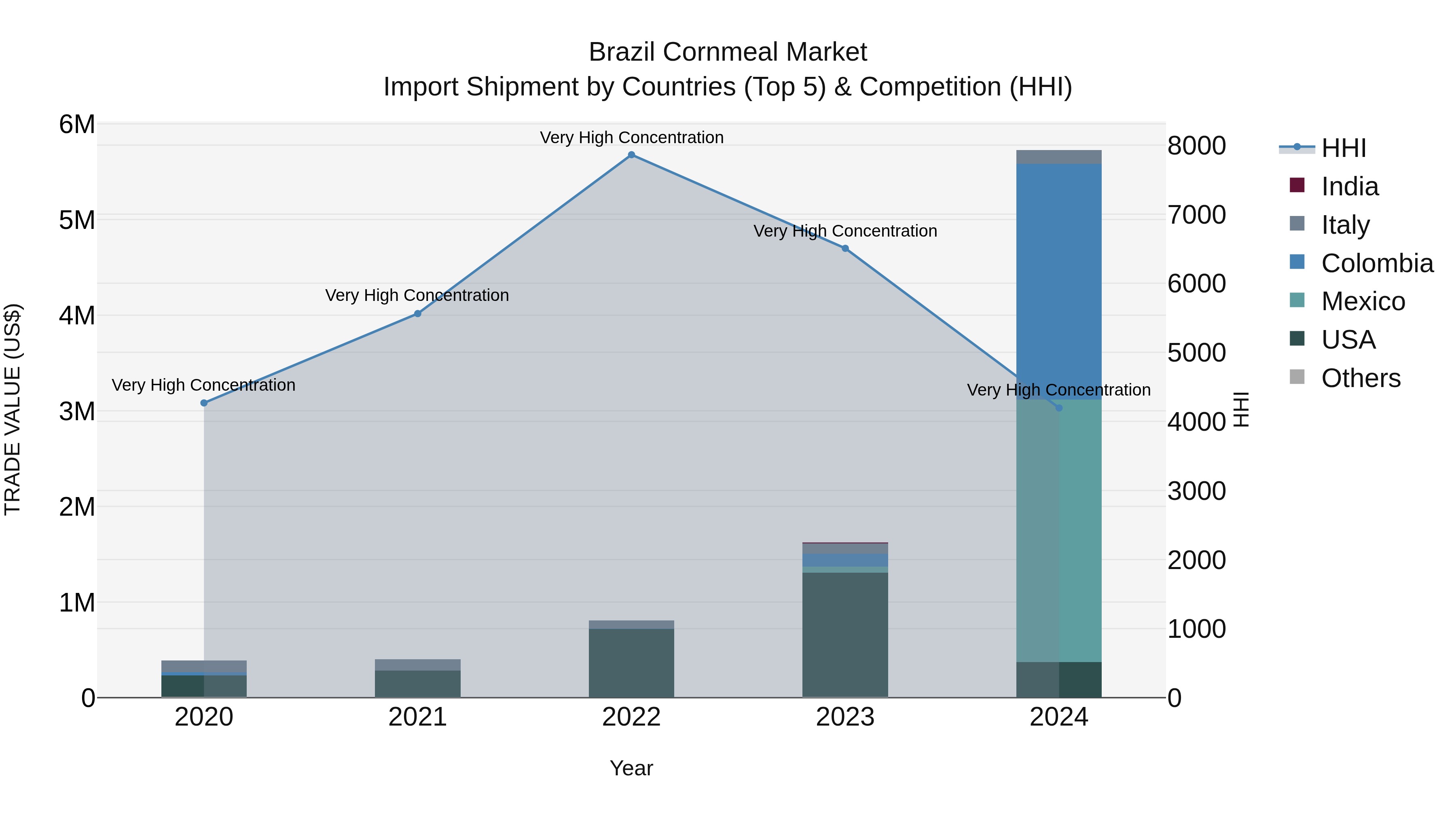
Brazil`s cornmeal import shipments in 2024 continued to be dominated by top exporters such as Mexico, Colombia, USA, Italy, and Argentina. The High Herfindahl-Hirschman Index (HHI) indicates a very high level of market concentration, suggesting limited competition among suppliers. The impressive compound annual growth rate (CAGR) of 95.75% from 2020 to 2024 highlights the robust demand for cornmeal in Brazil. Moreover, the remarkable growth rate of 252.99% from 2023 to 2024 indicates a significant surge in import volumes, reflecting the evolving market dynamics and consumer preferences in the country.
Brazil Cornmeal Market Overview
The Brazil cornmeal market is experiencing steady growth driven by the increasing demand for traditional Brazilian dishes like "farofa" and "pamonha." Cornmeal, known as "fubá" in Brazil, is a staple ingredient in the country`s culinary culture. The market is also benefiting from the rising consumer awareness of the nutritional benefits of cornmeal, such as its gluten-free properties and high fiber content. Additionally, the versatile nature of cornmeal allows for its usage in a wide range of food products, from savory to sweet. With a strong agricultural sector supporting corn production in Brazil, the availability of high-quality corn for cornmeal production is abundant, further fueling market growth. Domestic consumption remains the primary driver of the Brazil cornmeal market, but there is also potential for export opportunities as the product gains popularity internationally.
Brazil Cornmeal Market Trends
In the Brazil cornmeal market, there is a growing trend towards the consumption of organic and non-GMO cornmeal products. Consumers are increasingly seeking healthier and more sustainable food options, leading to a rise in demand for organic and non-genetically modified cornmeal. Additionally, there is a growing interest in traditional and regional Brazilian cornmeal varieties, as consumers look to support local producers and preserve cultural culinary practices. Convenience and ready-to-cook cornmeal products are also gaining popularity among busy urban consumers. Overall, the market is witnessing a shift towards more diverse product offerings that cater to various consumer preferences, including health-conscious, environmentally conscious, and convenience-seeking individuals.
Brazil Cornmeal Market Challenges
The Brazil cornmeal market faces several challenges, including fluctuations in corn prices, which can impact production costs and profit margins for manufacturers. Additionally, competition from other staple food products in the market, such as rice and wheat, poses a challenge in terms of market share and consumer preferences. Logistics and transportation issues, including infrastructure limitations and distribution inefficiencies, can also hinder the growth and distribution of cornmeal products across the country. Furthermore, changing consumer dietary preferences towards healthier and more diverse food options present a challenge for cornmeal products to remain relevant and attractive in the market. Overall, addressing these challenges through strategic pricing, marketing, and product development efforts will be crucial for companies operating in the Brazil cornmeal market.
Brazil Cornmeal Market Investment Opportunities
Investment opportunities in the Brazilian cornmeal market are promising due to the high consumer demand for this staple food product. With Brazil being one of the world`s largest corn producers, investing in cornmeal production facilities or partnering with existing producers could be lucrative. Additionally, there is potential for innovation and diversification within the cornmeal market by introducing new flavors or packaging options to cater to changing consumer preferences. As the Brazilian economy continues to grow, investing in the cornmeal market can provide stable returns and opportunities for expansion both domestically and for export markets. Overall, the cornmeal market in Brazil presents attractive investment prospects for those looking to capitalize on the country`s agricultural strengths and consumer demand for this essential product.
Brazil Cornmeal Market Government Policy
The government policies related to the Brazil cornmeal market include regulations on production, trade, and pricing. The Brazilian government provides support to corn farmers through subsidies and incentives to promote production. Additionally, there are import tariffs imposed on foreign cornmeal to protect domestic producers. The government also regulates the quality standards of cornmeal to ensure consumer safety. Price controls may be implemented to stabilize market prices and prevent inflation. Overall, government policies in Brazil aim to support domestic corn producers, ensure food security, and regulate the cornmeal market to maintain stability and fair competition.
Brazil Cornmeal Market Future Outlook
The future outlook for the Brazil cornmeal market appears promising due to several factors. The increasing adoption of corn-based products in the country`s culinary culture, coupled with the growing demand for gluten-free and versatile ingredients, is expected to drive the market growth. Additionally, the rise in disposable income levels and changing consumer preferences towards healthier food options are likely to further boost the demand for cornmeal products. Furthermore, the expanding food processing industry in Brazil presents opportunities for cornmeal manufacturers to diversify their product offerings and cater to a wider customer base. With ongoing innovations in product development and marketing strategies, the Brazil cornmeal market is anticipated to witness steady growth in the coming years.
Key Highlights of the Report:
- Brazil Cornmeal Market Outlook
- Market Size of Brazil Cornmeal Market,2024
- Forecast of Brazil Cornmeal Market, 2031
- Historical Data and Forecast of Brazil Cornmeal Revenues & Volume for the Period 2021-2031
- Brazil Cornmeal Market Trend Evolution
- Brazil Cornmeal Market Drivers and Challenges
- Brazil Cornmeal Price Trends
- Brazil Cornmeal Porter's Five Forces
- Brazil Cornmeal Industry Life Cycle
- Historical Data and Forecast of Brazil Cornmeal Market Revenues & Volume By Type for the Period 2021-2031
- Historical Data and Forecast of Brazil Cornmeal Market Revenues & Volume By Yellow Cornmeal for the Period 2021-2031
- Historical Data and Forecast of Brazil Cornmeal Market Revenues & Volume By White Cornmeal for the Period 2021-2031
- Historical Data and Forecast of Brazil Cornmeal Market Revenues & Volume By Blue Cornmeal for the Period 2021-2031
- Historical Data and Forecast of Brazil Cornmeal Market Revenues & Volume By Others for the Period 2021-2031
- Historical Data and Forecast of Brazil Cornmeal Market Revenues & Volume By Processing Method for the Period 2021-2031
- Historical Data and Forecast of Brazil Cornmeal Market Revenues & Volume By Stone-Ground for the Period 2021-2031
- Historical Data and Forecast of Brazil Cornmeal Market Revenues & Volume By Steel-Ground for the Period 2021-2031
- Historical Data and Forecast of Brazil Cornmeal Market Revenues & Volume By Organic for the Period 2021-2031
- Historical Data and Forecast of Brazil Cornmeal Market Revenues & Volume By Others for the Period 2021-2031
- Historical Data and Forecast of Brazil Cornmeal Market Revenues & Volume By Application for the Period 2021-2031
- Historical Data and Forecast of Brazil Cornmeal Market Revenues & Volume By Bakery for the Period 2021-2031
- Historical Data and Forecast of Brazil Cornmeal Market Revenues & Volume By Snacks for the Period 2021-2031
- Historical Data and Forecast of Brazil Cornmeal Market Revenues & Volume By Industrial Use for the Period 2021-2031
- Historical Data and Forecast of Brazil Cornmeal Market Revenues & Volume By Others for the Period 2021-2031
- Historical Data and Forecast of Brazil Cornmeal Market Revenues & Volume By End User for the Period 2021-2031
- Historical Data and Forecast of Brazil Cornmeal Market Revenues & Volume By Households for the Period 2021-2031
- Historical Data and Forecast of Brazil Cornmeal Market Revenues & Volume By Restaurants for the Period 2021-2031
- Historical Data and Forecast of Brazil Cornmeal Market Revenues & Volume By Food Manufacturers for the Period 2021-2031
- Historical Data and Forecast of Brazil Cornmeal Market Revenues & Volume By Others for the Period 2021-2031
- Historical Data and Forecast of Brazil Cornmeal Market Revenues & Volume By Distribution Channel for the Period 2021-2031
- Historical Data and Forecast of Brazil Cornmeal Market Revenues & Volume By Retail for the Period 2021-2031
- Historical Data and Forecast of Brazil Cornmeal Market Revenues & Volume By Wholesale for the Period 2021-2031
- Historical Data and Forecast of Brazil Cornmeal Market Revenues & Volume By Direct Sales for the Period 2021-2031
- Historical Data and Forecast of Brazil Cornmeal Market Revenues & Volume By Others for the Period 2021 - 2029
- Brazil Cornmeal Import Export Trade Statistics
- Market Opportunity Assessment By Type
- Market Opportunity Assessment By Processing Method
- Market Opportunity Assessment By Application
- Market Opportunity Assessment By End User
- Market Opportunity Assessment By Distribution Channel
- Brazil Cornmeal Top Companies Market Share
- Brazil Cornmeal Competitive Benchmarking By Technical and Operational Parameters
- Brazil Cornmeal Company Profiles
- Brazil Cornmeal Key Strategic Recommendations






































