Brazil Feed Enzymes Market Top 5 Importing Countries and Market Competition (HHI) Analysis
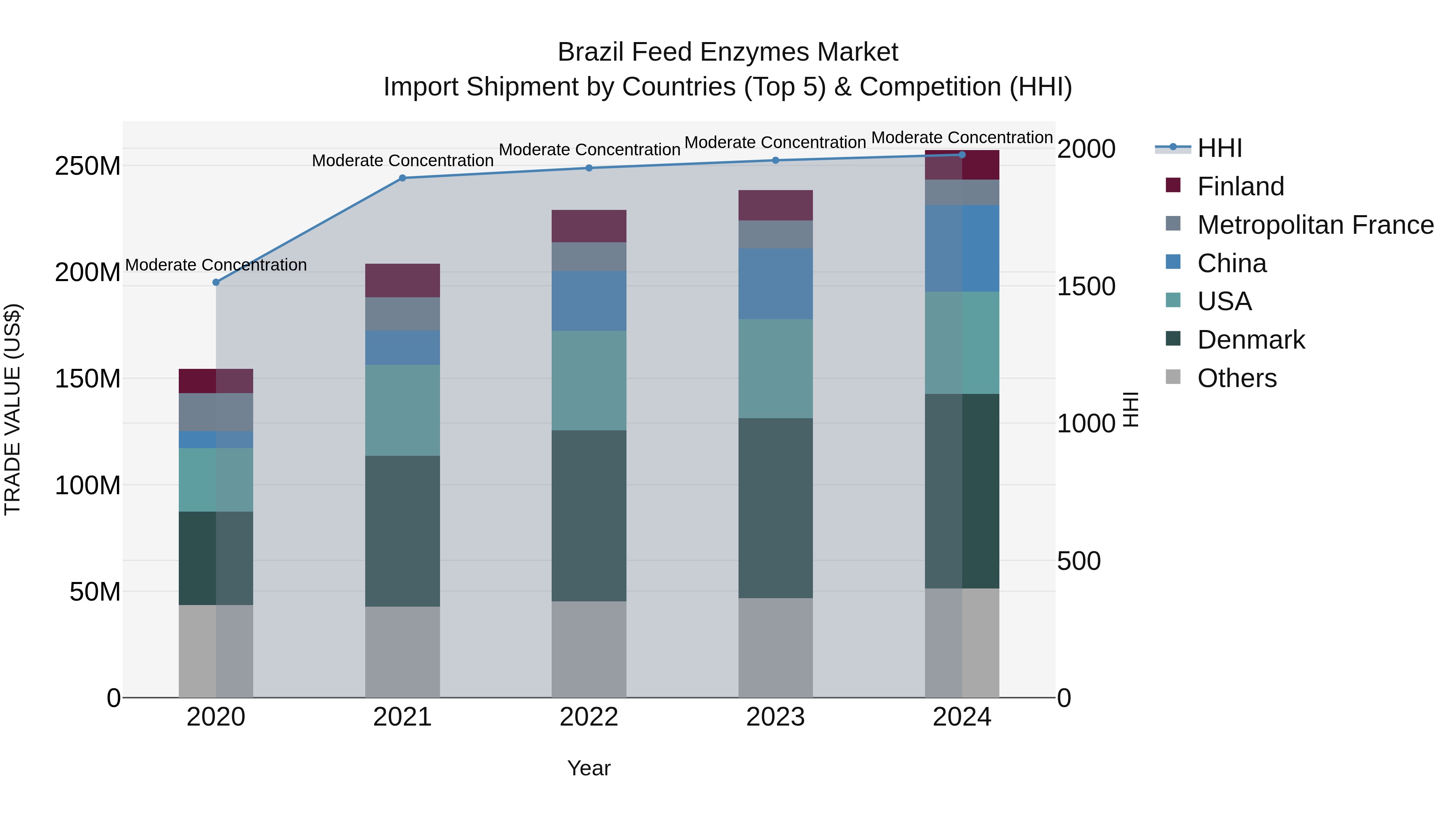
In 2024, Brazil saw a notable increase in feed enzymes import shipments, with Denmark, USA, China, Argentina, and Finland emerging as the top exporting countries. The market displayed moderate concentration levels, indicating a competitive landscape. The compound annual growth rate (CAGR) from 2020 to 2024 was strong at 13.59%, with a continued growth rate of 7.88% in 2024. This data suggests a growing demand for feed enzymes in Brazil, driven by quality products from key global suppliers.
Brazil Feed Enzymes Market Overview
The feed enzymes market in Brazil is experiencing growth as livestock producers seek solutions to improve feed digestibility and nutrient utilization. Feed enzymes such as carbohydrases and proteases break down complex feed components, enhancing nutrient absorption and feed efficiency in animals.
Drivers of the market
In Brazil, the Feed Enzymes market is influenced by the increasing demand for animal protein, expansion of intensive animal farming, and the need for improving feed efficiency and nutrient utilization. Feed enzymes are biological catalysts added to animal feeds to break down complex nutrients such as carbohydrates, proteins, and fats, enhancing digestion and nutrient absorption in animals. With the growing concerns about feed costs, environmental sustainability, and the need for reducing nutrient waste, the demand for feed enzymes is expected to rise in Brazil. Moreover, advancements in enzyme production technologies, enzyme stability, and application methods further contribute to market growth by improving feed efficiency and animal performance.
Challenges of the market
Challenges in the Brazil feed enzymes market include ensuring stability and efficacy of enzyme formulations in feed processing and digestion, addressing variability in enzyme activity and substrate specificity, managing the cost-effectiveness of enzyme supplementation, and providing education and support on enzyme use for improving nutrient utilization and animal performance.
Government Policy of the market
Brazil government regulations addressing feed efficiency, nutrient utilization, and environmental sustainability have influenced the feed enzymes market. Compliance with regulatory requirements for feed enzyme use, feed additive labeling standards, and environmental impact assessments has driven the demand for feed enzymes among feed manufacturers, livestock producers, and animal nutritionists in Brazil.
Key Highlights of the Report:
- Brazil Feed Enzymes Market Outlook
- Market Size of Brazil Feed Enzymes Market, 2024
- Forecast of Brazil Feed Enzymes Market, 2031
- Historical Data and Forecast of Brazil Feed Enzymes Revenues & Volume for the Period 2021-2031
- Brazil Feed Enzymes Market Trend Evolution
- Brazil Feed Enzymes Market Drivers and Challenges
- Brazil Feed Enzymes Price Trends
- Brazil Feed Enzymes Porter's Five Forces
- Brazil Feed Enzymes Industry Life Cycle
- Historical Data and Forecast of Brazil Feed Enzymes Market Revenues & Volume By Type for the Period 2021-2031
- Historical Data and Forecast of Brazil Feed Enzymes Market Revenues & Volume By Phytase for the Period 2021-2031
- Historical Data and Forecast of Brazil Feed Enzymes Market Revenues & Volume By Carbohydrase for the Period 2021-2031
- Historical Data and Forecast of Brazil Feed Enzymes Market Revenues & Volume By Protease for the Period 2021-2031
- Historical Data and Forecast of Brazil Feed Enzymes Market Revenues & Volume By Livestock for the Period 2021-2031
- Historical Data and Forecast of Brazil Feed Enzymes Market Revenues & Volume By Poultry for the Period 2021-2031
- Historical Data and Forecast of Brazil Feed Enzymes Market Revenues & Volume By Swine for the Period 2021-2031
- Historical Data and Forecast of Brazil Feed Enzymes Market Revenues & Volume By Ruminants for the Period 2021-2031
- Historical Data and Forecast of Brazil Feed Enzymes Market Revenues & Volume By Aquatic Animals for the Period 2021-2031
- Historical Data and Forecast of Brazil Feed Enzymes Market Revenues & Volume By Source for the Period 2021-2031
- Historical Data and Forecast of Brazil Feed Enzymes Market Revenues & Volume By Microorganism for the Period 2021-2031
- Historical Data and Forecast of Brazil Feed Enzymes Market Revenues & Volume By Plant for the Period 2021-2031
- Historical Data and Forecast of Brazil Feed Enzymes Market Revenues & Volume By Animal for the Period 2021-2031
- Brazil Feed Enzymes Import Export Trade Statistics
- Market Opportunity Assessment By Type
- Market Opportunity Assessment By Livestock
- Market Opportunity Assessment By Source
- Brazil Feed Enzymes Top Companies Market Share
- Brazil Feed Enzymes Competitive Benchmarking By Technical and Operational Parameters
- Brazil Feed Enzymes Company Profiles
- Brazil Feed Enzymes Key Strategic Recommendations






































