Brazil Ferrochrome Market Growth Rate Analysis (2021-2031)
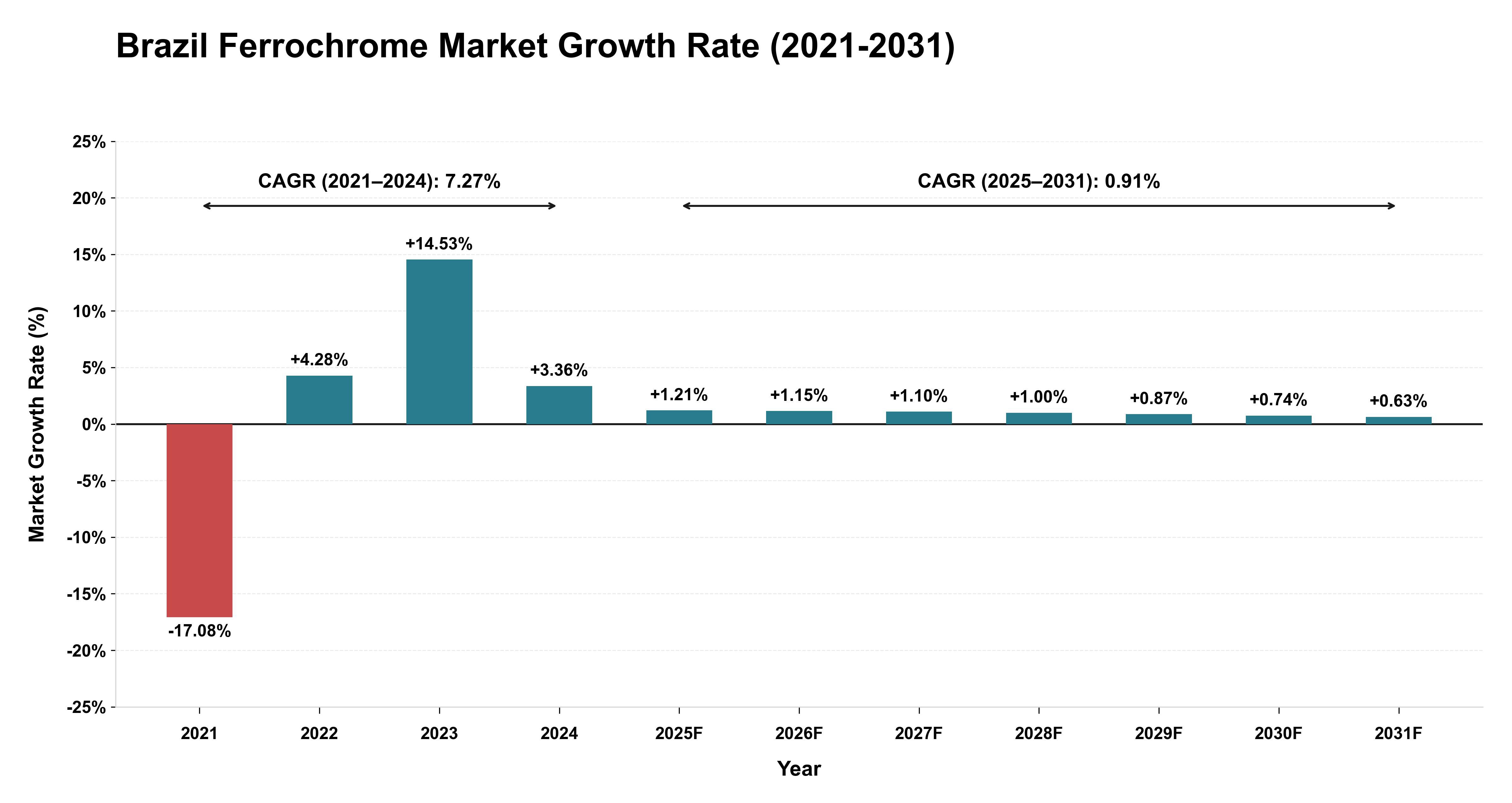
The Brazil Ferrochrome market experienced a tumultuous period from 2021 to 2024, characterized by a notable contraction in 2021 followed by a gradual recovery in the subsequent years, with growth rates of 4.28%, 14.53%, and 3.36% respectively. This fluctuation can be attributed to external shocks and market adjustments. Looking forward to the forecast period from 2025 to 2031, the sector is anticipated to stabilize, with a much lower but positive CAGR of 0.91%. This indicates a phase of consolidation and maturity within the market as it transitions towards a more sustainable growth trajectory. Factors such as evolving global demand patterns, technological advancements, and regulatory changes are expected to influence the future landscape of the Brazil Ferrochrome market, fostering modest yet steady growth over the forecast horizon.
Brazil Ferrochrome Market Overview
The Ferrochrome market in Brazil has witnessed significant growth in recent years. As a crucial alloy in the production of stainless steel, ferrochrome plays a pivotal role in the country`s industrial sector. Brazil abundant chromite ore reserves contribute to the thriving ferrochrome market, making it a key player in the global stainless steel supply chain.
Drivers of the market
The Brazil Ferrochrome market is witnessing robust growth driven by the increasing demand from the stainless steel industry. The country`s thriving construction and infrastructure sectors are major contributors, as stainless steel finds extensive use in these applications. Additionally, the rise in manufacturing activities and the automotive industry further fuels the demand for ferrochrome, as it is a vital alloying agent in the production of high-strength steel.
Challenges of the market
The Brazil Ferrochrome market has witnessed steady growth, driven by the country`s robust industrial sector. However, challenges persist in the form of fluctuating global demand and raw material prices. The market is also sensitive to geopolitical factors that influence trade dynamics. Ensuring a stable supply chain for raw materials and addressing environmental concerns associated with ferrochrome production are key challenges faced by stakeholders.
Government Policy of the market
The ferrochrome market in Brazil has witnessed significant growth in recent years. With a rising demand for stainless steel, the production and consumption of ferrochrome have increased. Government policies have played a role in supporting this industry, with initiatives to boost mining and metallurgical activities. The Brazil government has implemented measures to streamline regulatory processes and encourage investments in the ferrochrome sector.
Key Highlights of the Report:
- Brazil Ferrochrome Market Outlook
- Market Size of Brazil Ferrochrome Market, 2024
- Forecast of Brazil Ferrochrome Market, 2031
- Historical Data and Forecast of Brazil Ferrochrome Revenues & Volume for the Period 2018 - 2031
- Brazil Ferrochrome Market Trend Evolution
- Brazil Ferrochrome Market Drivers and Challenges
- Brazil Ferrochrome Price Trends
- Brazil Ferrochrome Porter's Five Forces
- Brazil Ferrochrome Industry Life Cycle
- Historical Data and Forecast of Brazil Ferrochrome Market Revenues & Volume By Type for the Period 2018 - 2031
- Historical Data and Forecast of Brazil Ferrochrome Market Revenues & Volume By High carbon for the Period 2018 - 2031
- Historical Data and Forecast of Brazil Ferrochrome Market Revenues & Volume By Medium carbon for the Period 2018 - 2031
- Historical Data and Forecast of Brazil Ferrochrome Market Revenues & Volume By Low carbon for the Period 2018 - 2031
- Historical Data and Forecast of Brazil Ferrochrome Market Revenues & Volume By Applications for the Period 2018 - 2031
- Historical Data and Forecast of Brazil Ferrochrome Market Revenues & Volume By Stainless steel for the Period 2018 - 2031
- Historical Data and Forecast of Brazil Ferrochrome Market Revenues & Volume By Other steels for the Period 2018 - 2031
- Brazil Ferrochrome Import Export Trade Statistics
- Market Opportunity Assessment By Type
- Market Opportunity Assessment By Applications
- Brazil Ferrochrome Top Companies Market Share
- Brazil Ferrochrome Competitive Benchmarking By Technical and Operational Parameters
- Brazil Ferrochrome Company Profiles
- Brazil Ferrochrome Key Strategic Recommendations






































