Brazil Gas Market Top 5 Importing Countries and Market Competition (HHI) Analysis
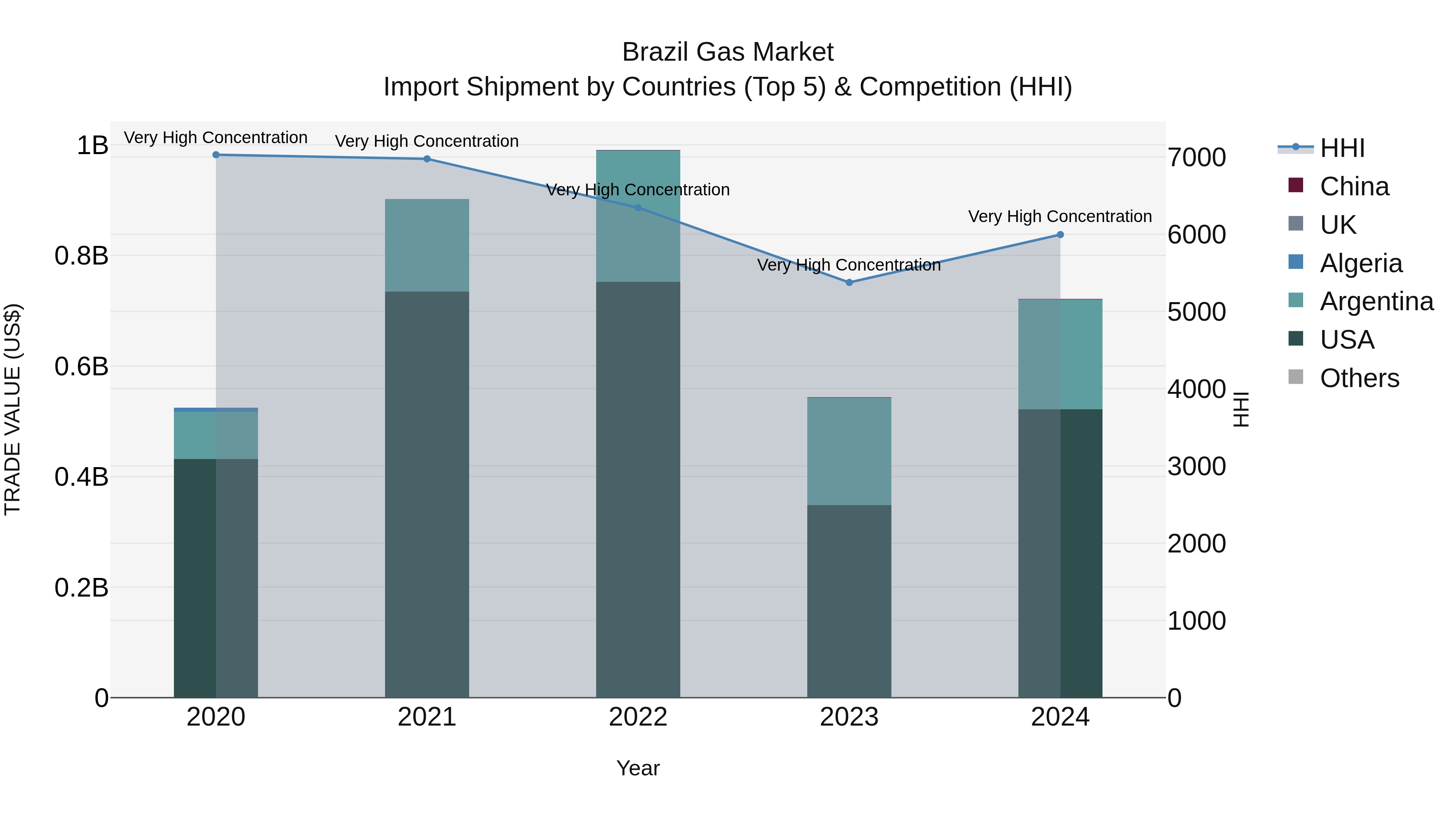
In 2024, Brazil`s gas import market continued to be dominated by top exporters such as the USA, Argentina, China, Italy, and South Korea. The market concentration, as measured by the Herfindahl-Hirschman Index (HHI), remained very high throughout the year. With a notable Compound Annual Growth Rate (CAGR) of 8.28% from 2020 to 2024, the industry experienced significant expansion. Moreover, the impressive growth rate of 32.74% from 2023 to 2024 indicates the thriving demand for gas imports in Brazil, highlighting opportunities for market players to capitalize on this upward trajectory.
Brazil Gas Market Synopsis
The Brazil gas market is a dynamic and rapidly evolving sector characterized by a mix of domestic production, imports, and distribution. Petrobras, the state-owned oil company, plays a significant role in gas production and distribution, but the market is also open to private and international companies. Natural gas is a crucial energy source for power generation, industry, and residential consumption in Brazil. The country has been investing in expanding its gas infrastructure, including pipelines and liquefied natural gas (LNG) terminals, to meet growing demand and improve supply reliability. Regulatory reforms have aimed to promote competition and attract investment in the sector, fostering a more competitive market environment. Brazil`s strategic location and abundant natural gas resources position it as a key player in the regional gas market.
Brazil Gas Market Trends
The Brazil gas market is currently experiencing several key trends and opportunities. One major trend is the increasing focus on natural gas as a cleaner alternative to traditional fossil fuels, driven by environmental concerns and government initiatives. Another trend is the growing demand for natural gas in various sectors such as power generation, industrial applications, and transportation. This has led to opportunities for investment in infrastructure development, including pipelines and storage facilities. Additionally, the discovery of offshore gas reserves presents opportunities for exploration and production companies to expand their operations in Brazil. Overall, the Brazil gas market is expected to continue evolving, offering opportunities for companies to capitalize on the country`s growing demand for natural gas and its potential as a key player in the global energy market.
Brazil Gas Market Challenges
The Brazil Gas Market faces several challenges, including regulatory barriers that hinder market competition and investment, an aging infrastructure that requires significant modernization and maintenance, and a heavy reliance on natural gas imports which can be affected by global price fluctuations and supply disruptions. Additionally, political instability and economic uncertainties in the country can impact the overall market dynamics and investment decisions. Environmental concerns and the need to transition towards cleaner energy sources also present challenges for the gas market in Brazil, as there is a growing demand for sustainable and renewable energy solutions. Overall, addressing these challenges will require a coordinated effort from government agencies, industry stakeholders, and investors to ensure a stable and sustainable gas market in Brazil.
Brazil Gas Market Investment Opportunities
The Brazil Gas Market is primarily driven by factors such as increasing energy demand, economic growth, industrialization, and urbanization. The country`s growing population and expanding middle class are fueling higher energy consumption levels, with natural gas being a cleaner alternative to traditional fossil fuels. Government initiatives to promote natural gas usage, such as tax incentives and infrastructure development projects, are also driving market growth. Additionally, Brazil`s abundant offshore gas reserves and the discovery of new gas fields are contributing to the market`s expansion. The shift towards cleaner energy sources and the need to reduce carbon emissions are further driving the demand for natural gas in Brazil, making it a key player in the country`s energy landscape.
Brazil Gas Market Government Polices
Government policies related to the Brazil Gas Market include the Gas Law, which aims to promote competition, attract investments, and increase the efficiency of the gas sector. The Gas Law establishes a legal framework for natural gas exploration, production, transportation, and distribution, allowing private companies to participate in these activities alongside state-owned Petrobras. Additionally, the government has implemented the Gas-to-Grow program to stimulate demand for natural gas in various sectors, such as industry, transportation, and power generation. These policies aim to diversify the energy mix, increase energy security, and reduce greenhouse gas emissions by promoting the use of natural gas as a cleaner alternative to other fossil fuels in Brazil.
Brazil Gas Market Future Outlook
The future outlook for the Brazil Gas Market appears promising, with steady growth expected in the coming years. Factors such as the country`s abundant natural gas reserves, increasing demand for cleaner energy sources, and ongoing investments in infrastructure development are likely to drive market expansion. The discovery of new offshore gas fields and the government`s efforts to attract foreign investment in the sector are also anticipated to contribute to the market`s growth. Additionally, Brazil`s commitment to reducing carbon emissions and transitioning towards a more sustainable energy mix bodes well for the gas market`s prospects. Overall, the Brazil Gas Market is poised for continued advancement and presents opportunities for both domestic and international players in the industry.
Key Highlights of the Report:
- Brazil Gas Market Outlook
- Market Size of Brazil Gas Market, 2024
- Forecast of Brazil Gas Market, 2031
- Historical Data and Forecast of Brazil Gas Revenues & Volume for the Period 2021- 2031
- Brazil Gas Market Trend Evolution
- Brazil Gas Market Drivers and Challenges
- Brazil Gas Price Trends
- Brazil Gas Porter's Five Forces
- Brazil Gas Industry Life Cycle
- Historical Data and Forecast of Brazil Gas Market Revenues & Volume By Application for the Period 2021- 2031
- Historical Data and Forecast of Brazil Gas Market Revenues & Volume By Utilities for the Period 2021- 2031
- Historical Data and Forecast of Brazil Gas Market Revenues & Volume By Industrial for the Period 2021- 2031
- Historical Data and Forecast of Brazil Gas Market Revenues & Volume By Commercial for the Period 2021- 2031
- Brazil Gas Import Export Trade Statistics
- Market Opportunity Assessment By Application
- Brazil Gas Top Companies Market Share
- Brazil Gas Competitive Benchmarking By Technical and Operational Parameters
- Brazil Gas Company Profiles
- Brazil Gas Key Strategic Recommendations






































