Brazil Industrial Chain Market Top 5 Importing Countries and Market Competition (HHI) Analysis
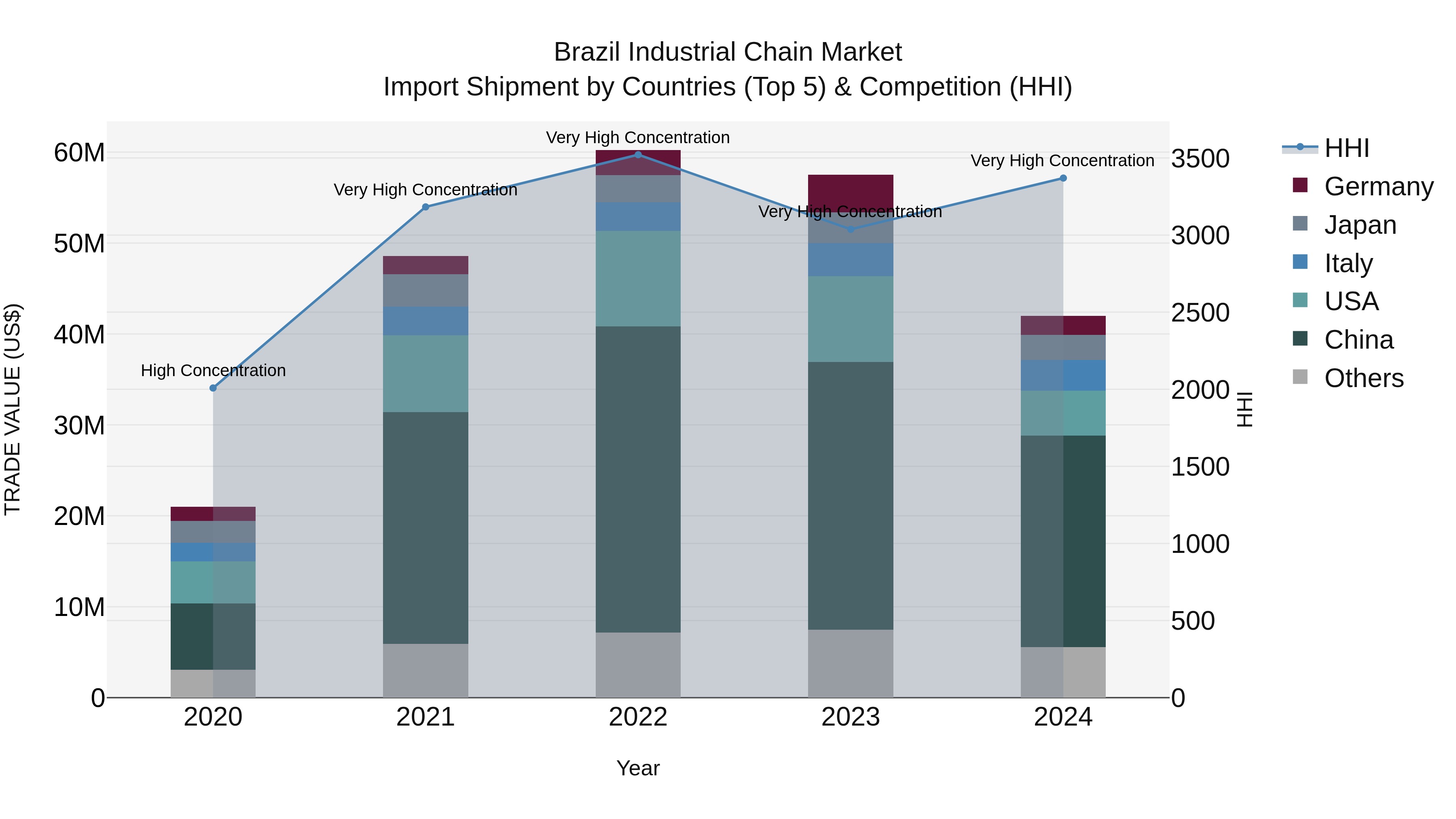
In 2024, Brazil`s industrial chain import shipments continued to be dominated by top exporters like China, USA, Italy, Japan, and Germany. Despite the high concentration with a very high HHI, the industry saw impressive growth with a CAGR of 18.95% from 2020 to 2024. However, there was a notable decline in growth rate from 2023 to 2024 at -26.94%. This indicates a potential shift in the market dynamics or external factors impacting the industrial chain import sector in Brazil. Stakeholders should closely monitor these trends for strategic decision-making.
Brazil Industrial Chain Market Market Overview
The industrial chain market in Brazil is diverse and robust, encompassing various sectors such as manufacturing, mining, agriculture, and construction. The country`s industrial chain is intricately connected, with raw materials being sourced from mining and agriculture sectors, processed in manufacturing facilities, and then distributed to construction projects and other industries. Key industries within the industrial chain include automotive, steel, petrochemicals, and food processing. Brazil`s industrial chain faces challenges such as infrastructure limitations, bureaucratic hurdles, and economic fluctuations. However, the market also presents opportunities for growth and innovation, particularly in sectors like renewable energy, technology, and sustainable manufacturing practices. Overall, the industrial chain market in Brazil offers a mix of challenges and opportunities for businesses looking to invest and operate in the country.
Brazil Industrial Chain Market Trends
In the Brazil industrial chain market, there are several notable trends emerging. One significant trend is the increasing adoption of advanced manufacturing technologies such as automation, robotics, and artificial intelligence to enhance efficiency and productivity. Companies are also focusing on sustainable practices and environmentally friendly processes to meet regulatory requirements and consumer demands for eco-conscious products. Additionally, there is a growing emphasis on supply chain resilience and risk management in response to external disruptions such as the COVID-19 pandemic. Digital transformation is playing a key role in streamlining operations and improving decision-making processes. Overall, the Brazil industrial chain market is witnessing a shift towards innovation, sustainability, and resilience to navigate the dynamic business environment effectively.
Brazil Industrial Chain Market Challenges
In the Brazilian industrial chain market, challenges such as high taxation and complex regulatory environment, inadequate infrastructure, skilled labor shortages, and political instability can hinder growth and efficiency. High tax burdens make it difficult for companies to remain competitive, while regulatory complexities add layers of compliance costs and bureaucratic hurdles. Inadequate infrastructure, including transportation and energy networks, can lead to logistical challenges and increased operational costs. Additionally, a shortage of skilled labor in certain sectors can impede productivity and innovation. Political instability and economic uncertainty further contribute to a challenging business environment, impacting investment decisions and long-term planning for companies operating within the Brazilian industrial chain market.
Brazil Industrial Chain Market Investment Opportunities
The Brazil industrial chain market offers various investment opportunities across sectors such as manufacturing, logistics, infrastructure, and technology. With the country`s focus on economic growth and industrial development, there is a growing demand for modernizing and expanding industrial facilities, improving supply chain efficiency, and adopting advanced technologies. Investors can explore opportunities in sectors like automotive, aerospace, renewable energy, and agribusiness, where there is potential for growth and innovation. Additionally, with the government`s initiatives to attract foreign investment and promote industrial competitiveness, there are opportunities for partnerships and collaborations that can lead to long-term success in the Brazil industrial chain market.
Brazil Industrial Chain Market Government Policy
The Brazilian government has implemented various policies to support the industrial chain market, including tax incentives, trade agreements, and infrastructure investments. Tax incentives aim to stimulate domestic production and attract foreign investment, while trade agreements facilitate market access and promote exports. Infrastructure investments in transportation and logistics improve the efficiency of the supply chain, reducing costs and enhancing competitiveness. Additionally, the government has introduced sector-specific policies to support key industries such as automotive, aerospace, and agribusiness. Overall, these policies aim to foster innovation, increase productivity, and boost economic growth within the Brazilian industrial chain market.
Brazil Industrial Chain Market Future Outlook
The future outlook for the industrial chain market in Brazil appears promising, driven by factors such as increasing industrialization, infrastructure development projects, and a growing focus on technological advancements. The country`s diverse industrial sectors, including automotive, electronics, and machinery, are expected to drive demand for industrial chains used in various applications. Additionally, initiatives to enhance manufacturing efficiency and productivity are likely to propel the market further. However, challenges such as fluctuations in raw material prices, regulatory changes, and global economic uncertainties may impact market growth. Overall, with the government`s emphasis on promoting industrial growth and innovation, coupled with potential opportunities in emerging sectors, the Brazil industrial chain market is anticipated to witness steady growth in the coming years.
Key Highlights of the Report:
- Brazil Industrial Chain Market Outlook
- Market Size of Brazil Industrial Chain Market,2024
- Forecast of Brazil Industrial Chain Market, 2031
- Historical Data and Forecast of Brazil Industrial Chain Revenues & Volume for the Period 2021-2031
- Brazil Industrial Chain Market Trend Evolution
- Brazil Industrial Chain Market Drivers and Challenges
- Brazil Industrial Chain Price Trends
- Brazil Industrial Chain Porter's Five Forces
- Brazil Industrial Chain Industry Life Cycle
- Historical Data and Forecast of Brazil Industrial Chain Market Revenues & Volume By Chain Type for the Period 2021-2031
- Historical Data and Forecast of Brazil Industrial Chain Market Revenues & Volume By Roller Chains for the Period 2021-2031
- Historical Data and Forecast of Brazil Industrial Chain Market Revenues & Volume By Leaf Chains for the Period 2021-2031
- Historical Data and Forecast of Brazil Industrial Chain Market Revenues & Volume By Silent Chains for the Period 2021-2031
- Historical Data and Forecast of Brazil Industrial Chain Market Revenues & Volume By Engineered Chains for the Period 2021-2031
- Historical Data and Forecast of Brazil Industrial Chain Market Revenues & Volume By Material Used for the Period 2021-2031
- Historical Data and Forecast of Brazil Industrial Chain Market Revenues & Volume By Stainless Steel for the Period 2021-2031
- Historical Data and Forecast of Brazil Industrial Chain Market Revenues & Volume By Carbon Steel for the Period 2021-2031
- Historical Data and Forecast of Brazil Industrial Chain Market Revenues & Volume By Alloy Steel for the Period 2021-2031
- Historical Data and Forecast of Brazil Industrial Chain Market Revenues & Volume By Nickel-Plated Steel for the Period 2021-2031
- Historical Data and Forecast of Brazil Industrial Chain Market Revenues & Volume By Application for the Period 2021-2031
- Historical Data and Forecast of Brazil Industrial Chain Market Revenues & Volume By Conveyor Systems for the Period 2021-2031
- Historical Data and Forecast of Brazil Industrial Chain Market Revenues & Volume By Power Transmission for the Period 2021-2031
- Historical Data and Forecast of Brazil Industrial Chain Market Revenues & Volume By Lifting Applications for the Period 2021-2031
- Historical Data and Forecast of Brazil Industrial Chain Market Revenues & Volume By Mining & Drilling for the Period 2021-2031
- Historical Data and Forecast of Brazil Industrial Chain Market Revenues & Volume By End User for the Period 2021-2031
- Historical Data and Forecast of Brazil Industrial Chain Market Revenues & Volume By Manufacturing for the Period 2021-2031
- Historical Data and Forecast of Brazil Industrial Chain Market Revenues & Volume By Automotive for the Period 2021-2031
- Historical Data and Forecast of Brazil Industrial Chain Market Revenues & Volume By Construction for the Period 2021-2031
- Historical Data and Forecast of Brazil Industrial Chain Market Revenues & Volume By Oil & Gas for the Period 2021-2031
- Historical Data and Forecast of Brazil Industrial Chain Market Revenues & Volume By Sales Model for the Period 2021-2031
- Historical Data and Forecast of Brazil Industrial Chain Market Revenues & Volume By Direct Sales for the Period 2021-2031
- Historical Data and Forecast of Brazil Industrial Chain Market Revenues & Volume By Distributors for the Period 2021-2031
- Historical Data and Forecast of Brazil Industrial Chain Market Revenues & Volume By Online Suppliers for the Period 2021-2031
- Historical Data and Forecast of Brazil Industrial Chain Market Revenues & Volume By Industrial Suppliers for the Period 2021 - 2029
- Brazil Industrial Chain Import Export Trade Statistics
- Market Opportunity Assessment By Chain Type
- Market Opportunity Assessment By Material Used
- Market Opportunity Assessment By Application
- Market Opportunity Assessment By End User
- Market Opportunity Assessment By Sales Model
- Brazil Industrial Chain Top Companies Market Share
- Brazil Industrial Chain Competitive Benchmarking By Technical and Operational Parameters
- Brazil Industrial Chain Company Profiles
- Brazil Industrial Chain Key Strategic Recommendations






































