Brazil Maize Market Top 5 Importing Countries and Market Competition (HHI) Analysis
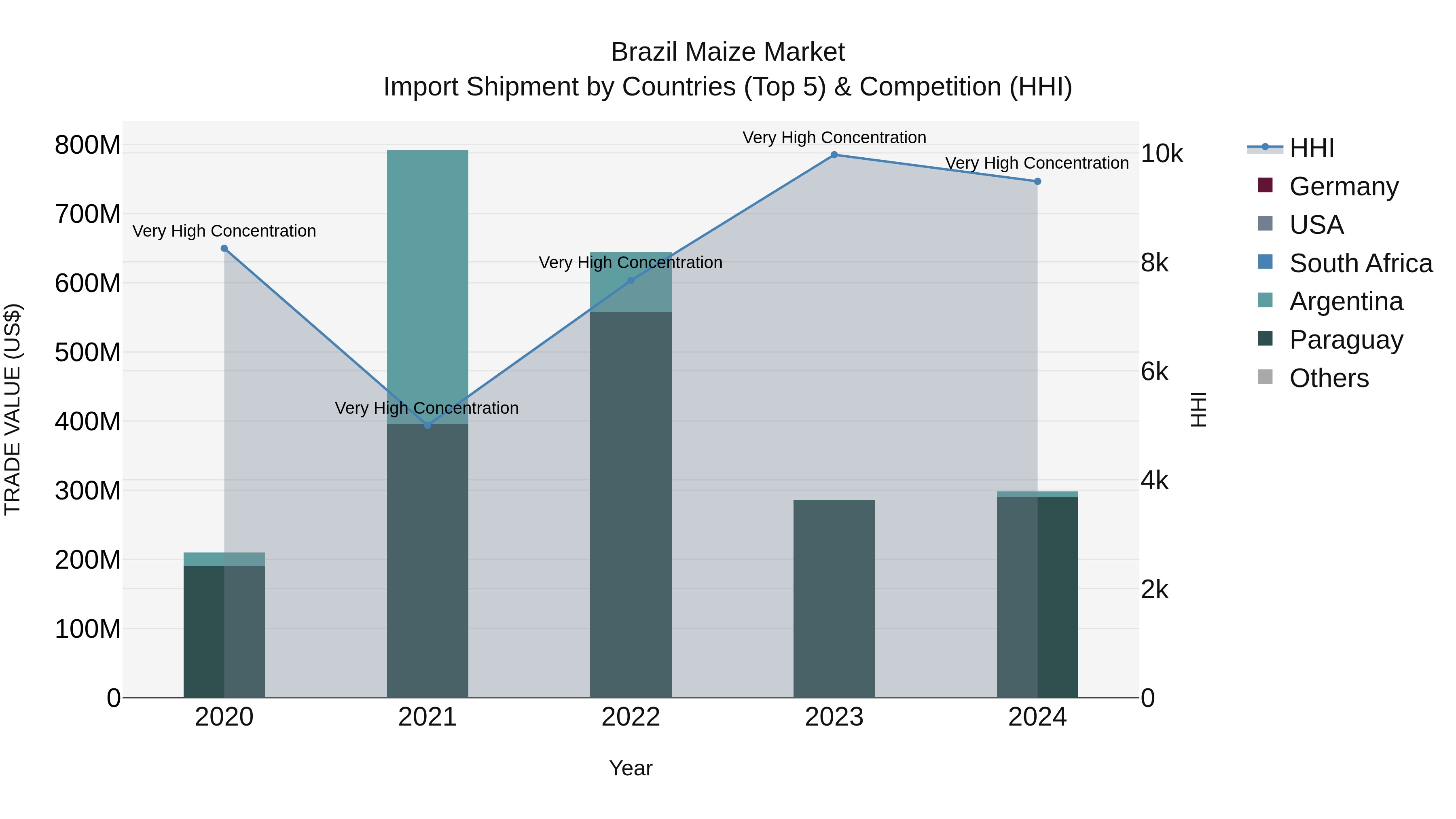
Brazil`s maize import market in 2024 continues to be dominated by top exporting countries including Paraguay, Argentina, South Africa, Germany, and the USA. The high Herfindahl-Hirschman Index (HHI) indicates significant concentration within the market. With a strong compound annual growth rate (CAGR) of 9.15% from 2020 to 2024 and a growth rate of 4.27% from 2023 to 2024, the maize import sector in Brazil shows promising expansion and strategic relationships with key global suppliers.
Brazil Maize Market Overview
The Brazil maize market is a key player in the global agricultural industry, being one of the largest producers and exporters of maize. Maize, also known as corn, is a staple crop in Brazil with a wide range of applications including food production, animal feed, and ethanol production. The country benefits from its vast arable land, favorable climate conditions, and advanced agricultural technologies, allowing for high yields and quality maize production. Brazil`s maize market is highly competitive, with both domestic consumption and international trade playing significant roles in shaping market dynamics. Government policies, weather conditions, and global market trends all impact the maize market in Brazil, making it essential for stakeholders to closely monitor these factors to make informed decisions in this dynamic and important market segment.
Brazil Maize Market Trends
Currently, the Brazil maize market is experiencing several key trends. One notable trend is the increasing demand for maize for animal feed due to the growth of the livestock industry in the country. Additionally, the expansion of ethanol production from maize is also driving market growth, as Brazil continues to invest in renewable energy sources. Climate change and weather conditions are also impacting the market, with fluctuations in rainfall and temperature affecting maize production levels. Another trend is the emphasis on sustainable farming practices and the use of technology to improve crop yields and efficiency. Overall, the Brazil maize market is dynamic and evolving, with a focus on meeting the growing demand for maize while addressing sustainability concerns and adapting to changing environmental conditions.
Brazil Maize Market Challenges
In the Brazilian maize market, some challenges include unpredictable weather patterns affecting crop yields, competition with other agricultural commodities for land use, fluctuating global prices impacting export opportunities, and infrastructure limitations hindering efficient distribution. Additionally, pest infestations and diseases can also pose a threat to maize production in Brazil. These challenges require farmers to constantly adapt their cultivation practices, invest in technology and research for pest management, and navigate market uncertainties to ensure profitability and sustainability in the maize sector. Government policies and support programs play a crucial role in addressing these challenges and fostering a conducive environment for the development of the maize industry in Brazil.
Brazil Maize Market Investment Opportunities
Investment opportunities in the Brazil maize market include investing in companies involved in maize production, processing, and distribution. Brazil is one of the largest producers of maize globally, with a strong export market for maize products. Investors can consider investing in agribusiness companies that operate in Brazil and have a focus on maize production. Additionally, investing in agricultural technology companies that provide innovative solutions for maize cultivation and processing can be profitable. With the growing demand for maize both domestically and internationally, investing in the Brazil maize market can offer long-term growth potential for investors looking to capitalize on the country`s strong agricultural industry.
Brazil Maize Market Government Policy
The Brazilian government has implemented various policies to support the maize market, including providing subsidies for maize producers, offering credit facilities through public banks, and regulating prices to stabilize the market. Additionally, the government has introduced programs to promote sustainable maize production practices and ensure food security. Brazil`s agricultural policies also focus on supporting small-scale farmers and promoting agricultural research and development to enhance productivity and competitiveness in the maize sector. Overall, these policies aim to boost maize production, ensure market stability, and support the livelihoods of farmers in the country.
Brazil Maize Market Future Outlook
The future outlook for the Brazil maize market appears positive, driven by factors such as increasing global demand for corn-based products, growing livestock feed industry, and expansion of the ethanol production sector. Brazil`s advantageous climate conditions and fertile land make it a key player in the global maize market, with the potential to increase production and exports in the coming years. Additionally, advancements in agricultural technology and practices are expected to enhance productivity levels and efficiency within the maize industry. However, challenges such as fluctuations in weather patterns and market volatility could impact the market`s growth trajectory. Overall, Brazil is well-positioned to capitalize on the opportunities presented by the maize market, provided that it continues to invest in sustainable agricultural practices and infrastructure development.
Key Highlights of the Report:
- Brazil Maize Market Outlook
- Market Size of Brazil Maize Market,2024
- Forecast of Brazil Maize Market, 2031
- Historical Data and Forecast of Brazil Maize Revenues & Volume for the Period 2021-2031
- Brazil Maize Market Trend Evolution
- Brazil Maize Market Drivers and Challenges
- Brazil Maize Price Trends
- Brazil Maize Porter's Five Forces
- Brazil Maize Industry Life Cycle
- Historical Data and Forecast of Brazil Maize Market Revenues & Volume By Type for the Period 2021-2031
- Historical Data and Forecast of Brazil Maize Market Revenues & Volume By Yellow Maize for the Period 2021-2031
- Historical Data and Forecast of Brazil Maize Market Revenues & Volume By White Maize for the Period 2021-2031
- Historical Data and Forecast of Brazil Maize Market Revenues & Volume By Sweet Corn for the Period 2021-2031
- Historical Data and Forecast of Brazil Maize Market Revenues & Volume By Application for the Period 2021-2031
- Historical Data and Forecast of Brazil Maize Market Revenues & Volume By Animal Feed for the Period 2021-2031
- Historical Data and Forecast of Brazil Maize Market Revenues & Volume By Human Consumption for the Period 2021-2031
- Historical Data and Forecast of Brazil Maize Market Revenues & Volume By Fresh Produce for the Period 2021-2031
- Historical Data and Forecast of Brazil Maize Market Revenues & Volume By End User for the Period 2021-2031
- Historical Data and Forecast of Brazil Maize Market Revenues & Volume By Livestock for the Period 2021-2031
- Historical Data and Forecast of Brazil Maize Market Revenues & Volume By Food Industry for the Period 2021-2031
- Historical Data and Forecast of Brazil Maize Market Revenues & Volume By Retail Consumers for the Period 2021-2031
- Historical Data and Forecast of Brazil Maize Market Revenues & Volume By Distribution Channel for the Period 2021-2031
- Historical Data and Forecast of Brazil Maize Market Revenues & Volume By Direct Sales for the Period 2021-2031
- Historical Data and Forecast of Brazil Maize Market Revenues & Volume By Online Sales for the Period 2021-2031
- Historical Data and Forecast of Brazil Maize Market Revenues & Volume By Distributors for the Period 2021-2031
- Brazil Maize Import Export Trade Statistics
- Market Opportunity Assessment By Type
- Market Opportunity Assessment By Application
- Market Opportunity Assessment By End User
- Market Opportunity Assessment By Distribution Channel
- Brazil Maize Top Companies Market Share
- Brazil Maize Competitive Benchmarking By Technical and Operational Parameters
- Brazil Maize Company Profiles
- Brazil Maize Key Strategic Recommendations






































