Brazil Plasticizers Market Growth Rate Analysis (2021-2031)
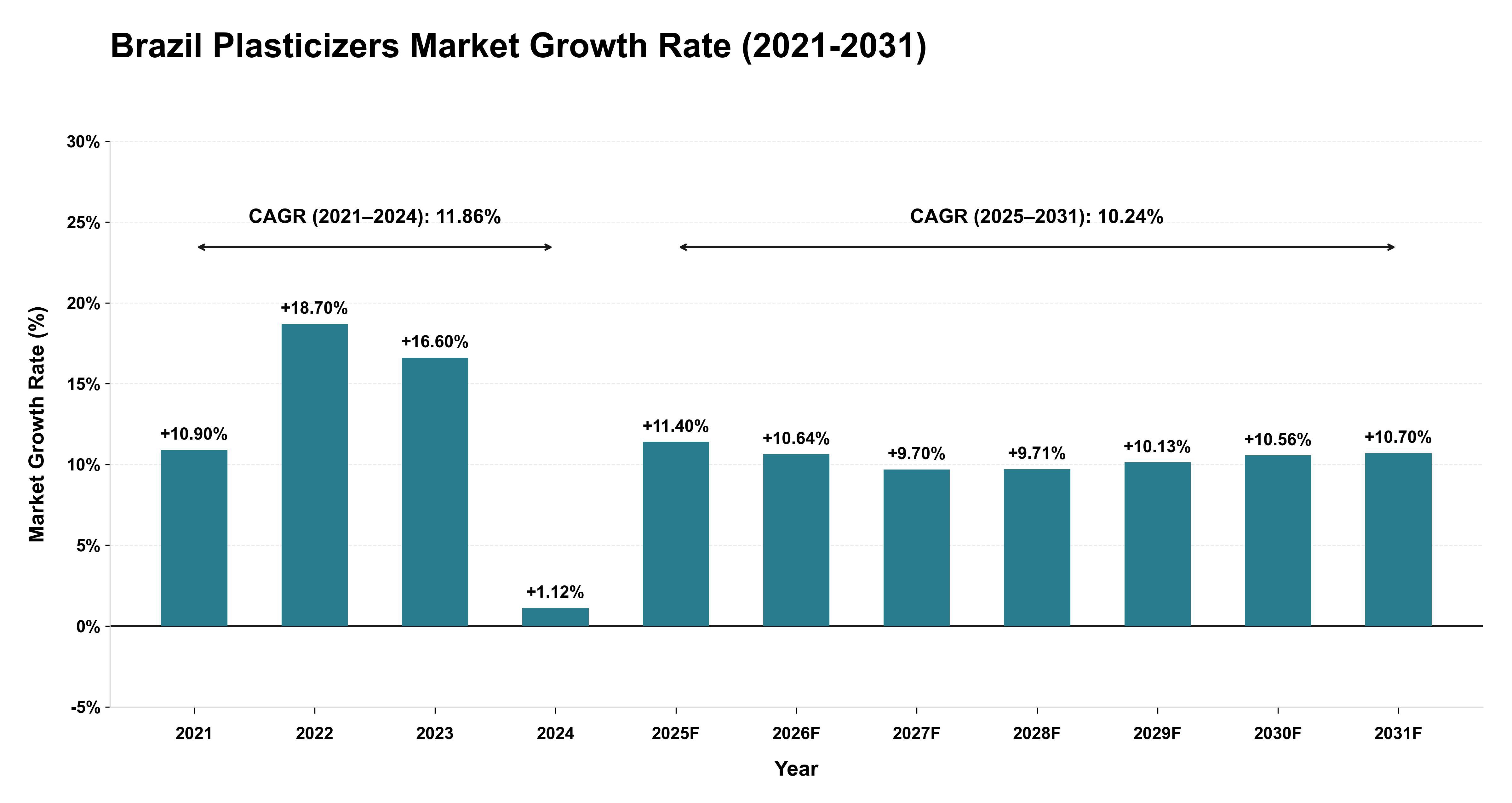
The Brazil Plasticizers Market demonstrated robust growth from 2021 to 2024, with a CAGR of 11.86%, fueled by increased industrial production and infrastructure development. Notably, there was a substantial surge in 2022 and 2023, with growth rates of 18.70% and 16.60%, respectively, reflecting strong demand across various sectors. However, in 2024, growth decelerated to 1.12%, indicating a temporary adjustment phase post rapid expansion. Looking ahead to the forecast period of 2025-2031, the market is anticipated to sustain a healthy growth trajectory with a projected CAGR of 10.24%. This slower yet stable growth rate signifies a phase of market stabilization post previous rapid escalations, as the industry matures and aligns with sustainable demand and supply levels amidst economic conditions and regulatory changes.
Brazil Plasticizers Market Overview
Brazil plasticizers market is witnessing steady growth driven by the plastics processing, construction, and automotive industries` demand for additives to improve flexibility, durability, and workability of polymer materials. Plasticizers, including phthalates, adipates, and trimellitates, reduce polymer stiffness and enhance processing characteristics in PVC, polyethylene, and other plastic formulations. With increasing construction activity and infrastructure development, the market for plasticizers is expanding in Brazil.
Drivers of the market
Navigating regulatory restrictions and addressing concerns about plasticizer safety and environmental impact pose challenges for manufacturers in Brazil market. Developing non-toxic alternatives and ensuring material compatibility further complicate market growth.
Challenges of the market
The Brazil Plasticizers Market is witnessing steady growth driven by several key factors. Firstly, the growing demand for flexible and durable plastic products across various industries such as construction, automotive, and packaging is driving the need for plasticizers, which are essential additives used to impart flexibility and resilience to plastics. Additionally, the expanding construction sector in Brazil, driven by infrastructure development projects and urbanization, is boosting the demand for plasticizers for applications such as PVC pipes, flooring, and cables. Moreover, technological advancements leading to the development of eco-friendly and non-phthalate plasticizers are further driving market growth by addressing environmental and health concerns associated with traditional plasticizers.
Government Policy of the market
Government regulations in Brazil aim to promote the responsible use of plasticizers for enhancing the flexibility and durability of plastics and polymer materials. Policies focus on promoting alternative plasticizer technologies, product safety standards, and industry collaboration to ensure the safety and sustainability of plasticizer-based products.
Key Highlights of the Report:
- Brazil Plasticizers Market Outlook
- Market Size of Brazil Plasticizers Market, 2024
- Forecast of Brazil Plasticizers Market, 2031
- Historical Data and Forecast of Brazil Plasticizers Revenues & Volume for the Period 2021-2031
- Brazil Plasticizers Market Trend Evolution
- Brazil Plasticizers Market Drivers and Challenges
- Brazil Plasticizers Price Trends
- Brazil Plasticizers Porter's Five Forces
- Brazil Plasticizers Industry Life Cycle
- Historical Data and Forecast of Brazil Plasticizers Market Revenues & Volume By Type for the Period 2021-2031
- Historical Data and Forecast of Brazil Plasticizers Market Revenues & Volume By Phthalates for the Period 2021-2031
- Historical Data and Forecast of Brazil Plasticizers Market Revenues & Volume By Non-Phthalates for the Period 2021-2031
- Historical Data and Forecast of Brazil Plasticizers Market Revenues & Volume By Application for the Period 2021-2031
- Historical Data and Forecast of Brazil Plasticizers Market Revenues & Volume By Flooring & Wall Covering for the Period 2021-2031
- Historical Data and Forecast of Brazil Plasticizers Market Revenues & Volume By Wire & Cable for the Period 2021-2031
- Historical Data and Forecast of Brazil Plasticizers Market Revenues & Volume By Coated Fabric for the Period 2021-2031
- Historical Data and Forecast of Brazil Plasticizers Market Revenues & Volume By Consumer Goods for the Period 2021-2031
- Historical Data and Forecast of Brazil Plasticizers Market Revenues & Volume By Film & Sheet for the Period 2021-2031
- Brazil Plasticizers Import Export Trade Statistics
- Market Opportunity Assessment By Type
- Market Opportunity Assessment By Application
- Brazil Plasticizers Top Companies Market Share
- Brazil Plasticizers Competitive Benchmarking By Technical and Operational Parameters
- Brazil Plasticizers Company Profiles
- Brazil Plasticizers Key Strategic Recommendations






































