Brazil Plastics Products Market Summary
The brazil plastics products market was estimated at USD 323 Million in 2025 and is projected to reach USD 388 Million by 2032, growing at a CAGR of 2.6% from 2026 to 2032.
Brazil Plastics Products Market Year-wise Growth Rate and Key Drivers
This graph highlights how the Brazil Plastics Products Market has steadily grown over the past five years, supported by major growth factors.
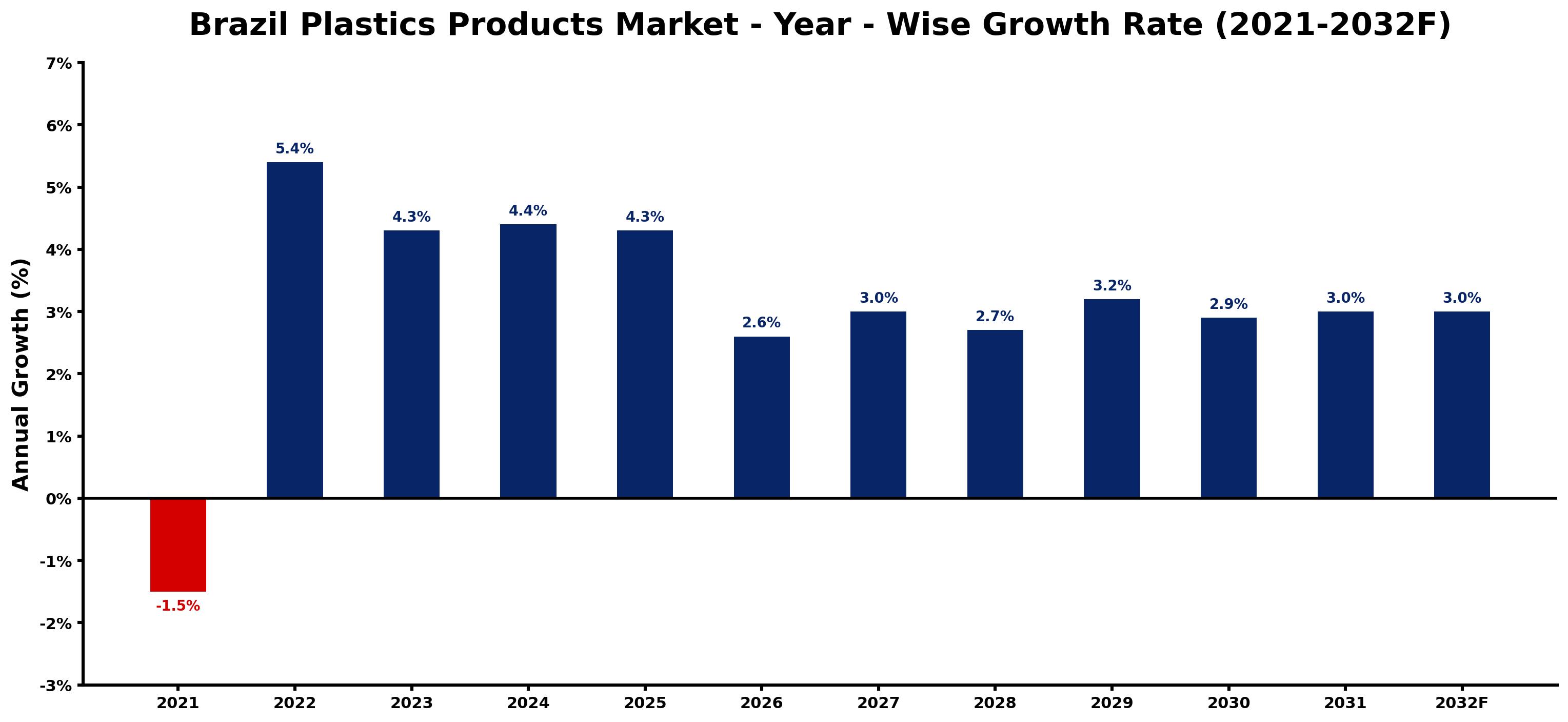
The table below presents the year wise growth rates along with the key drivers influencing the market
| Year | Growth Rate | Major Drivers |
| 2021 | -1.5% | Increased environmental regulations led to higher compliance costs, constraining industry growth and driving innovation hesitance. |
| 2022 | 5.4% | Thriving e-commerce sector stimulates packaging innovations within the plastics industry. |
| 2023 | 4.3% | Sustainability trends prompt manufacturers to explore biodegradable plastic alternatives. |
| 2024 | 4.4% | Infrastructure investments in urban areas create new opportunities for plastic applications. |
| 2025 | 4.3% | Technological advancements in recycling processes enhance circular economy initiatives. |
| 2026 | 2.6% | Consumer preferences shift towards sustainable packaging, influencing brand strategies. |
| 2027 | 3.0% | Global supply chain adjustments influence local production capacities and materials sourcing. |
| 2028 | 2.7% | Development in automotive sector fuels demand for lightweight plastic components. |
| 2029 | 3.2% | Rising urbanization trends increase usage of plastic in construction projects. |
| 2030 | 2.9% | Emerging regulations drive innovation towards eco-friendly materials and solutions. |
| 2031 | 3.0% | Growing awareness of plastic waste encourages investment in waste management technologies. |
| 2032 | 3.0% | Collaborative efforts among industries promote the adoption of sustainable practices. |
Note - Market size estimations and growth projections presented in this report are based on 6Wresearch's advanced forecasting approach, validated with industry datasets as of June 2026.
Brazil Plastics Products Market Synopsis
The Brazil Plastics Products Market is projected to reach 2.6% and witness significant growth during the forecast period (2026-2032). This expansion is primarily driven by the increasing demand across various end-use industries including packaging, automotive, and construction. As consumer preferences evolve towards lightweight and durable materials, the Brazilian plastics sector is undergoing a transformation that prioritizes innovation and sustainability.
Brazil Plastics Products Market Growth Drivers
The growth of the Brazil Plastics Products Market can be attributed to several key factors:
- The packaging sector remains a significant contributor, accounting for a substantial share of plastic consumption as businesses increasingly seek materials that offer durability combined with cost-effectiveness.
- In construction, the adoption of plastic materials for insulation, piping, and structural components is on the rise, driven by their lightweight nature and ease of installation.
- The automotive industry is witnessing a shift towards lighter materials to enhance fuel efficiency, where plastics are being integrated into vehicle design and production processes.
- Innovative applications of recycled plastics are gaining traction, driven by both consumer demand and industry initiatives aimed at reducing waste and promoting circular economy practices.
- Boosted by advancements in manufacturing technologies, the production of high-performance plastics is expanding, catering to specialized applications that require enhanced material properties.
Brazil Plastics Products Market Challenges and Restraints
Despite the promising growth trajectory, the Brazil Plastics Products Market faces several challenges that could impede its progress:
- Environmental concerns regarding plastic pollution are becoming increasingly prominent, with rising public awareness pushing for stringent regulations and sustainable alternatives.
- The Brazilian government is implementing stricter regulations on single-use plastics, which can affect market dynamics and compel manufacturers to innovate or alter their product offerings.
- Recycling infrastructure remains underdeveloped in many regions, limiting the effective processing of plastic waste and hampering the market for recycled products.
- Consumer preferences are shifting towards eco-friendly products, putting pressure on traditional plastic manufacturers to invest in green technologies and sustainable practices.
- Compliance with evolving regulations may pose significant challenges for manufacturers who must adapt their operations to meet new environmental standards.
Brazil Plastics Products Market Trends and Opportunities
As the Brazil Plastics Products Market evolves, several trends and emerging opportunities are evident:
- There is a growing emphasis on bioplastics and biodegradable alternatives, reflecting a broader shift in consumer preferences towards sustainability.
- Investment in research and development (R&D) is expected to drive innovation in material science, leading to the creation of high-performance materials tailored for specific applications.
- Collaboration between industries and research organizations is likely to foster the development of advanced recycling technologies, enhancing the market for post-consumer recycled plastics.
- Consumer demand for personalized and customized packaging solutions is likely to escalate, offering opportunities for innovative companies to differentiate themselves in a competitive market.
- Expanding e-commerce and retail sectors in Brazil are expected to increase the demand for efficient packaging solutions, further bolstering the plastics products market.
Brazil Plastics Products Market Government Investment and Initiatives
The Brazilian government is actively promoting initiatives aimed at addressing the challenges within the plastics sector. With a focus on sustainability, various policies have been instituted to incentivize recycling and the use of environmentally friendly materials. Key initiatives include:
- Introduction of regulations mandating recycling and waste management practices for plastic products to mitigate environmental impact and enhance resource recovery.
- Support for research and development projects that explore sustainable materials and efficient processing technologies to promote eco-friendly practices across the industry.
- Public awareness campaigns aimed at educating consumers about plastic pollution and encouraging responsible consumption and disposal practices.
- Investment in infrastructure projects to improve recycling facilities and create a more robust system for handling plastic waste across various regions.
- Promotion of public-private partnerships aimed at fostering innovation in sustainable packaging solutions and reducing reliance on single-use plastics.
Brazil Plastics Products Market Latest Developments (May 2025 - June 2026)
During the period from May 2025 to June 2026, the Brazil Plastics Products Market has experienced notable developments that reflect its dynamic nature. Key directions include:
- An increase in government initiatives focusing on sustainable practices within the plastics industry, emphasizing the importance of reducing plastic waste through legislative measures.
- Growing interest from businesses in adopting innovative recycling technologies, driven by both regulatory pressures and consumer demand for environmentally responsible products.
- Expansion of collaborative efforts between companies and academic institutions to enhance research capabilities and bring forth advanced materials that meet changing market needs.
- Significant advancements in biodegradable plastics, with several pilot projects launched to evaluate their effectiveness and market potential.
- Increased dialogues among stakeholders in the plastics value chain aimed at addressing sustainability challenges and exploring new market opportunities.
Brazil Plastics Products Market - Key Attractiveness of the Report
- 10 Years of Market Numbers
- Historical Data Starting from 2022 to 2025
- Base Year: 2025
- Forecast Data until 2032
- Key Performance Indicators Impacting the Market
- Major Upcoming Developments and Projects
Key Highlights of the Report:
- Brazil Plastics Products Market Outlook
- Market Size of Brazil Plastics Products Market, 2025
- Forecast of Brazil Plastics Products Market, 2032
- Historical Data and Forecast of Brazil Plastics Products Revenues & Volume for the Period 2022-2032F
- Brazil Plastics Products Market Trend Evolution
- Brazil Plastics Products Market Drivers and Challenges
- Brazil Plastics Products Price Trends
- Brazil Plastics Products Porter's Five Forces
- Brazil Plastics Products Industry Life Cycle
- Historical Data and Forecast of Brazil Plastics Products Market Revenues & Volume By Types for the Period 2022-2032F
- Historical Data and Forecast of Brazil Plastics Products Market Revenues & Volume By Plastics Packaging Materials And Unlaminated Film And Sheet for the Period 2022-2032F
- Historical Data and Forecast of Brazil Plastics Products Market Revenues & Volume By Plastic Pipes And Shapes for the Period 2022-2032F
- Historical Data and Forecast of Brazil Plastics Products Market Revenues & Volume By Laminated Plastics Plate, Sheet, And Shape for the Period 2022-2032F
- Historical Data and Forecast of Brazil Plastics Products Market Revenues & Volume By Plastics Bottle for the Period 2022-2032F
- Historical Data and Forecast of Brazil Plastics Products Market Revenues & Volume By Urethane And Other Foam Product for the Period 2022-2032F
- Historical Data and Forecast of Brazil Plastics Products Market Revenues & Volume By Polystyrene Foam Product for the Period 2022-2032F
- Historical Data and Forecast of Brazil Plastics Products Market Revenues & Volume By Other Plastics Product ? ? for the Period 2022-2032F
- Historical Data and Forecast of Brazil Plastics Products Market Revenues & Volume By End-users for the Period 2022-2032F
- Historical Data and Forecast of Brazil Plastics Products Market Revenues & Volume By Automotive & Transportation for the Period 2022-2032F
- Historical Data and Forecast of Brazil Plastics Products Market Revenues & Volume By Electrical & Electronics for the Period 2022-2032F
- Historical Data and Forecast of Brazil Plastics Products Market Revenues & Volume By Medical for the Period 2022-2032F
- Historical Data and Forecast of Brazil Plastics Products Market Revenues & Volume By Construction for the Period 2022-2032F
- Historical Data and Forecast of Brazil Plastics Products Market Revenues & Volume By Others for the Period 2022-2032F
- Brazil Plastics Products Import Export Trade Statistics
- Market Opportunity Assessment By Types
- Market Opportunity Assessment By End-users
- Brazil Plastics Products Top Companies Market Share
- Brazil Plastics Products Competitive Benchmarking By Technical and Operational Parameters
- Brazil Plastics Products Company Profiles
- Brazil Plastics Products Key Strategic Recommendations






































