Brazil Soft Drinks Packaging Market Size, Share & Growth Rate
The Brazil Soft Drinks Packaging Market was estimated at USD 323 Million in 2025 and is projected to reach USD 386 Million by 2032, growing at a CAGR of 2.6% from 2026 to 2032. This trajectory is being driven by a notable shift in consumer preferences towards healthier beverages, alongside a rising demand for sustainable and innovative packaging solutions. Furthermore, advancements in packaging technologies and increasing regulatory support for recycling initiatives are catalyzing growth in this dynamic sector.
Brazil Soft Drinks Packaging Market Year-wise Growth Rate and Key Drivers
This graph highlights how the Brazil Soft Drinks Packaging Market has steadily grown over the years, supported by major growth factors.
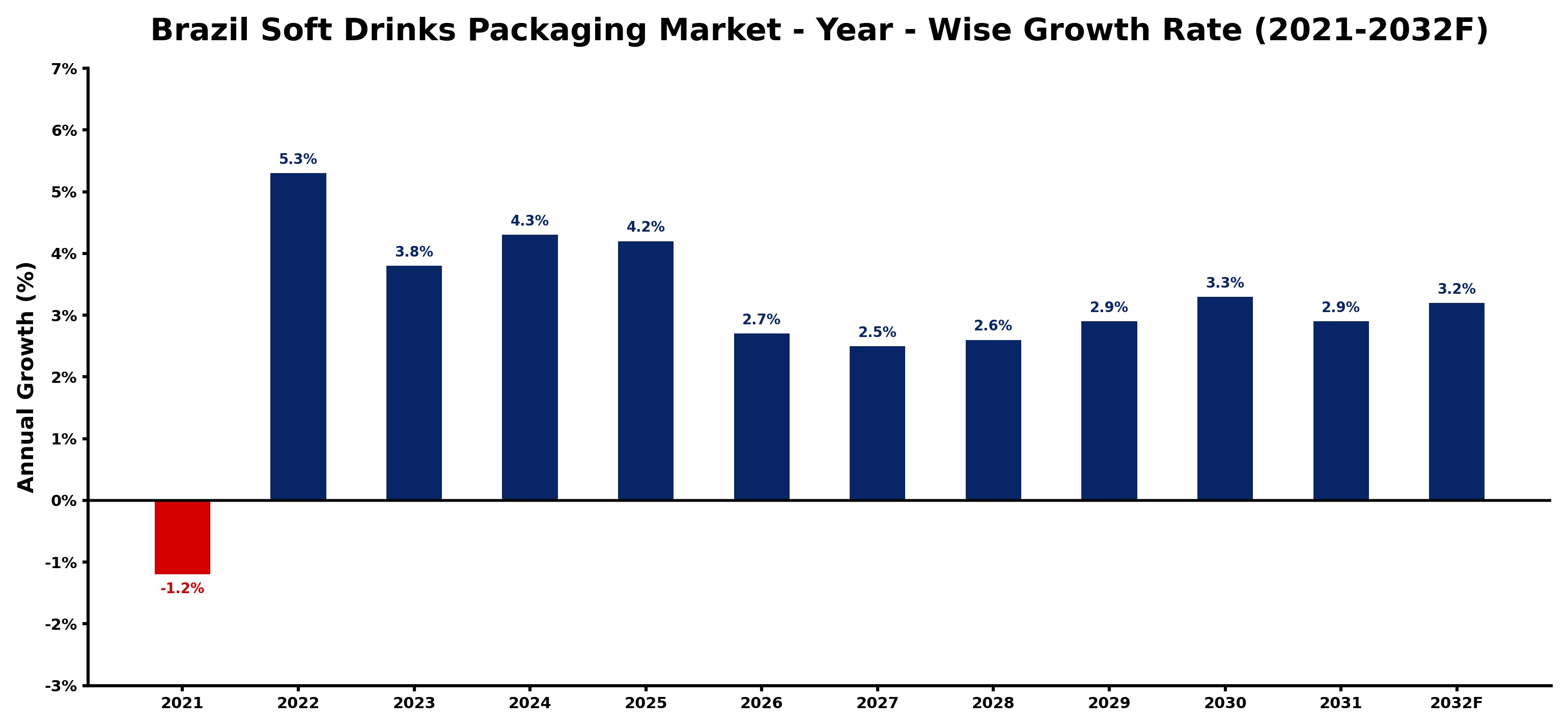
The table below presents the year‑wise growth rates along with the key drivers influencing the market
| Year | Growth Rate | Major Drivers |
| 2021 | -1.2% | Consumer spending decreased significantly |
| 2022 | 5.3% | Health-conscious trends drove demand |
| 2023 | 3.8% | Sustainability initiatives enhanced packaging |
| 2024 | 4.3% | E-commerce growth expanded reach |
| 2025 | 4.2% | Innovative packaging designs attracted buyers |
| 2026 | 2.7% | Local sourcing gained popularity rapidly |
| 2027 | 2.5% | Flavored beverages increased market interest |
| 2028 | 2.6% | Convenience packaging improved usability |
| 2029 | 2.9% | Brand collaborations enhanced visibility |
| 2030 | 3.3% | Functional beverages captured consumer attention |
| 2031 | 2.9% | Seasonal promotions drove sales growth |
| 2032 | 3.2% | Recyclable materials gained consumer preference |
Note - Market size estimations and growth projections presented in this report are based on 6Wresearch's advanced forecasting approach, validated with industry datasets as of June 2026.
Brazil Soft Drinks Packaging Market Synopsis
In Brazil, the soft drinks packaging market is heavily influenced by consumer demand for convenience and portability, evident in the growing popularity of lightweight PET bottles. As these bottles dominate the market, manufacturers are prioritizing not only functionality but also eco-friendliness, aiming to develop recyclable solutions that resonate with environmentally conscious consumers.
Additionally, interactive and uniquely designed packaging is emerging as a key differentiation strategy among brands seeking to capture market share. With heightened competition, companies are increasingly investing in marketing campaigns that highlight their sustainable practices and innovative packaging designs, effectively engaging consumers and enhancing brand loyalty.
Brazil Soft Drinks Packaging Market Key Takeaways
- Dominance of lightweight PET bottles, driving convenience and recyclability in packaging.
- Growing emphasis on eco-friendly materials in response to consumer sustainability concerns.
- Innovative packaging designs crucial for brand differentiation amid intense competition.
- Advancements in technology fostering enhanced consumer engagement through interactive solutions.
- Government initiatives aimed at promoting recycling and sustainable packaging materials impacting market dynamics.
Evaluation of Restraints in Brazil Soft Drinks Packaging Market
Despite the promising growth outlook, the Brazil Soft Drinks Packaging Market faces certain restraints that may hinder progress. A significant challenge is the pressing need for sustainability, as increasing consumer awareness about packaging waste intensifies scrutiny on manufacturers. Companies must navigate the complexities of developing eco-friendly solutions while maintaining affordability and convenience. Additionally, differentiating brands in a crowded marketplace requires substantial investment in innovative designs and effective marketing strategies, which can pose a barrier for smaller entities.
Brazil Soft Drinks Packaging Market Trends
The soft drinks packaging landscape in Brazil is currently shaped by several emerging trends. A notable trend is the shift towards biodegradable and compostable packaging options, reflecting heightened environmental consciousness among consumers. Moreover, there's a growing interest in smart packaging technologies that enhance consumer interaction, providing features like QR codes for product information and promotions. These trends are driving manufacturers to rethink traditional packaging approaches, aligning them with modern consumer values and expectations.
Brazil Soft Drinks Packaging Market Opportunities
The potential for growth within the Brazil Soft Drinks Packaging Market is substantial, particularly for brands that can successfully integrate sustainability into their packaging strategies. Opportunities abound in the development of innovative materials that prioritize both functionality and environmental impact. Additionally, as the demand for health-conscious beverages increases, packaging that communicates product benefits effectively can create significant market advantages. The emphasis on convenience is also opening avenues for portable packaging solutions tailored to on-the-go consumers.
Government Initiatives in the Brazil Soft Drinks Packaging Market
Government policies in Brazil are increasingly focused on reducing the environmental footprint of packaging within the soft drinks sector. Initiatives promoting recycling and the use of eco-friendly materials are being encouraged through regulations that require clear labeling for recycling practices. Furthermore, public spending is directed towards infrastructure that supports recycling initiatives, fostering an environment conducive to sustainable packaging solutions. These governmental efforts play a pivotal role in shaping the future of the soft drinks packaging market.
Future Insights of the Brazil Soft Drinks Packaging Market
Looking ahead to the period between 2026 and 2032, the Brazil Soft Drinks Packaging Market is expected to evolve significantly. Innovations in sustainable packaging will likely be at the forefront, as brands seek to address consumer demands for environmentally responsible solutions. The integration of technology into packaging will also continue to gain momentum, enhancing consumer engagement and providing manufacturers with valuable insights into consumer behavior. Overall, the market is poised for steady growth, driven by a confluence of sustainability, convenience, and technological advancements.
Brazil Soft Drinks Packaging Market Latest Developments (May 2025 - June 2026)
Recent developments in the Brazil Soft Drinks Packaging Market indicate a strong focus on sustainable packaging solutions. Many manufacturers are exploring innovative materials and designs to meet the growing consumer demand for eco-friendly products. Additionally, there has been a surge in collaborative efforts between brands and recycling organizations to improve packaging waste management. This period is witnessing a noticeable shift towards interactive packaging, further enhancing consumer engagement with products.
Brazil Soft Drinks Packaging Market - Key Attractiveness of the Report
- 10 Years of Market Numbers
- Historical Data Starting from 2022 to 2025
- Base Year: 2025
- Forecast Data until 2032
- Key Performance Indicators Impacting the Market
- Major Upcoming Developments and Projects
Key Highlights of the Report:
- Brazil Soft Drinks Packaging Market Outlook
- Market Size of Brazil Soft Drinks Packaging Market, 2025
- Forecast of Brazil Soft Drinks Packaging Market, 2032
- Historical Data and Forecast of Brazil Soft Drinks Packaging Revenues & Volume for the Period 2022-2032F
- Brazil Soft Drinks Packaging Market Trend Evolution
- Brazil Soft Drinks Packaging Market Drivers and Challenges
- Brazil Soft Drinks Packaging Price Trends
- Brazil Soft Drinks Packaging Porter's Five Forces
- Brazil Soft Drinks Packaging Industry Life Cycle
- Historical Data and Forecast of Brazil Soft Drinks Packaging Market Revenues & Volume By Material for the Period 2022-2032F
- Historical Data and Forecast of Brazil Soft Drinks Packaging Market Revenues & Volume By Paper for the Period 2022-2032F
- Historical Data and Forecast of Brazil Soft Drinks Packaging Market Revenues & Volume By Plastic for the Period 2022-2032F
- Historical Data and Forecast of Brazil Soft Drinks Packaging Market Revenues & Volume By Metal for the Period 2022-2032F
- Historical Data and Forecast of Brazil Soft Drinks Packaging Market Revenues & Volume By Glass for the Period 2022-2032F
- Historical Data and Forecast of Brazil Soft Drinks Packaging Market Revenues & Volume By for the Period 2022-2032F
- Historical Data and Forecast of Brazil Soft Drinks Packaging Market Revenues & Volume By for the Period 2022-2032F
- Historical Data and Forecast of Brazil Soft Drinks Packaging Market Revenues & Volume By Product Type for the Period 2022-2032F
- Historical Data and Forecast of Brazil Soft Drinks Packaging Market Revenues & Volume By Cans for the Period 2022-2032F
- Historical Data and Forecast of Brazil Soft Drinks Packaging Market Revenues & Volume By Boxes for the Period 2022-2032F
- Historical Data and Forecast of Brazil Soft Drinks Packaging Market Revenues & Volume By Bottles for the Period 2022-2032F
- Historical Data and Forecast of Brazil Soft Drinks Packaging Market Revenues & Volume By Cartons for the Period 2022-2032F
- Historical Data and Forecast of Brazil Soft Drinks Packaging Market Revenues & Volume By for the Period 2022-2032F
- Historical Data and Forecast of Brazil Soft Drinks Packaging Market Revenues & Volume By for the Period 2022-2032F
- Historical Data and Forecast of Brazil Soft Drinks Packaging Market Revenues & Volume By Capacity for the Period 2022-2032F
- Historical Data and Forecast of Brazil Soft Drinks Packaging Market Revenues & Volume By Up to 100 ml for the Period 2022-2032F
- Historical Data and Forecast of Brazil Soft Drinks Packaging Market Revenues & Volume By 100 to 250 ml for the Period 2022-2032F
- Historical Data and Forecast of Brazil Soft Drinks Packaging Market Revenues & Volume By 250 to 500 ml for the Period 2022-2032F
- Historical Data and Forecast of Brazil Soft Drinks Packaging Market Revenues & Volume By 500 to 1000 ml for the Period 2022-2032F
- Historical Data and Forecast of Brazil Soft Drinks Packaging Market Revenues & Volume By 1000 to 2000 ml for the Period 2022-2032F
- Historical Data and Forecast of Brazil Soft Drinks Packaging Market Revenues & Volume By Above 2000 ml for the Period 2022-2032F
- Historical Data and Forecast of Brazil Soft Drinks Packaging Market Revenues & Volume By Application for the Period 2022-2032F
- Historical Data and Forecast of Brazil Soft Drinks Packaging Market Revenues & Volume By Carbonated soft drinks for the Period 2022-2032F
- Historical Data and Forecast of Brazil Soft Drinks Packaging Market Revenues & Volume By Functional Drinks for the Period 2022-2032F
- Historical Data and Forecast of Brazil Soft Drinks Packaging Market Revenues & Volume By Sport Drinks for the Period 2022-2032F
- Historical Data and Forecast of Brazil Soft Drinks Packaging Market Revenues & Volume By Energy Drinks for the Period 2022-2032F
- Historical Data and Forecast of Brazil Soft Drinks Packaging Market Revenues & Volume By Others for the Period 2022-2032F
- Historical Data and Forecast of Brazil Soft Drinks Packaging Market Revenues & Volume By Juices for the Period 2022-2032F
- Brazil Soft Drinks Packaging Import Export Trade Statistics
- Market Opportunity Assessment By Material
- Market Opportunity Assessment By Product Type
- Market Opportunity Assessment By Capacity
- Market Opportunity Assessment By Application
- Brazil Soft Drinks Packaging Top Companies Market Share
- Brazil Soft Drinks Packaging Competitive Benchmarking By Technical and Operational Parameters
- Brazil Soft Drinks Packaging Company Profiles
- Brazil Soft Drinks Packaging Key Strategic Recommendations






































