Brazil Swine Feed Market Size, Share & Growth Rate
The Brazil Swine Feed Market was estimated at USD 248 Million in 2025 and is projected to reach USD 297 Million by 2032, growing at a CAGR of 2.6% from 2026 to 2032. This growth trajectory is underpinned by a combination of rising grain prices, evolving livestock health concerns, and favorable government policies aimed at enhancing the swine farming industry. The robust expansion of the swine farming sector in Brazil necessitates high-quality feed that meets both nutritional standards and regulatory compliance, contributing to the markets positive outlook.
Brazil Swine Feed Market Year-wise Growth Rate and Key Drivers
This graph highlights how the Brazil Swine Feed Market has steadily grown over the years, supported by major growth factors.
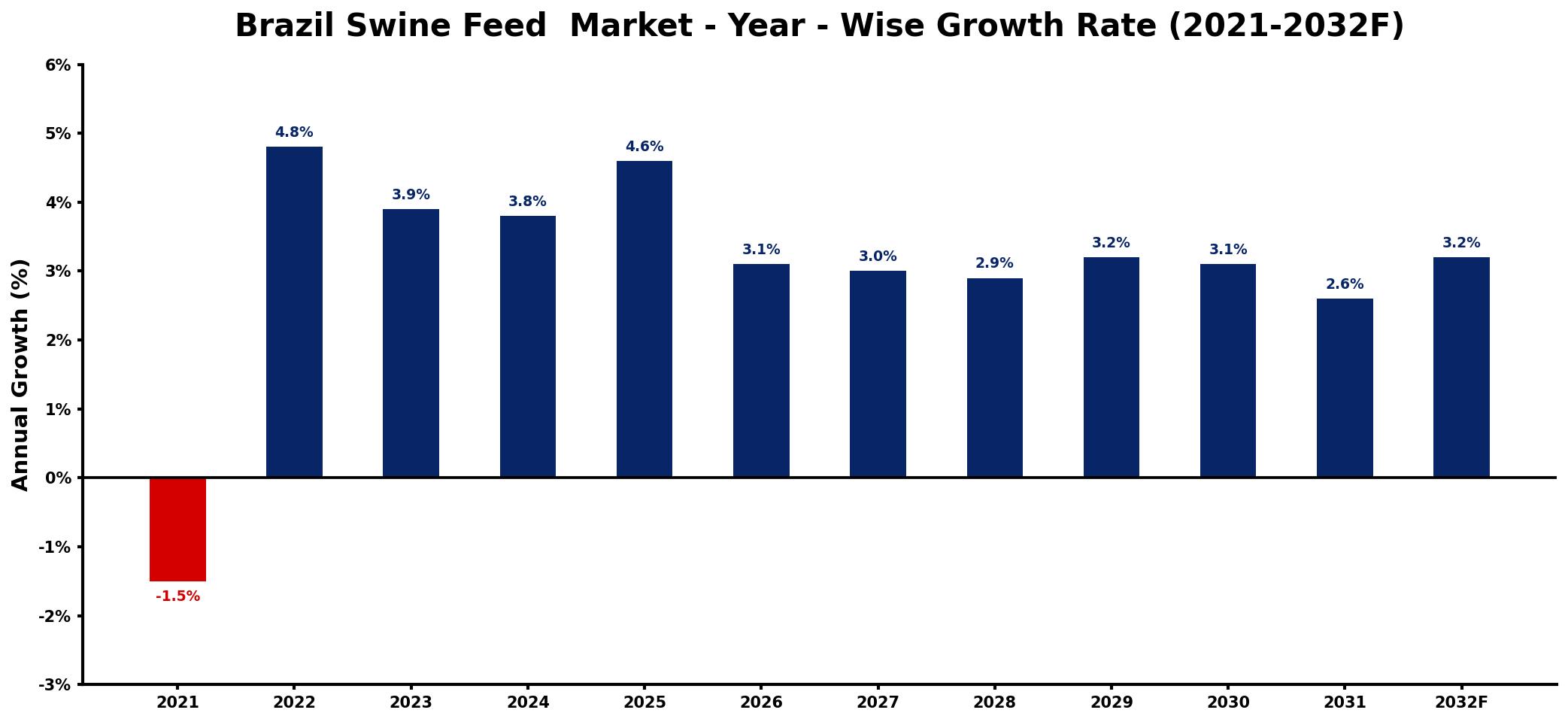
The table below presents the year‑wise growth rates along with the key drivers influencing the market
| Year | Growth Rate | Major Drivers |
| 2021 | -1.5% | Decreased livestock production levels |
| 2022 | 4.8% | Increased consumer meat demand |
| 2023 | 3.9% | Expansion of livestock operations |
| 2024 | 3.8% | Rising investment in agriculture |
| 2025 | 4.6% | Growing export market opportunities |
| 2026 | 3.1% | Technological advancements in farming |
| 2027 | 3.0% | Increased awareness of nutrition |
| 2028 | 2.9% | Strengthening supply chain efficiency |
| 2029 | 3.2% | Enhanced government support initiatives |
| 2030 | 3.1% | Growing trend of sustainable practices |
| 2031 | 2.6% | Diversification of livestock breeds |
| 2032 | 3.2% | Rising demand for organic options |
Note: Market size estimations and growth projections presented in this report are based on 6Wresearch's proprietary forecasting methodology, utilizing the latest available industry data, government publications, and primary research inputs.
Brazil Swine Feed Market Synopsis
Quality control stands as the most influential force shaping the Brazil Swine Feed Market. As producers prioritize feed safety, strategies surrounding ingredient sourcing and formulation are evolving, ensuring a healthier livestock population and optimizing farm productivity.
The interplay of governmental policies also plays a crucial role in this market. Brazil's regulatory framework not only emphasizes safety standards but also encourages the adoption of sustainable practices within the swine feed production process, fostering a more resilient agricultural sector.
Brazil Swine Feed Market Key Takeaways
- The market is driven by rising grain prices and livestock health considerations.
- Government policies focus on quality control and sustainable practices.
- Feed safety and ingredient sourcing remain central challenges for producers.
- Innovative feed formulations are emerging in response to health and regulatory demands.
- Collaboration with regulatory bodies is vital for market compliance and development.
Evaluation of Restraints in Brazil Swine Feed Market
Despite its potential, the Brazil Swine Feed Market faces significant restraints. The risks associated with feed ingredient safety pose continuous challenges for producers. Concerns regarding contamination and the use of antibiotics in feed formulations necessitate stringent quality control measures. Consequently, companies are pressured to invest in research and development for alternative feed solutions that maintain profitability while addressing consumer safety and health standards. Additionally, fluctuating global grain prices can destabilize feed costs, further complicating the market dynamics.
Brazil Swine Feed Market Trends
One notable trend in the Brazil Swine Feed Market is the growing emphasis on holistic nutrition for swine, which integrates both conventional and alternative feed ingredients. This evolution not only targets enhanced growth rates but also aims at improving the overall health of livestock. Moreover, the rising consumer preference for sustainably raised pork has driven swine farmers to seek environmentally friendly feed options, further igniting demand for innovative formulations.
Brazil Swine Feed Market Opportunities
The future of the Brazil Swine Feed Market is rich with opportunities. With the increasing focus on sustainable agricultural practices, there is substantial potential for investment in research that develops alternative feed ingredients. Additionally, leveraging local ingredient sources can not only reduce costs but also align with government initiatives promoting sustainability. As regulatory frameworks evolve, companies that adapt to these changes and focus on quality assurance will likely emerge as leaders in the market.
Government Initiatives in the Brazil Swine Feed Market
The Brazilian government has implemented a series of policies aimed at bolstering the swine feed market through quality control and safety standards. These regulations ensure the nutritional adequacy of feed products while also minimizing the spread of livestock diseases. Additionally, various support programs are available to encourage the use of locally sourced ingredients, thereby promoting economic stability and environmentally sustainable practices within the swine farming sector.
Future Insights of the Brazil Swine Feed Market
Looking ahead to the period from 2026 to 2032, the Brazil Swine Feed Market is poised for gradual growth. The continued alignment of farming practices with consumer health demands and regulatory expectations will shape the industry. As companies invest in innovative feed solutions and the development of sustainable practices becomes commonplace, the market's resilience will strengthen, attracting further investment and driving advancements in swine nutrition.
Brazil Swine Feed Market Latest Developments (2025 - 2026)
Recent developments in the Brazil Swine Feed Market have highlighted a shift towards more sustainable feed formulations. Companies are increasingly collaborating with local farmers to source high-quality, locally produced ingredients, reinforcing the commitment to environmental stewardship. Additionally, there is an observable trend in the adoption of advanced technologies for quality control, which aim to mitigate risks associated with feed safety and enhance overall production efficiency.
Brazil Swine Feed Market - Key Attractiveness of the Report
- 10 Years of Market Numbers
- Historical Data Starting from 2022 to 2025
- Base Year: 2025
- Forecast Data until 2032
- Key Performance Indicators Impacting the Market
- Major Upcoming Developments and Projects
Key Highlights of the Report:
- Brazil Swine Feed Market Outlook
- Market Size of Brazil Swine Feed Market, 2025
- Forecast of Brazil Swine Feed Market, 2032
- Historical Data and Forecast of Brazil Swine Feed Revenues & Volume for the Period 2022-2032F
- Brazil Swine Feed Market Trend Evolution
- Brazil Swine Feed Market Drivers and Challenges
- Brazil Swine Feed Price Trends
- Brazil Swine Feed Porter's Five Forces
- Brazil Swine Feed Industry Life Cycle
- Historical Data and Forecast of Brazil Swine Feed Market Revenues & Volume By Product Type for the Period 2022-2032F
- Historical Data and Forecast of Brazil Swine Feed Market Revenues & Volume By Grower for the Period 2022-2032F
- Historical Data and Forecast of Brazil Swine Feed Market Revenues & Volume By Starter for the Period 2022-2032F
- Historical Data and Forecast of Brazil Swine Feed Market Revenues & Volume By Sow for the Period 2022-2032F
- Historical Data and Forecast of Brazil Swine Feed Market Revenues & Volume By Others for the Period 2022-2032F
- Historical Data and Forecast of Brazil Swine Feed Market Revenues & Volume By Feed Essence for the Period 2022-2032F
- Historical Data and Forecast of Brazil Swine Feed Market Revenues & Volume By Vitamins for the Period 2022-2032F
- Historical Data and Forecast of Brazil Swine Feed Market Revenues & Volume By Antioxidants for the Period 2022-2032F
- Historical Data and Forecast of Brazil Swine Feed Market Revenues & Volume By Feed Acidifiers for the Period 2022-2032F
- Historical Data and Forecast of Brazil Swine Feed Market Revenues & Volume By Feed Enzymes for the Period 2022-2032F
- Historical Data and Forecast of Brazil Swine Feed Market Revenues & Volume By Amino Acids for the Period 2022-2032F
- Historical Data and Forecast of Brazil Swine Feed Market Revenues & Volume By Others for the Period 2022-2032F
- Historical Data and Forecast of Brazil Swine Feed Market Revenues & Volume By Feed Additive Type for the Period 2022-2032F
- Historical Data and Forecast of Brazil Swine Feed Market Revenues & Volume By Zootechnical Feed Additives for the Period 2022-2032F
- Historical Data and Forecast of Brazil Swine Feed Market Revenues & Volume By Sensory Feed Additives for the Period 2022-2032F
- Historical Data and Forecast of Brazil Swine Feed Market Revenues & Volume By Nutritional Feed Additives for the Period 2022-2032F
- Brazil Swine Feed Import Export Trade Statistics
- Market Opportunity Assessment By Product Type
- Market Opportunity Assessment By Feed Essence
- Market Opportunity Assessment By Feed Additive Type
- Brazil Swine Feed Top Companies Market Share
- Brazil Swine Feed Competitive Benchmarking By Technical and Operational Parameters
- Brazil Swine Feed Company Profiles
- Brazil Swine Feed Key Strategic Recommendations






































