Brunei Darussalam Acetic Acid Market Growth Rate Analysis (2025 - 2031)
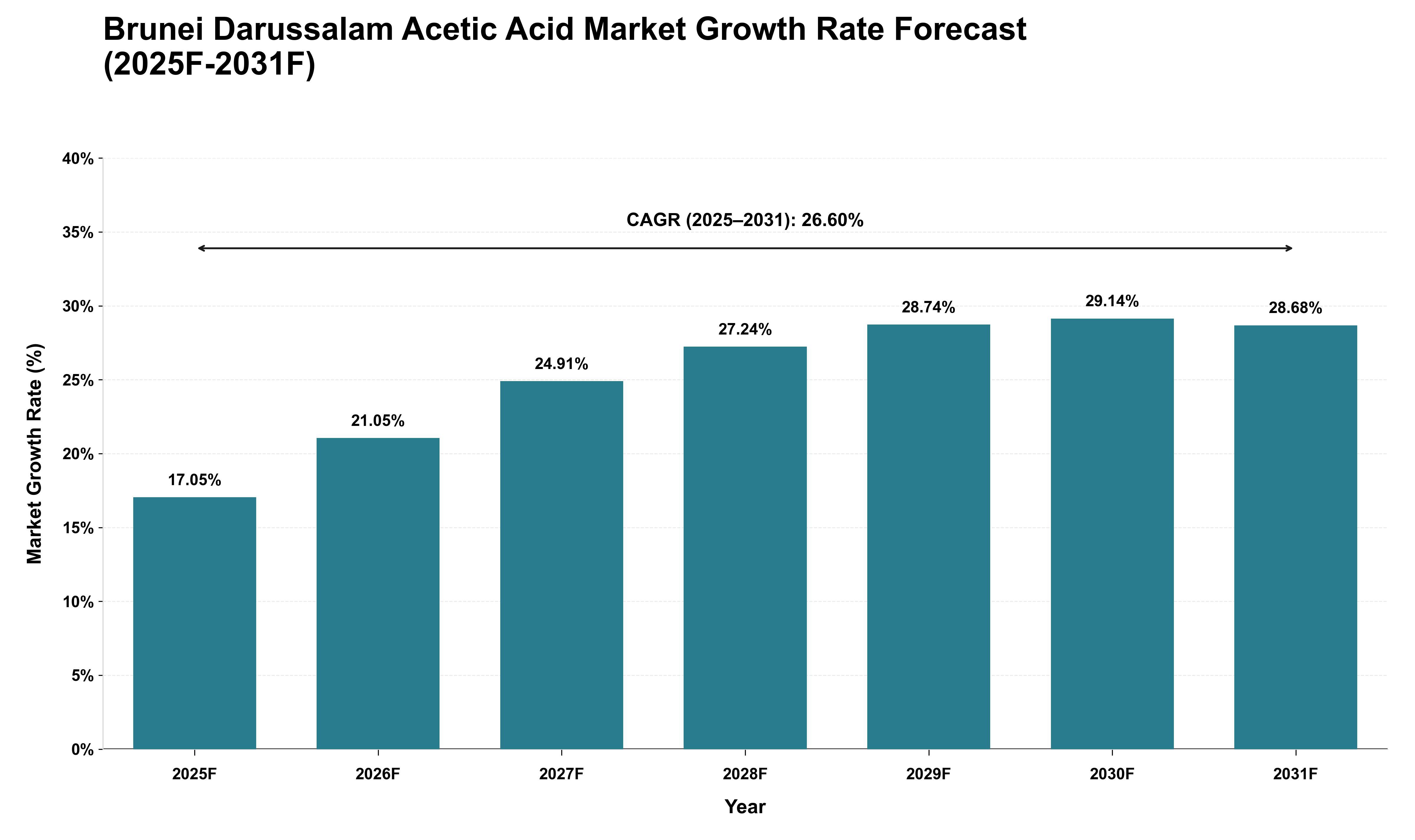
The Brunei Darussalam acetic acid market will experience significant growth driven by evolving macroeconomic factors and increasing demand across various sectors, particularly in manufacturing and chemicals. The projected CAGR of 26.60% from 2025 to 2031 reflects a robust expansion trajectory, with annual growth rates escalating from 17.05% in 2025 to a peak of 29.14% in 2030. This surge will likely be fueled by rising import dependencies as domestic production may not keep pace with burgeoning consumption needs, particularly in industries such as textiles and plastics that utilize acetic acid as a key input. Additionally, cyclical trends associated with global economic recovery post-pandemic will enhance industrial activity, further driving demand for acetic acid. As these structural transitions unfold, the market will adapt to shifts in supply chain dynamics and regulatory frameworks that could influence pricing and availability throughout the forecast period.
Key Highlights of the Report:
- Brunei Acetic Acid Market Outlook
- Market Size of Brunei Acetic Acid Market, 2024
- Forecast of Brunei Acetic Acid Market, 2031
- Historical Data and Forecast of Brunei Acetic Acid Revenues & Volume for the Period 2021-2031
- Brunei Acetic Acid Market Trend Evolution
- Brunei Acetic Acid Market Drivers and Challenges
- Brunei Acetic Acid Price Trends
- Brunei Acetic Acid Porter`s Five Forces
- Brunei Acetic Acid Industry Life Cycle
- Historical Data and Forecast of Brunei Acetic Acid Market Revenues & Volume By Application for the Period 2021-2031
- Historical Data and Forecast of Brunei Acetic Acid Market Revenues & Volume By Vinyl Acetate Monomer for the Period 2021-2031
- Historical Data and Forecast of Brunei Acetic Acid Market Revenues & Volume By Acetic Anhydride for the Period 2021-2031
- Historical Data and Forecast of Brunei Acetic Acid Market Revenues & Volume By Acetate Esters for the Period 2021-2031
- Historical Data and Forecast of Brunei Acetic Acid Market Revenues & Volume By Purified Terephthalic Acid for the Period 2021-2031
- Historical Data and Forecast of Brunei Acetic Acid Market Revenues & Volume By Ethanol for the Period 2021-2031
- Historical Data and Forecast of Brunei Acetic Acid Market Revenues & Volume By Others for the Period 2021-2031
- Brunei Acetic Acid Import Export Trade Statistics
- Market Opportunity Assessment By Application
- Brunei Acetic Acid Top Companies Market Share
- Brunei Acetic Acid Competitive Benchmarking By Technical and Operational Parameters
- Brunei Acetic Acid Company Profiles
- Brunei Acetic Acid Key Strategic Recommendations






































