Brunei Darussalam Decaffeinated Coffee Market Growth Rate Analysis (2021 - 2031)
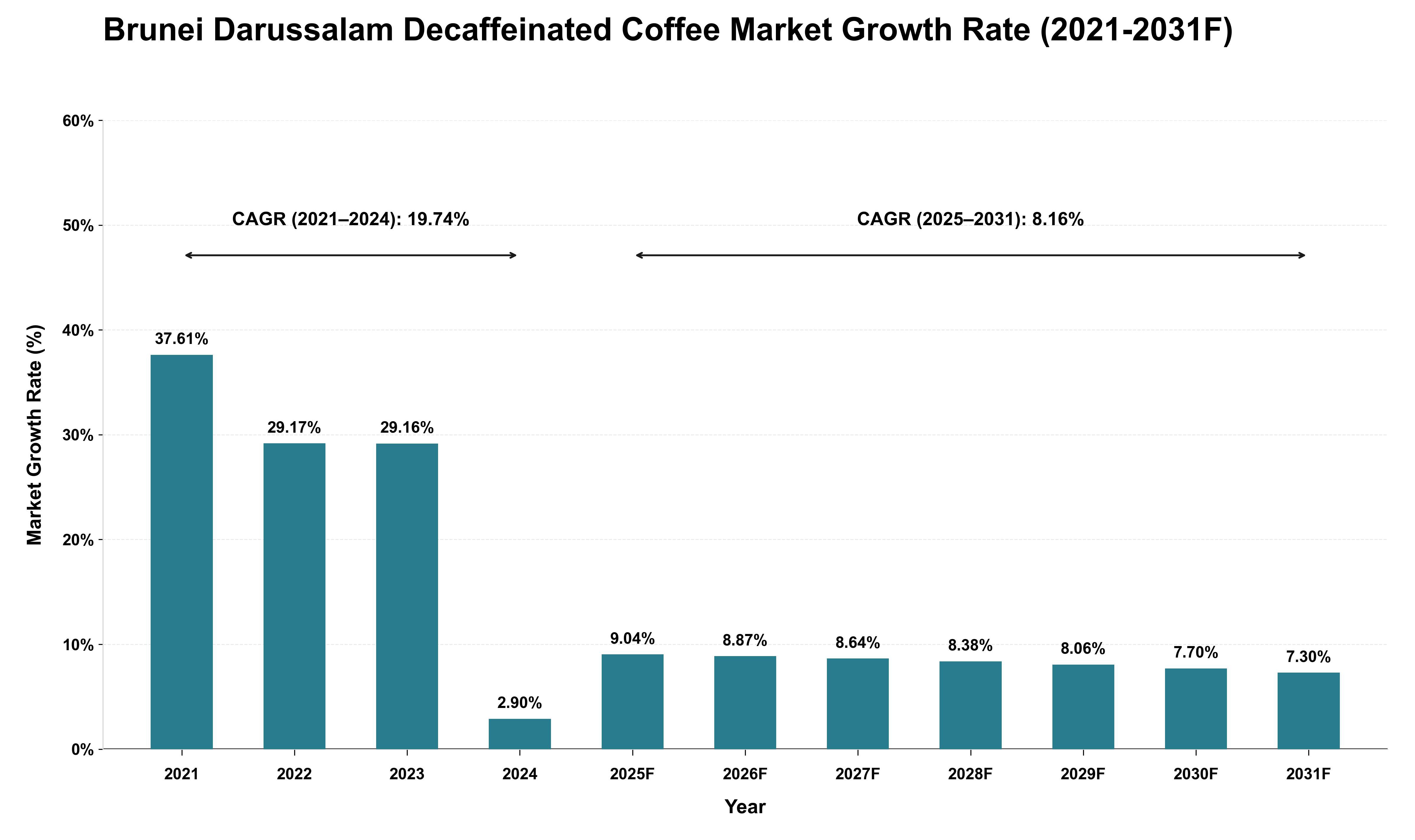
Between 2021 and 2024, the Brunei Darussalam decaffeinated coffee market experienced a remarkable CAGR of 19.74%, driven by post-pandemic consumer behavior shifts favoring health-conscious products and a surge in global demand for specialty coffees. The initial explosive growth rates of 37.61% in 2021 and subsequent high double-digit increases reflected a rebound effect as hospitality sectors reopened, coupled with supply chain disruptions that heightened interest in premium imports. However, by 2024, growth decelerated to just 2.90%, indicating a transition towards more normalized consumption patterns amid rising import costs and global commodity price fluctuations. Looking ahead to 2025-2031, the forecasted CAGR of 8.16% suggests a stabilization phase where the market will likely benefit from sustained interest in decaffeinated options, albeit at a more moderate pace as consumers adjust to economic conditions influenced by inflationary pressures and evolving trade dynamics in the coffee sector.
Key Highlights of the Report:
- Brunei Decaffeinated Coffee Market Outlook
- Market Size of Brunei Decaffeinated Coffee Market, 2024
- Forecast of Brunei Decaffeinated Coffee Market, 2031
- Historical Data and Forecast of Brunei Decaffeinated Coffee Revenues & Volume for the Period 2021-2031
- Brunei Decaffeinated Coffee Market Trend Evolution
- Brunei Decaffeinated Coffee Market Drivers and Challenges
- Brunei Decaffeinated Coffee Price Trends
- Brunei Decaffeinated Coffee Porter`s Five Forces
- Brunei Decaffeinated Coffee Industry Life Cycle
- Historical Data and Forecast of Brunei Decaffeinated Coffee Market Revenues & Volume By Product for the Period 2021-2031
- Historical Data and Forecast of Brunei Decaffeinated Coffee Market Revenues & Volume By Roasted for the Period 2021-2031
- Historical Data and Forecast of Brunei Decaffeinated Coffee Market Revenues & Volume By Raw for the Period 2021-2031
- Historical Data and Forecast of Brunei Decaffeinated Coffee Market Revenues & Volume By Speciesfor the Period 2021-2031
- Historical Data and Forecast of Brunei Decaffeinated Coffee Market Revenues & Volume By Arabica for the Period 2021-2031
- Historical Data and Forecast of Brunei Decaffeinated Coffee Market Revenues & Volume By Robusta for the Period 2021-2031
- Historical Data and Forecast of Brunei Decaffeinated Coffee Market Revenues & Volume By Distribution Channel for the Period 2021-2031
- Historical Data and Forecast of Brunei Decaffeinated Coffee Market Revenues & Volume By Online for the Period 2021-2031
- Historical Data and Forecast of Brunei Decaffeinated Coffee Market Revenues & Volume By Offline for the Period 2021-2031
- Brunei Decaffeinated Coffee Import Export Trade Statistics
- Market Opportunity Assessment By Product
- Market Opportunity Assessment By Species
- Market Opportunity Assessment By Distribution Channel
- Brunei Decaffeinated Coffee Top Companies Market Share
- Brunei Decaffeinated Coffee Competitive Benchmarking By Technical and Operational Parameters
- Brunei Decaffeinated Coffee Company Profiles
- Brunei Decaffeinated Coffee Key Strategic Recommendations






































