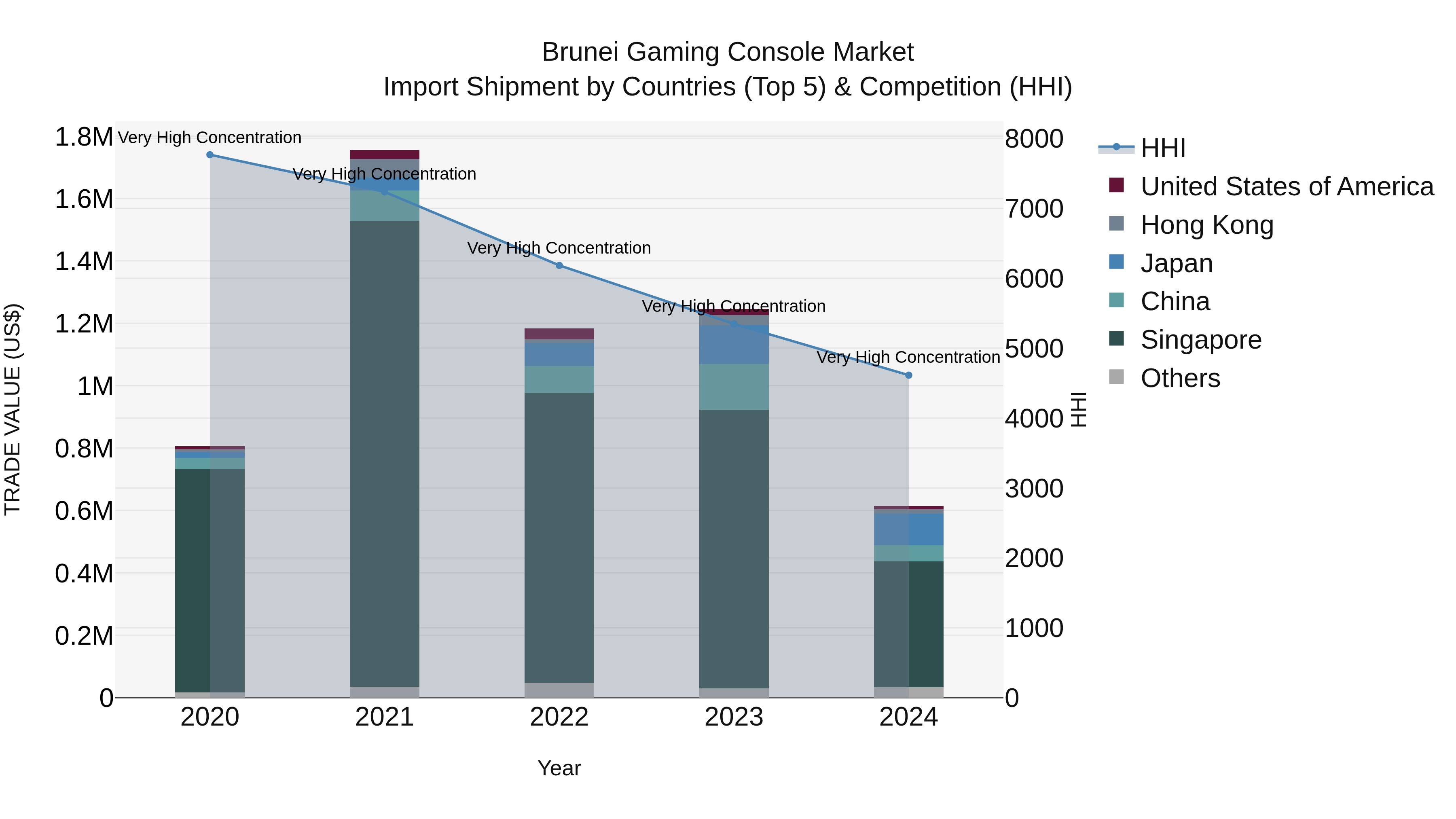
Brunei Gaming Console Market: Top 5 Importing Countries and Market Competition (HHI) Analysis
In 2024, Brunei gaming console import market continued to see a high concentration with top exporters being Singapore, Japan, China, Malaysia, and Hong Kong. Despite a negative CAGR of -6.53% from 2020 to 2024, the growth rate in 2024 significantly declined by -50.61%. This indicates a challenging market environment with potential shifts in consumer preferences or economic conditions impacting the demand for gaming consoles in Brunei. The dominance of key exporting countries suggests continued competition and potential market dynamics influencing import trends in the gaming console sector.
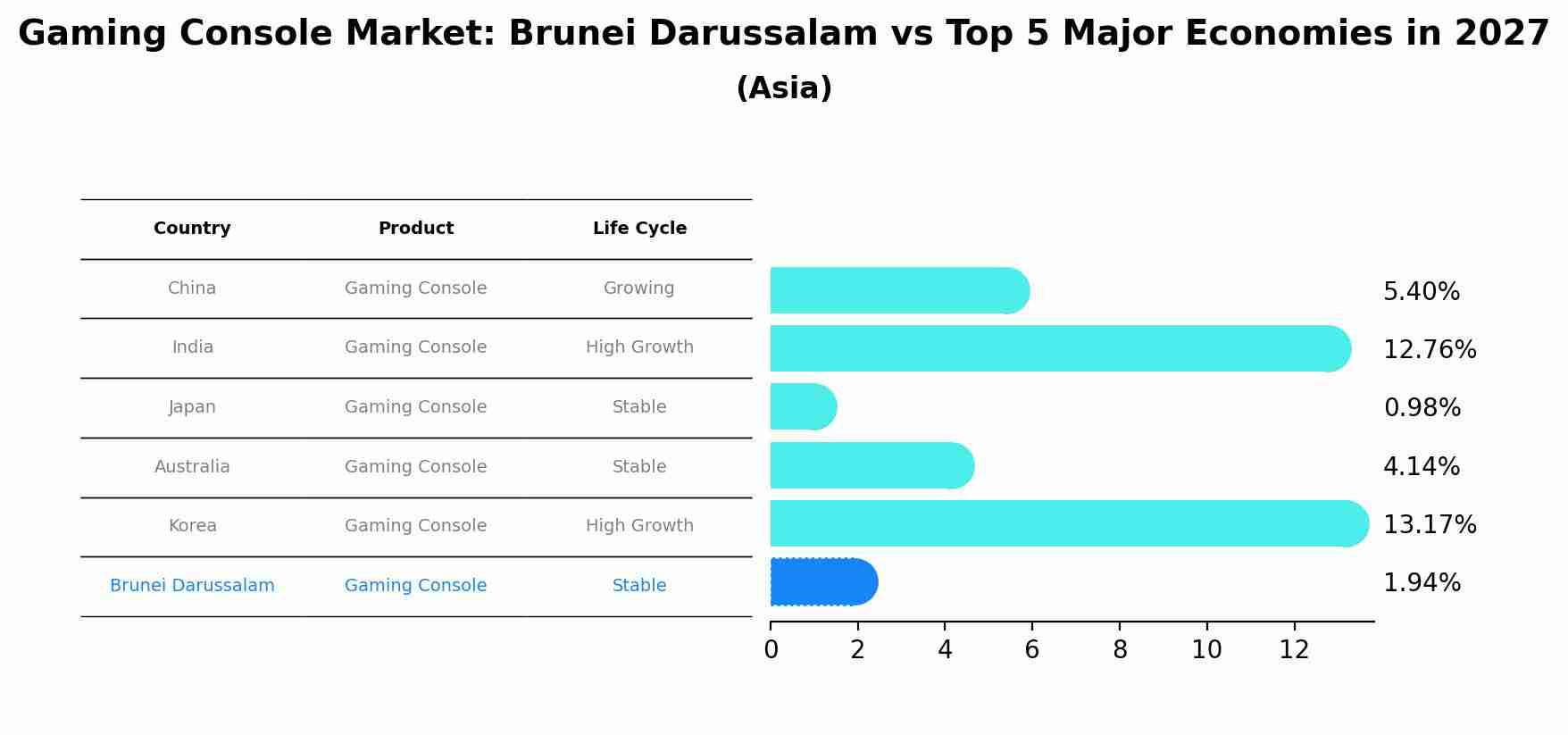
Gaming Console Market: Brunei Darussalam vs Top 5 Major Economies in 2027 (Asia)
In the Asia region, the Gaming Console market in Brunei Darussalam is projected to expand at a stable growth rate of 1.94% by 2027. The largest economy is China, followed by India, Japan, Australia and South Korea.
Key Highlights of the Report:
- Brunei Gaming Console Market Outlook
- Market Size of Brunei Gaming Console Market, 2025
- Forecast of Brunei Gaming Console Market, 2032
- Historical Data and Forecast of Brunei Gaming Console Revenues & Volume for the Period 2022 - 2032F
- Brunei Gaming Console Market Trend Evolution
- Brunei Gaming Console Market Drivers and Challenges
- Brunei Gaming Console Price Trends
- Brunei Gaming Console Porter`s Five Forces
- Brunei Gaming Console Industry Life Cycle
- Historical Data and Forecast of Brunei Gaming Console Market Revenues & Volume By Component for the Period 2022 - 2032F
- Historical Data and Forecast of Brunei Gaming Console Market Revenues & Volume By Hardware for the Period 2022 - 2032F
- Historical Data and Forecast of Brunei Gaming Console Market Revenues & Volume By Software for the Period 2022 - 2032F
- Historical Data and Forecast of Brunei Gaming Console Market Revenues & Volume By Type for the Period 2022 - 2032F
- Historical Data and Forecast of Brunei Gaming Console Market Revenues & Volume By Home Consoles for the Period 2022 - 2032F
- Historical Data and Forecast of Brunei Gaming Console Market Revenues & Volume By Handheld Consoles for the Period 2022 - 2032F
- Historical Data and Forecast of Brunei Gaming Console Market Revenues & Volume By Hybrid Consoles for the Period 2022 - 2032F
- Historical Data and Forecast of Brunei Gaming Console Market Revenues & Volume By Dedicated Consoles for the Period 2022 - 2032F
- Historical Data and Forecast of Brunei Gaming Console Market Revenues & Volume By Others for the Period 2022 - 2032F
- Historical Data and Forecast of Brunei Gaming Console Market Revenues & Volume By End-use for the Period 2022 - 2032F
- Historical Data and Forecast of Brunei Gaming Console Market Revenues & Volume By Personal for the Period 2022 - 2032F
- Historical Data and Forecast of Brunei Gaming Console Market Revenues & Volume By Commercial for the Period 2022 - 2032F
- Historical Data and Forecast of Brunei Gaming Console Market Revenues & Volume By Others for the Period 2022 - 2032F
- Brunei Gaming Console Import Export Trade Statistics
- Market Opportunity Assessment By Component
- Market Opportunity Assessment By Type
- Market Opportunity Assessment By End-use
- Brunei Gaming Console Top Companies Market Share
- Brunei Gaming Console Competitive Benchmarking By Technical and Operational Parameters
- Brunei Gaming Console Company Profiles
- Brunei Gaming Console Key Strategic Recommendations






































