Cambodia Contactless Payment Market Size & Growth Rate (2026-2032)
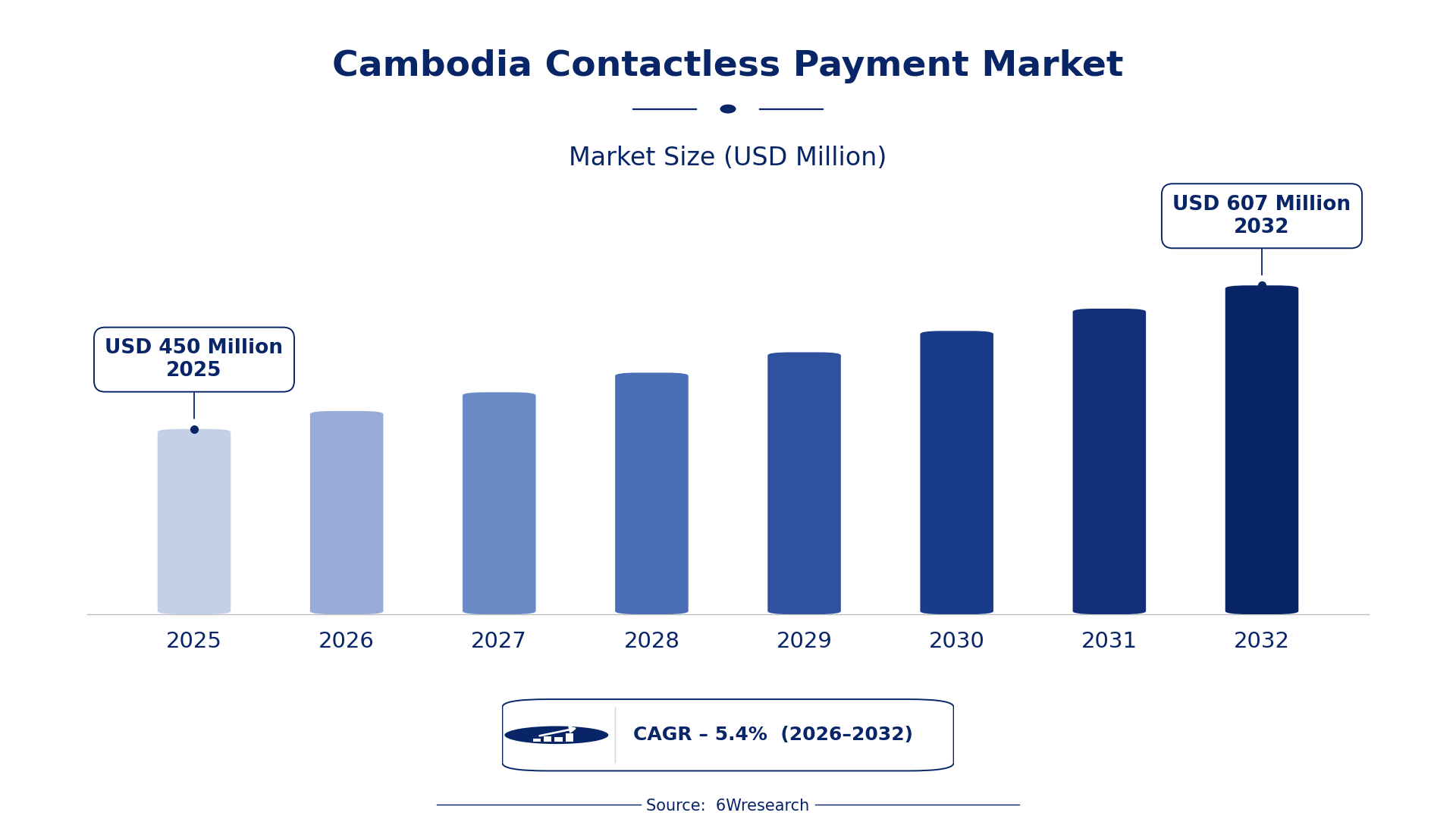
The Cambodia Contactless Payment Market was estimated at USD 450 Million in 2025 and is projected to reach USD 607 Million by 2032, growing at a CAGR of 5.4% from 2026 to 2032.
Cambodia Contactless Payment Market Synopsis
The Cambodian market is witnessing a notable shift towards contactless payment methods, driven by the increasing smartphone penetration and a young, tech-savvy population. This demographic is not just familiar with digital technology but is actively seeking faster and more secure payment options.
As the government pushes for digital financial inclusion, the acceptance of contactless payments is becoming more widespread across various sectors. Retailers, in particular, are adapting quickly to consumer demand, recognizing that speed and convenience can lead to improved customer satisfaction and loyalty.
Cambodia Contactless Payment Market Year-wise Growth Rate and Key Drivers
This graph illustrates the annual growth rates of the Cambodia Contactless Payment Market from 2021 to 2032, highlighting a steady upward trajectory and projected expansion over the forecast period.
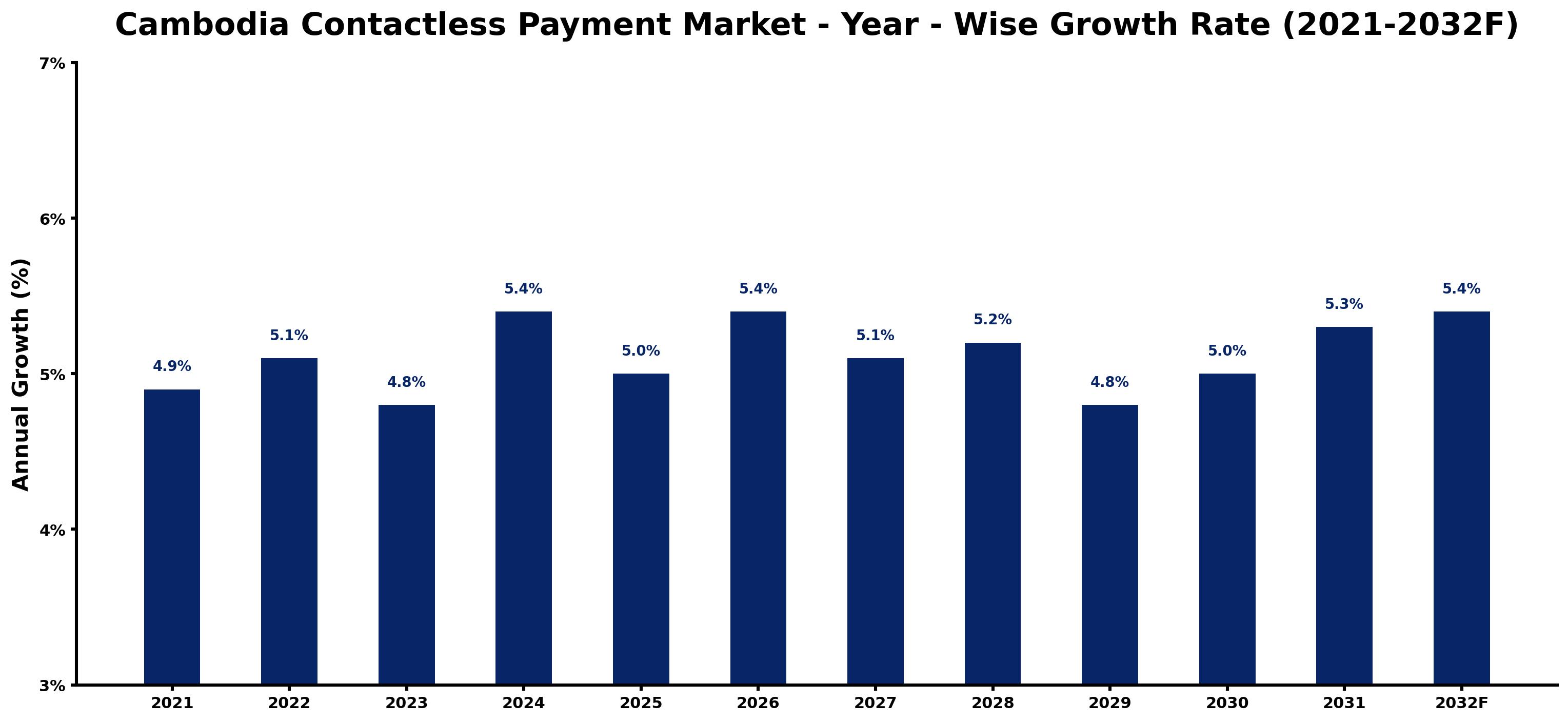
The table below presents the year‑wise growth rates along with the key drivers influencing the market
| Year | Growth Rate | Major Drivers |
| 2021 | 4.9% | Central Bank’s push for digital financial services. |
| 2022 | 5.1% | Increasing smartphone penetration among younger demographics. |
| 2023 | 4.8% | Government incentives for cashless transaction systems. |
| 2024 | 5.4% | Rising adoption of QR code payments by merchants. |
| 2025 | 5.0% | Tourism recovery boosting foreign contactless payment usage. |
| 2026 | 5.4% | Local fintech startups enhancing digital wallet offerings. |
| 2027 | 5.1% | Regulatory support for electronic payment innovations. |
| 2028 | 5.2% | Growing urban population fostering retail digitalization. |
| 2029 | 4.8% | Integration of contactless payments in transportation systems. |
| 2030 | 5.0% | Partnerships between banks and tech companies expansion. |
| 2031 | 5.3% | Increased consumer awareness of digital transaction safety. |
| 2032 | 5.4% | Enhanced internet connectivity driving mobile payment growth. |
Note: Market size estimations and growth projections presented in this report are based on 6Wresearch's proprietary forecasting methodology, utilizing the latest available industry data, government publications, and primary research inputs.
Cambodia Contactless Payment Market Key Takeaways
Below are some of the specific key takeaways from the market, including:
- Rapid adoption of mobile wallets and contactless payment solutions among consumers.
- Government initiatives actively promoting digital payment infrastructure and consumer awareness.
- Increasing presence of contactless-enabled POS terminals across retail and service sectors.
- Growing concerns about security and fraud necessitating enhanced consumer education and infrastructure investment.
- Significant opportunities for fintech companies to develop tailored solutions for Cambodian consumers.
Evaluation of Restraints in Cambodia Contactless Payment Market
Despite the momentum, the Cambodia Contactless Payment Market faces hurdles that could impede its growth. A primary concern is the limited acceptance infrastructure; many merchants still lack the necessary NFC-enabled terminals. This creates a gap between consumer readiness and merchant capability. on top of that, the lack of widespread consumer education about contactless payment security contributes to hesitation among potential users. Building trust and providing adequate infrastructure will be crucial for the market's sustained growth.
Cambodia Contactless Payment Market Trends
Several trends are currently shaping the Cambodia Contactless Payment Market. The integration of advanced security features such as biometric authentication is becoming increasingly common, addressing consumer concerns about fraud. Additionally, the rise of e-commerce is further fueling demand for contactless transactions, with more businesses recognizing the need to offer diverse payment options. Collaborations between fintech firms and traditional banks are also on the rise, leading to innovative solutions tailored to local needs.
Cambodia Contactless Payment Market Opportunities
Opportunities abound for stakeholders in the Cambodia Contactless Payment Market. The ongoing government push for digital financial services opens doors for new entrants, especially fintech companies. By developing user-friendly applications and expanding merchant networks, these firms can capture a growing customer base. on top of that, targeting rural areas with tailored contactless solutions can significantly enhance financial inclusion, thereby driving further market growth.
Government Initiatives in the Cambodia Contactless Payment Market
The Cambodian government is actively fostering a conducive environment for contactless payment solutions. Through various regulatory reforms, the administration aims to enhance interoperability among payment systems, making digital transactions more accessible to the public. Such policies not only promote financial inclusion but also aim to instill consumer confidence in cashless transactions.
- A national digital infrastructure upgrade programme launched recently to enhance the connectivity and capacity of payment systems.
- Ongoing regulatory reforms focusing on reducing transaction costs and enhancing consumer protection in digital payments.
- Collaboration with international organizations to implement consumer education initiatives highlighting the benefits and security of contactless payments.
- Planned public-private partnerships aimed at expanding the acceptance network for contactless payments in underserved areas.
Future Insights of the Cambodia Contactless Payment Market
Looking ahead to 2026-2032, the Cambodia Contactless Payment Market is set to experience robust growth. The combination of increased smartphone usage and proactive government policies will likely catalyze broader acceptance of contactless payments. As security measures improve and consumer awareness grows, more individuals will transition away from cash, further embedding contactless payment methods into daily life. The alignment of technology with consumer needs will be essential for sustained market momentum.
Cambodia Contactless Payment Market Latest Developments
In the past year, the Cambodia Contactless Payment Market has seen various significant developments. The growing embrace of digital payments has prompted several businesses to enhance their service offerings, driving innovation and competition within the sector.
- Launch of a new mobile wallet application in Q1 2025 that integrates advanced security features and user-friendly interfaces.
- A major technology vendor announced the rollout of contactless payment solutions to over 1,000 retail locations across Phnom Penh, completed by late 2025.
- Ongoing partnership between local banks and fintech startups to create tailored financial products catering to small and medium enterprises.
- Upcoming initiative expected to begin in mid-2026, aiming to establish NFC-enabled payment terminals in rural areas to boost financial inclusion.
Cambodia Contactless Payment Market - Key Attractiveness of the Report
- 10 Years of Market Numbers
- Historical Data Starting from 2022 to 2025
- Base Year: 2025
- Forecast Data until 2032
- Key Performance Indicators Impacting the Market
- Major Upcoming Developments and Projects
Key Highlights of the Report:
- Cambodia Contactless Payment Market Outlook
- Market Size of Cambodia Contactless Payment Market, 2025
- Forecast of Cambodia Contactless Payment Market, 2032
- Historical Data and Forecast of Cambodia Contactless Payment Revenues & Volume for the Period 2022-2032F
- Cambodia Contactless Payment Market Trend Evolution
- Cambodia Contactless Payment Market Drivers and Challenges
- Cambodia Contactless Payment Price Trends
- Cambodia Contactless Payment Porter's Five Forces
- Cambodia Contactless Payment Industry Life Cycle
- Historical Data and Forecast of Cambodia Contactless Payment Market Revenues & Volume By Component for the Period 2022-2032F
- Historical Data and Forecast of Cambodia Contactless Payment Market Revenues & Volume By Hardware for the Period 2022-2032F
- Historical Data and Forecast of Cambodia Contactless Payment Market Revenues & Volume By Solutions for the Period 2022-2032F
- Historical Data and Forecast of Cambodia Contactless Payment Market Revenues & Volume By Services for the Period 2022-2032F
- Historical Data and Forecast of Cambodia Contactless Payment Market Revenues & Volume By Vertical for the Period 2022-2032F
- Historical Data and Forecast of Cambodia Contactless Payment Market Revenues & Volume By Retail for the Period 2022-2032F
- Historical Data and Forecast of Cambodia Contactless Payment Market Revenues & Volume By Hospitality for the Period 2022-2032F
- Historical Data and Forecast of Cambodia Contactless Payment Market Revenues & Volume By Healthcare for the Period 2022-2032F
- Historical Data and Forecast of Cambodia Contactless Payment Market Revenues & Volume By Energy and Utilities for the Period 2022-2032F
- Historical Data and Forecast of Cambodia Contactless Payment Market Revenues & Volume By Transportation and Logistics for the Period 2022-2032F
- Historical Data and Forecast of Cambodia Contactless Payment Market Revenues & Volume By BFSI for the Period 2022-2032F
- Historical Data and Forecast of Cambodia Contactless Payment Market Revenues & Volume By Others (Government, telecommunications, and education) for the Period 2022-2032F
- Cambodia Contactless Payment Import Export Trade Statistics
- Market Opportunity Assessment By Component
- Market Opportunity Assessment By Vertical
- Cambodia Contactless Payment Top Companies Market Share
- Cambodia Contactless Payment Competitive Benchmarking By Technical and Operational Parameters
- Cambodia Contactless Payment Company Profiles
- Cambodia Contactless Payment Key Strategic Recommendations






































