Cameroon Electric Mobility Market: Top 5 Importing Countries and Market Competition (HHI) Analysis
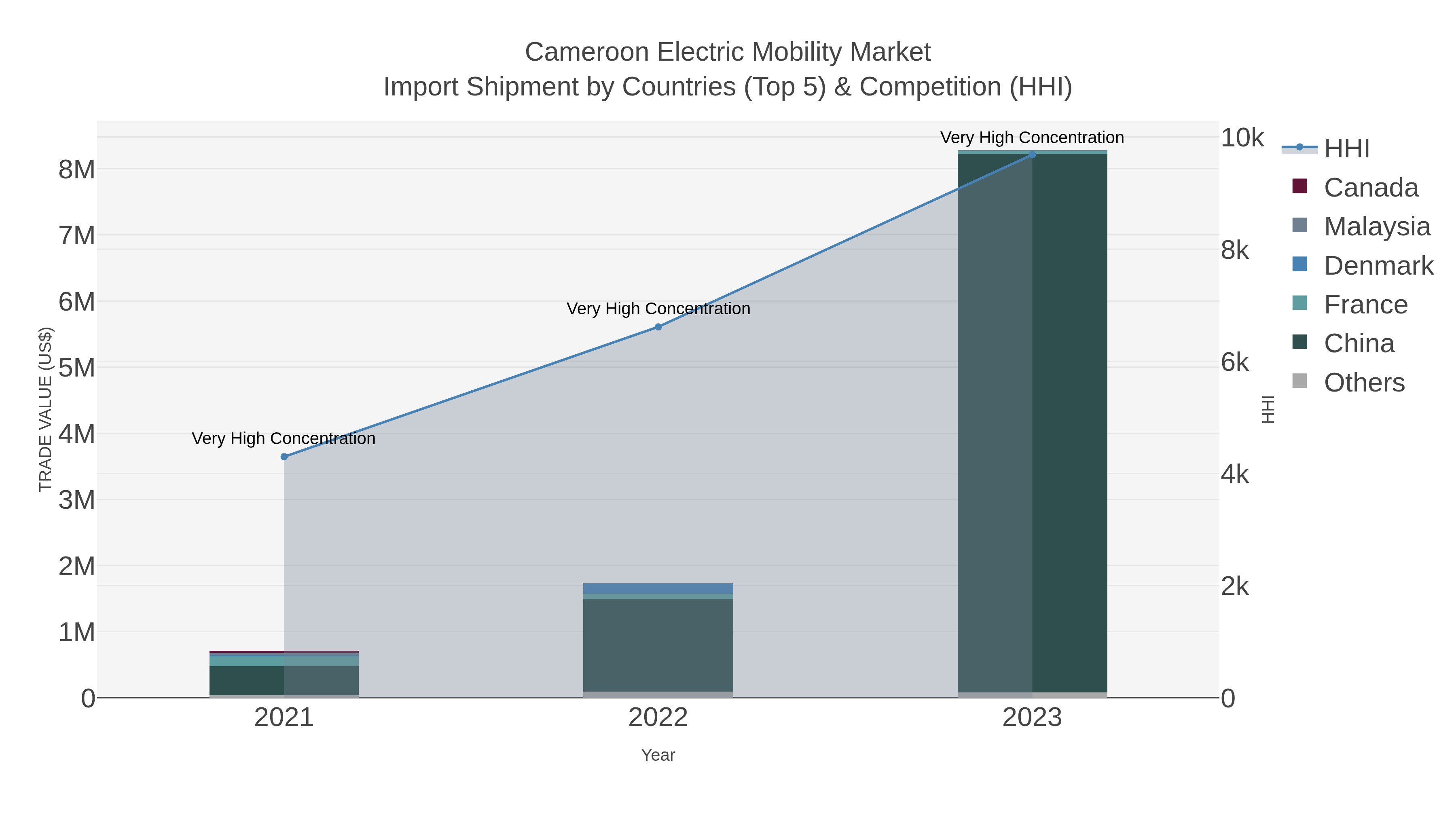
Electric mobility import shipments to Cameroon saw a significant surge in 2023, with top exporters including China, France, Turkey, United Kingdom, and Germany. Despite the high concentration with a very high Herfindahl-Hirschman Index (HHI), the industry demonstrated remarkable growth with a Compound Annual Growth Rate (CAGR) of 241.02 and a growth rate of 377.7. This data suggests a strong demand for electric vehicles in Cameroon, with key exporters continuing to capitalize on this expanding market opportunity.
Cameroon Electric Mobility Market Overview
The Cameroon Electric Mobility Market is gradually gaining traction as the government and private sector focus on reducing carbon emissions and promoting sustainable transportation solutions. The market is primarily driven by initiatives to combat air pollution and decrease reliance on fossil fuels. Electric vehicles, including cars, motorcycles, and bicycles, are increasingly being adopted in major cities like Douala and Yaoundé. However, challenges such as limited charging infrastructure, high initial costs, and lack of awareness hinder widespread adoption. Government incentives, such as tax breaks and subsidies, are being introduced to encourage the transition to electric vehicles. Overall, the market shows promise for growth as awareness increases and infrastructure development progresses.
Cameroon Electric Mobility Market Trends and Opportunities
The Cameroon Electric Mobility Market is experiencing significant growth due to increasing awareness of environmental sustainability and government incentives promoting the adoption of electric vehicles. Key trends include a growing demand for electric motorcycles and bicycles for urban transportation, as well as the development of charging infrastructure in major cities. Opportunities in the market include partnerships between local governments and private sector companies to expand electric vehicle infrastructure, as well as the introduction of innovative mobility solutions such as electric ride-sharing services. With the government`s commitment to reducing carbon emissions and promoting clean energy, the Cameroon Electric Mobility Market presents a promising landscape for investment and growth in the coming years.
Cameroon Electric Mobility Market Challenges
In the Cameroon Electric Mobility Market, several challenges are faced, including limited infrastructure for electric vehicle charging stations, high initial costs of electric vehicles, lack of government incentives and policies to promote electric mobility, inadequate consumer awareness and education about the benefits of electric vehicles, and potential concerns regarding the reliability of charging infrastructure. Additionally, the country`s power grid may not be equipped to handle the increased demand from a growing number of electric vehicles, leading to potential strain on resources. Overcoming these challenges will require collaborative efforts between the government, private sector, and stakeholders to invest in infrastructure development, provide financial incentives, raise awareness, and address regulatory barriers to foster the growth of electric mobility in Cameroon.
Cameroon Electric Mobility Market Drivers
The Cameroon Electric Mobility Market is primarily being driven by the increasing awareness of environmental sustainability and the need to reduce greenhouse gas emissions. Government initiatives and policies promoting electric vehicles, such as tax incentives and subsidies, are also fueling the growth of the market. Additionally, rising fuel prices and the desire for energy independence are pushing consumers towards electric vehicles as a more cost-effective and efficient transportation option. The advancement in technology, including improvements in battery life and charging infrastructure, is further accelerating the adoption of electric vehicles in Cameroon. Overall, these factors are driving the growth of the electric mobility market in Cameroon and shaping a more sustainable future for the transportation sector.
Cameroon Electric Mobility Market Government Policy
In Cameroon, government policies related to the electric mobility market primarily focus on promoting the adoption and usage of electric vehicles to reduce greenhouse gas emissions and dependence on fossil fuels. The government has implemented various initiatives such as tax incentives and subsidies to encourage the purchase of electric vehicles, as well as the development of charging infrastructure across the country. Additionally, there are regulations in place to ensure the safety and performance standards of electric vehicles, as well as to promote research and development in the electric mobility sector. Overall, the government is actively supporting the growth of the electric mobility market in Cameroon through a combination of financial incentives, infrastructure development, and regulatory frameworks.
Cameroon Electric Mobility Market Future Outlook
The future outlook for the Cameroon Electric Mobility Market looks promising as the government is increasingly focusing on sustainable development and reducing carbon emissions. With growing awareness about the environmental benefits of electric vehicles (EVs) and the need to combat air pollution, there is a rising interest among consumers and businesses in adopting EVs. The government has also implemented policies to promote the use of EVs, such as tax incentives and subsidies for EV purchases. Additionally, the improving infrastructure for charging stations and advancements in battery technology are likely to further drive the adoption of electric vehicles in Cameroon. Overall, the Cameroon Electric Mobility Market is expected to witness significant growth in the coming years, offering opportunities for both local and international players in the industry.
Key Highlights of the Report:
- Cameroon Electric Mobility Market Outlook
- Market Size of Cameroon Electric Mobility Market, 2024
- Forecast of Cameroon Electric Mobility Market, 2031
- Historical Data and Forecast of Cameroon Electric Mobility Revenues & Volume for the Period 2021- 2031
- Cameroon Electric Mobility Market Trend Evolution
- Cameroon Electric Mobility Market Drivers and Challenges
- Cameroon Electric Mobility Price Trends
- Cameroon Electric Mobility Porter's Five Forces
- Cameroon Electric Mobility Industry Life Cycle
- Historical Data and Forecast of Cameroon Electric Mobility Market Revenues & Volume By Product for the Period 2021- 2031
- Historical Data and Forecast of Cameroon Electric Mobility Market Revenues & Volume By Electric Bikes for the Period 2021- 2031
- Historical Data and Forecast of Cameroon Electric Mobility Market Revenues & Volume By Electric Scooters for the Period 2021- 2031
- Historical Data and Forecast of Cameroon Electric Mobility Market Revenues & Volume By Electric Motorized Scooters for the Period 2021- 2031
- Historical Data and Forecast of Cameroon Electric Mobility Market Revenues & Volume By Electric Motorcycles for the Period 2021- 2031
- Historical Data and Forecast of Cameroon Electric Mobility Market Revenues & Volume By Drive for the Period 2021- 2031
- Historical Data and Forecast of Cameroon Electric Mobility Market Revenues & Volume By Belt Drive for the Period 2021- 2031
- Historical Data and Forecast of Cameroon Electric Mobility Market Revenues & Volume By Chain Drive for the Period 2021- 2031
- Historical Data and Forecast of Cameroon Electric Mobility Market Revenues & Volume By Hub Drive for the Period 2021- 2031
- Historical Data and Forecast of Cameroon Electric Mobility Market Revenues & Volume By Battery for the Period 2021- 2031
- Historical Data and Forecast of Cameroon Electric Mobility Market Revenues & Volume By Lead Acid Battery for the Period 2021- 2031
- Historical Data and Forecast of Cameroon Electric Mobility Market Revenues & Volume By Li-Ion Battery for the Period 2021- 2031
- Historical Data and Forecast of Cameroon Electric Mobility Market Revenues & Volume By End-use for the Period 2021- 2031
- Historical Data and Forecast of Cameroon Electric Mobility Market Revenues & Volume By Personal for the Period 2021- 2031
- Historical Data and Forecast of Cameroon Electric Mobility Market Revenues & Volume By Commercial for the Period 2021- 2031
- Cameroon Electric Mobility Import Export Trade Statistics
- Market Opportunity Assessment By Product
- Market Opportunity Assessment By Drive
- Market Opportunity Assessment By Battery
- Market Opportunity Assessment By End-use
- Cameroon Electric Mobility Top Companies Market Share
- Cameroon Electric Mobility Competitive Benchmarking By Technical and Operational Parameters
- Cameroon Electric Mobility Company Profiles
- Cameroon Electric Mobility Key Strategic Recommendations






































