Cameroon Mobility Scooter Market: Top 5 Importing Countries and Market Competition (HHI) Analysis
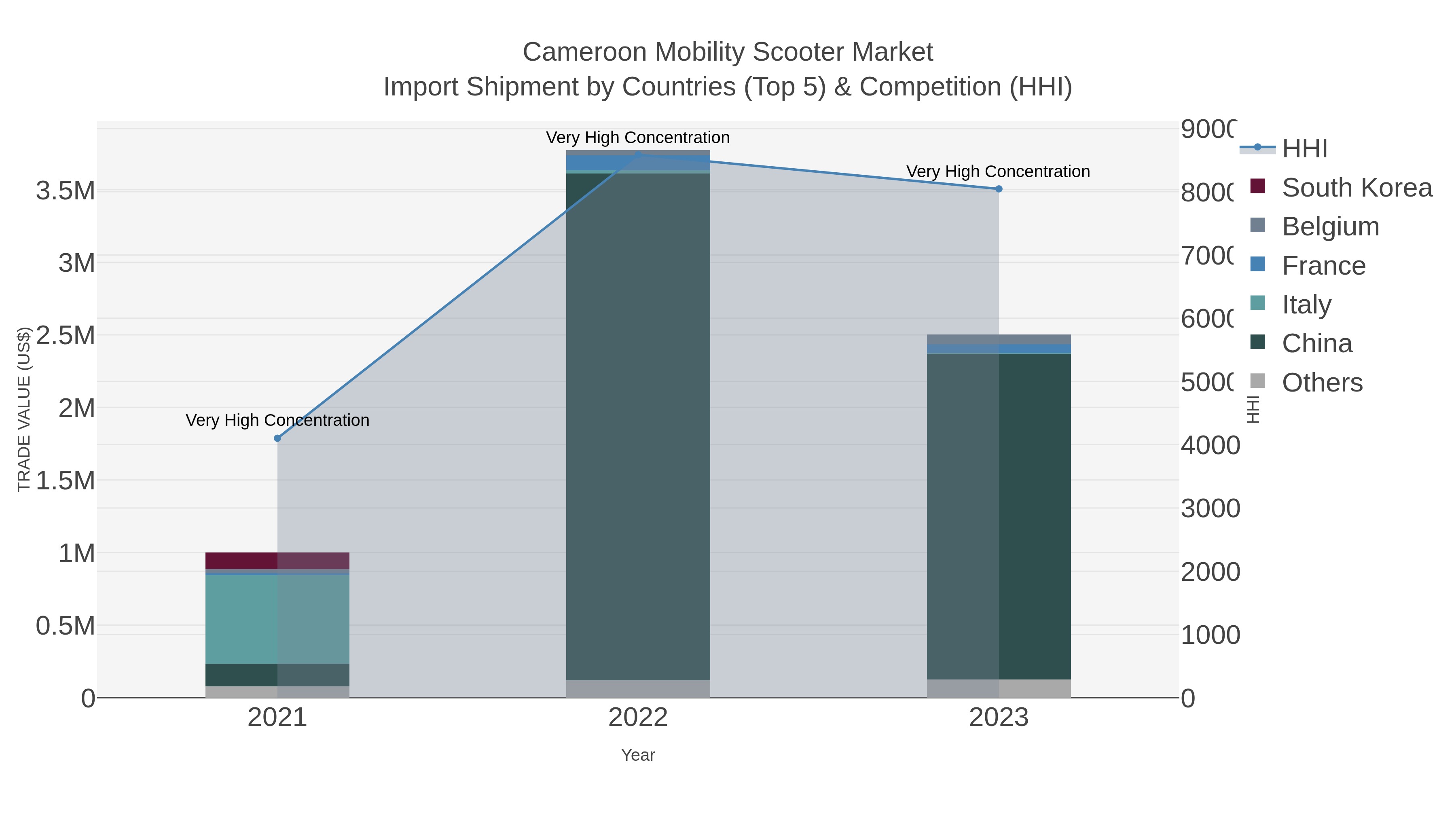
In 2023, Cameroon saw a significant rise in mobility scooter imports, with China, Belgium, France, UAE, and the UK emerging as top exporters. Despite high concentration levels, the market experienced a notable Compound Annual Growth Rate (CAGR) of 58.25%. However, the growth rate dipped to -33.66%, possibly indicating temporary market fluctuations. As demand for mobility scooters continues to increase in Cameroon, these export trends highlight the competitive landscape and potential opportunities for market players to capitalize on the growing market.
Cameroon Mobility Scooter Market Overview
The Cameroon Mobility Scooter Market is witnessing growth driven by factors such as the rising elderly population, increasing prevalence of mobility impairments, and improving healthcare infrastructure. Mobility scooters are becoming popular due to their convenience and affordability, offering individuals with limited mobility greater independence and mobility. The market is characterized by a mix of local and international manufacturers offering a variety of products catering to different needs and budgets. Key players are focusing on product innovation, lightweight designs, and enhanced battery life to attract a wider consumer base. Government initiatives to improve accessibility and inclusivity for people with disabilities are also driving market growth. However, challenges such as lack of awareness, limited distribution channels, and affordability constraints in rural areas are hindering market expansion. Overall, the Cameroon Mobility Scooter Market shows promising growth potential with a focus on enhancing accessibility and quality of life for individuals with mobility issues.
Cameroon Mobility Scooter Market Trends
The Cameroon Mobility Scooter Market is witnessing a growing demand driven by an increasing aging population, rising awareness about accessibility options, and improving healthcare infrastructure. Consumers are increasingly looking for lightweight and portable mobility scooters that offer ease of maneuverability and enhanced battery life. There is also a growing trend towards the adoption of advanced features such as adjustable seating, ergonomic designs, and customizable accessories. Companies in the market are focusing on developing innovative and technologically advanced products to cater to the evolving needs of consumers. Additionally, there is a rising emphasis on eco-friendly mobility solutions, leading to the introduction of electric-powered mobility scooters. Overall, the Cameroon Mobility Scooter Market is expected to continue growing as the population ages and demand for convenient mobility solutions increases.
Cameroon Mobility Scooter Market Challenges
In the Cameroon Mobility Scooter Market, there are several challenges that hinder its growth. These challenges include the high cost of mobility scooters, which makes them unaffordable for many individuals in the country, especially those from low-income backgrounds. Additionally, there is a lack of awareness and education about the benefits and availability of mobility scooters among potential users and healthcare professionals. Infrastructure limitations, such as poor road conditions and lack of accessibility features in public spaces, also pose challenges for mobility scooter users in Cameroon. Moreover, limited distribution channels and after-sales support further impede the market`s development. Overall, addressing these challenges through targeted pricing strategies, awareness campaigns, infrastructure improvements, and enhanced distribution networks is crucial for the growth of the Cameroon Mobility Scooter Market.
Cameroon Mobility Scooter Market Investment Opportunities
The Cameroon Mobility Scooter Market presents promising investment opportunities due to the increasing demand for mobility aids among the elderly and individuals with mobility impairments. With a growing aging population and rising awareness about the benefits of mobility scooters in enhancing independence and quality of life, there is a clear market potential for manufacturers, distributors, and retailers in this sector. Additionally, the government`s efforts to improve accessibility and infrastructure for people with disabilities further support the growth of the mobility scooter market. Investors can explore opportunities in expanding distribution networks, introducing innovative and affordable product offerings, and leveraging digital marketing to reach a wider customer base in Cameroon`s evolving mobility aid market.
Cameroon Mobility Scooter Market Government Policy
In Cameroon, the government has not implemented specific policies directly targeting the mobility scooter market. However, the country has a general framework for the importation and regulation of medical devices, which could indirectly affect the mobility scooter market. Importing mobility scooters may require compliance with quality standards and registration with relevant authorities. Additionally, there may be regulations related to accessibility and infrastructure development to accommodate mobility devices in public spaces. As the market for mobility scooters grows in Cameroon, there could be opportunities for the government to introduce specific policies or incentives to support the industry and improve access to mobility devices for individuals with disabilities or mobility limitations.
Cameroon Mobility Scooter Market Future Outlook
The future outlook for the Cameroon Mobility Scooter Market is promising, fueled by several factors including an aging population, increased awareness about mobility aids, improving healthcare infrastructure, and rising disposable incomes. As the demand for mobility solutions grows, manufacturers are likely to introduce more advanced and technologically innovative products to cater to the evolving needs of consumers. Additionally, government initiatives aimed at improving accessibility and inclusivity for individuals with mobility issues are expected to further drive market growth. With a focus on enhancing convenience, comfort, and overall quality of life for users, the Cameroon Mobility Scooter Market is poised for expansion in the coming years, presenting opportunities for both local and international players to capitalize on this growing sector.
Key Highlights of the Report:
- Cameroon Mobility Scooter Market Outlook
- Market Size of Cameroon Mobility Scooter Market, 2024
- Forecast of Cameroon Mobility Scooter Market, 2031
- Historical Data and Forecast of Cameroon Mobility Scooter Revenues & Volume for the Period 2021- 2031
- Cameroon Mobility Scooter Market Trend Evolution
- Cameroon Mobility Scooter Market Drivers and Challenges
- Cameroon Mobility Scooter Price Trends
- Cameroon Mobility Scooter Porter's Five Forces
- Cameroon Mobility Scooter Industry Life Cycle
- Historical Data and Forecast of Cameroon Mobility Scooter Market Revenues & Volume By Type for the Period 2021- 2031
- Historical Data and Forecast of Cameroon Mobility Scooter Market Revenues & Volume By Small (Less than 110cm) for the Period 2021- 2031
- Historical Data and Forecast of Cameroon Mobility Scooter Market Revenues & Volume By Medium (110-150cm) for the Period 2021- 2031
- Historical Data and Forecast of Cameroon Mobility Scooter Market Revenues & Volume By Large (More than 150cm) for the Period 2021- 2031
- Historical Data and Forecast of Cameroon Mobility Scooter Market Revenues & Volume By Application for the Period 2021- 2031
- Historical Data and Forecast of Cameroon Mobility Scooter Market Revenues & Volume By In-House for the Period 2021- 2031
- Historical Data and Forecast of Cameroon Mobility Scooter Market Revenues & Volume By Outdoor for the Period 2021- 2031
- Historical Data and Forecast of Cameroon Mobility Scooter Market Revenues & Volume By Off-Road for the Period 2021- 2031
- Historical Data and Forecast of Cameroon Mobility Scooter Market Revenues & Volume By Number of Wheels for the Period 2021- 2031
- Historical Data and Forecast of Cameroon Mobility Scooter Market Revenues & Volume By Three Wheels for the Period 2021- 2031
- Historical Data and Forecast of Cameroon Mobility Scooter Market Revenues & Volume By Four Wheels for the Period 2021- 2031
- Historical Data and Forecast of Cameroon Mobility Scooter Market Revenues & Volume By Others for the Period 2021- 2031
- Historical Data and Forecast of Cameroon Mobility Scooter Market Revenues & Volume By Battery Range for the Period 2021- 2031
- Historical Data and Forecast of Cameroon Mobility Scooter Market Revenues & Volume By Less than 10 Miles for the Period 2021- 2031
- Historical Data and Forecast of Cameroon Mobility Scooter Market Revenues & Volume By 10-20 Miles for the Period 2021- 2031
- Historical Data and Forecast of Cameroon Mobility Scooter Market Revenues & Volume By More than 20 Miles for the Period 2021- 2031
- Historical Data and Forecast of Cameroon Mobility Scooter Market Revenues & Volume By End use for the Period 2021- 2031
- Historical Data and Forecast of Cameroon Mobility Scooter Market Revenues & Volume By Personal Use for the Period 2021- 2031
- Historical Data and Forecast of Cameroon Mobility Scooter Market Revenues & Volume By Institutional Use for the Period 2021- 2031
- Cameroon Mobility Scooter Import Export Trade Statistics
- Market Opportunity Assessment By Type
- Market Opportunity Assessment By Application
- Market Opportunity Assessment By Number of Wheels
- Market Opportunity Assessment By Battery Range
- Market Opportunity Assessment By End use
- Cameroon Mobility Scooter Top Companies Market Share
- Cameroon Mobility Scooter Competitive Benchmarking By Technical and Operational Parameters
- Cameroon Mobility Scooter Company Profiles
- Cameroon Mobility Scooter Key Strategic Recommendations






































