Cameroon Natural Vanillin Market: Top 5 Importing Countries and Market Competition (HHI) Analysis
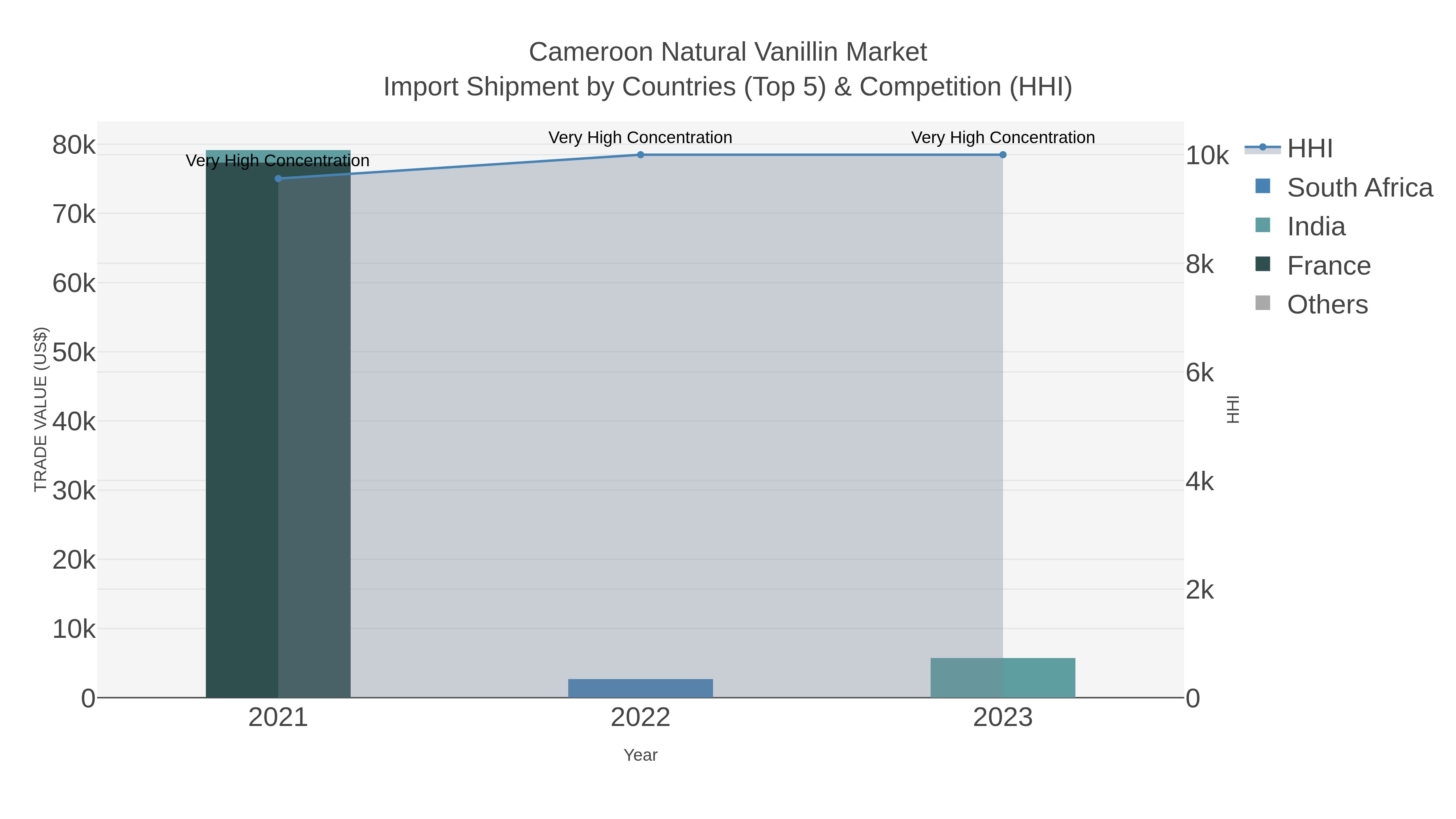
In 2023, Cameroon continued to rely on imports of natural vanillin, with top exporters being India, France, and South Africa. The market remained highly concentrated, with a high Herfindahl-Hirschman Index (HHI), indicating limited competition. Despite a significant negative compound annual growth rate (CAGR) of -73.07, the growth rate surged by 114.39 in the same period, suggesting potential opportunities for market expansion and development in the coming years. The dynamics of the natural vanillin import market in Cameroon are evolving, presenting both challenges and prospects for exporters and stakeholders.
Cameroon Natural Vanillin Market Overview
The natural vanillin market in Cameroon is developing as the demand for natural flavoring agents in food and beverage products increases. Natural vanillin, derived from vanilla beans, offers a more authentic flavor compared to synthetic vanillin. The market growth is supported by the rising popularity of natural and organic products, the expansion of the vanilla industry, and the increasing use of natural flavors in gourmet and specialty foods.
Drivers of the market
The natural vanillin market in Cameroon is primarily driven by the rising demand for natural and organic flavors in the food and beverage industry. As consumers become more health-conscious and seek natural ingredients, there is a growing preference for natural vanillin over synthetic alternatives. The expansion of the food and beverage sector, along with the increasing use of natural vanillin in perfumes and pharmaceuticals, supports market growth.
Challenges of the market
The Natural Vanillin Market in Cameroon faces challenges such as high production costs and limited local manufacturing capabilities. There is a lack of awareness about the benefits of natural vanillin compared to synthetic alternatives. Technical issues related to vanillin extraction and quality control further constrain market growth. Additionally, regulatory uncertainties and the absence of supportive policies for flavor and fragrance products create significant obstacles.
Government Policy of the market
To advance the natural vanillin market, the Cameroonian government supports the production and use of natural vanillin as an alternative to synthetic vanillin. Policies include offering incentives for local manufacturing and improving regulatory standards for product quality and safety. The government is also focused on promoting research and development in the natural vanillin sector and expanding market opportunities.
Key Highlights of the Report:
- Cameroon Natural Vanillin Market Outlook
- Market Size of Cameroon Natural Vanillin Market, 2024
- Forecast of Cameroon Natural Vanillin Market, 2031
- Historical Data and Forecast of Cameroon Natural Vanillin Revenues & Volume for the Period 2021-2031
- Cameroon Natural Vanillin Market Trend Evolution
- Cameroon Natural Vanillin Market Drivers and Challenges
- Cameroon Natural Vanillin Price Trends
- Cameroon Natural Vanillin Porter`s Five Forces
- Cameroon Natural Vanillin Industry Life Cycle
- Historical Data and Forecast of Cameroon Natural Vanillin Market Revenues & Volume By Source for the Period 2021-2031
- Historical Data and Forecast of Cameroon Natural Vanillin Market Revenues & Volume By Vanilla Bean Extract for the Period 2021-2031
- Historical Data and Forecast of Cameroon Natural Vanillin Market Revenues & Volume By Ferulic Acid Synthesis for the Period 2021-2031
- Historical Data and Forecast of Cameroon Natural Vanillin Market Revenues & Volume By Eugenol Synthesis for the Period 2021-2031
- Historical Data and Forecast of Cameroon Natural Vanillin Market Revenues & Volume By Application for the Period 2021-2031
- Historical Data and Forecast of Cameroon Natural Vanillin Market Revenues & Volume By Food & Beverages for the Period 2021-2031
- Historical Data and Forecast of Cameroon Natural Vanillin Market Revenues & Volume By Pharmaceuticals for the Period 2021-2031
- Historical Data and Forecast of Cameroon Natural Vanillin Market Revenues & Volume By Cosmetics & Personal Care for the Period 2021-2031
- Cameroon Natural Vanillin Import Export Trade Statistics
- Market Opportunity Assessment By Source
- Market Opportunity Assessment By Application
- Cameroon Natural Vanillin Top Companies Market Share
- Cameroon Natural Vanillin Competitive Benchmarking By Technical and Operational Parameters
- Cameroon Natural Vanillin Company Profiles
- Cameroon Natural Vanillin Key Strategic Recommendations






































