Cameroon Non-alcoholic Drink Market: Top 5 Importing Countries and Market Competition (HHI) Analysis
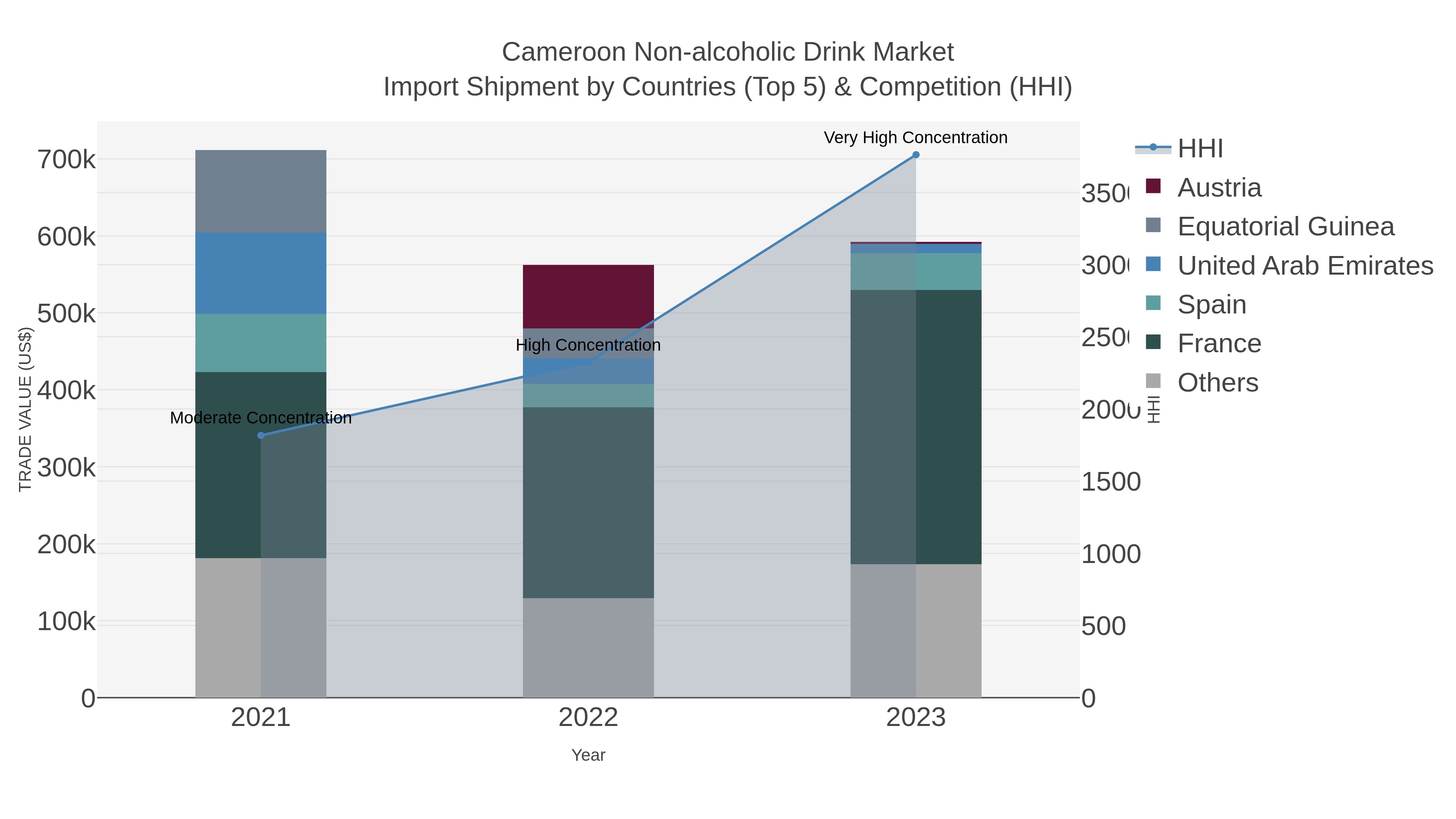
In 2023, Cameroon saw a significant shift in the non-alcoholic drink import market, with top exporters being France, Spain, Belgium, Brazil, and Poland. The market concentration, as measured by the Herfindahl-Hirschman Index (HHI), increased from high to very high concentration, indicating a more competitive landscape. Despite a negative compound annual growth rate (CAGR) of -8.74%, the industry still experienced a growth rate of 5.4%, signaling potential opportunities for both importers and local distributors in the market.
Cameroon Non-alcoholic Drink Market Overview
The Non-alcoholic Drink market in Cameroon is expanding as consumers seek a variety of beverage options that do not contain alcohol. This market includes soft drinks, fruit juices, flavored waters, and other non-alcoholic beverages. The growth is driven by increasing health consciousness, the rising demand for diverse beverage choices, and the expanding food and beverage industry. Innovations in product flavors, packaging, and marketing strategies contribute to the market`s development.
Drivers of the market
The non-alcoholic drink market in Cameroon is driven by the increasing consumer preference for healthier beverage options. As awareness of health and wellness rises, there is growing demand for non-alcoholic beverages, including fruit juices, flavored waters, and herbal teas. The expansion of the food and beverage industry, along with innovations in product offerings and packaging, supports market growth. Additionally, the rising disposable income and changing lifestyle habits contribute to the demand for non-alcoholic drinks.
Challenges of the market
Challenges in the Non-alcoholic Drink Market in Cameroon include high production and distribution costs and limited local manufacturing capabilities. There is a lack of awareness among consumers about the benefits and variety of non-alcoholic beverages. Technical issues related to product quality and safety further affect market growth. Additionally, regulatory hurdles and the absence of supportive policies for the beverage industry create significant obstacles.
Government Policy of the market
To support the non-alcoholic drink market, the Cameroonian government is promoting the production and distribution of non-alcoholic beverages. Policies include offering incentives for local manufacturing and improving regulatory standards to ensure product safety and quality. The government is also focused on expanding market access for non-alcoholic drinks and supporting innovation in the beverage sector.
Key Highlights of the Report:
- Cameroon Non-alcoholic Drink Market Outlook
- Market Size of Cameroon Non-alcoholic Drink Market, 2024
- Forecast of Cameroon Non-alcoholic Drink Market, 2031
- Historical Data and Forecast of Cameroon Non-alcoholic Drink Revenues & Volume for the Period 2021-2031
- Cameroon Non-alcoholic Drink Market Trend Evolution
- Cameroon Non-alcoholic Drink Market Drivers and Challenges
- Cameroon Non-alcoholic Drink Price Trends
- Cameroon Non-alcoholic Drink Porter`s Five Forces
- Cameroon Non-alcoholic Drink Industry Life Cycle
- Historical Data and Forecast of Cameroon Non-alcoholic Drink Market Revenues & Volume By Product Types for the Period 2021-2031
- Historical Data and Forecast of Cameroon Non-alcoholic Drink Market Revenues & Volume By CarbonatedDrinks for the Period 2021-2031
- Historical Data and Forecast of Cameroon Non-alcoholic Drink Market Revenues & Volume By Non-CarbonatedDrinks for the Period 2021-2031
- Historical Data and Forecast of Cameroon Non-alcoholic Drink Market Revenues & Volume By Distribution Channel for the Period 2021-2031
- Historical Data and Forecast of Cameroon Non-alcoholic Drink Market Revenues & Volume By Online for the Period 2021-2031
- Historical Data and Forecast of Cameroon Non-alcoholic Drink Market Revenues & Volume By Offline for the Period 2021-2031
- Cameroon Non-alcoholic Drink Import Export Trade Statistics
- Market Opportunity Assessment By Product Types
- Market Opportunity Assessment By Distribution Channel
- Cameroon Non-alcoholic Drink Top Companies Market Share
- Cameroon Non-alcoholic Drink Competitive Benchmarking By Technical and Operational Parameters
- Cameroon Non-alcoholic Drink Company Profiles
- Cameroon Non-alcoholic Drink Key Strategic Recommendations






































