Canada Carbon Market: Import Trend Analysis
During 2020-2024, Canada`s carbon market imports exhibited a Compound Annual Growth Rate (CAGR) of 20.55%. In 2023-2024, the year-on-year growth rate was 4.77%, indicating a steady increase in imports. These figures reflect a consistent upward trend in the import of carbon market products in Canada during the specified period.
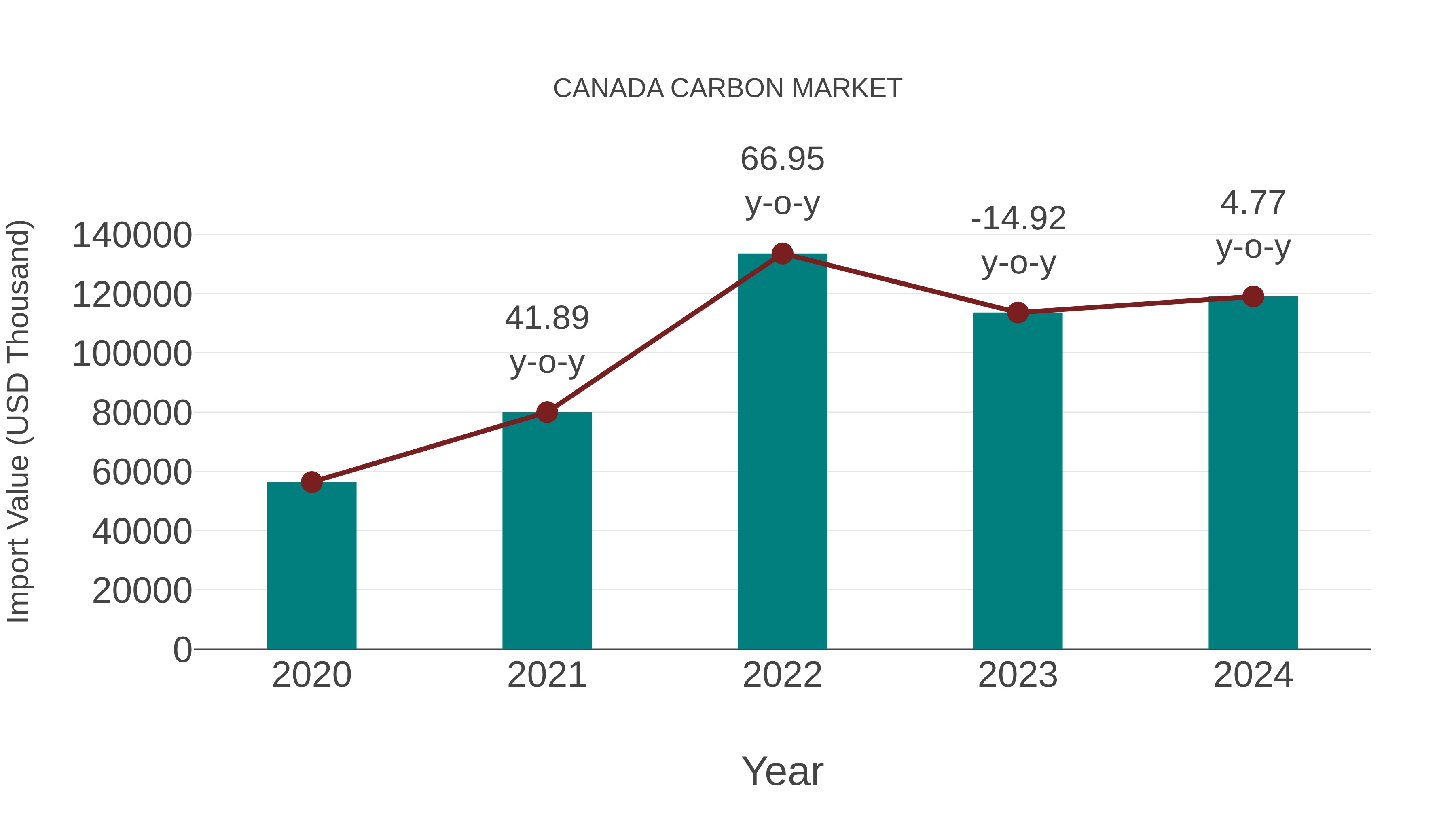
Canada Carbon Market Growth Rate
According to 6Wresearch internal database and industry insights, the Canada Carbon Market is projected to grow at a compound annual growth rate (CAGR) of 6.1% during the forecast period (2026–2032).
Five-Years Growth Trajectory of the Canada Carbon Market with Core Drivers
Below is the evaluation of the year-wise growth rate along with key drivers:
| Years | Estimated Annual Growth (%) | Growth Drivers |
| 2021 | 3.9 | Increasing use of carbon materials in automotive and industrial components |
| 2022 | 4.4 | Growth in construction activities and demand for high-strength materials |
| 2023 | 4.9 | Expansion of engineering industries and infrastructure modernization |
| 2024 | 5.4 | Rising adoption of advanced carbon materials in aerospace and manufacturing |
| 2025 | 5.8 | Government-backed clean technology programs and low-emission material initiatives |
Topics Covered in the Canada Carbon Market Report
The Canada Carbon Market report thoroughly covers the market by Product Types and Applications. The report provides a detailed analysis of ongoing market trends, opportunities/high-growth areas, and market drivers that will help stakeholders devise and align strategies according to current and future market dynamics.
Canada Carbon Market Highlights
| Report Name | Canada Carbon Market |
| Forecast period | 2026–2032 |
| CAGR | 6.1% |
| Growing Sector | Advanced Materials and Industrial Manufacturing |
Canada Carbon Market Synopsis
The Canada Carbon Industry is experiencing strong growth supported by increasing demand from automotive, construction, and engineering industries. Rising concentration on lightweight, durable, and high-performance materials is accelerating the adoption of carbon-based products. Development of aerospace manufacturing and advanced engineering applications is further bolstering the requirement of carbon material. Government-led efforts encouraging clean technologies, eco-efficient materials, and modern manufacturing procedures are supporting overall market development.
Evaluation of Growth Drivers in the Canada Carbon Market
Below are some prominent drivers and their influence on the Canada Carbon Market dynamics:
| Drivers | Primary Segments Affected | Why it Matters |
| Rising Automotive Lightweighting | By Applications (Automotive) | Lightweight carbon materials help enhance fuel efficiency and vehicle performance. |
| Infrastructure Development | By Applications (Construction) | Expanding infrastructure projects increase demand for strong and durable carbon materials. |
| Expansion of Engineering Industries | By Applications (Engineering Industries) | Advanced carbon products support high-performance and precision industrial applications. |
| Government Clean Technology Support | By Product Types (Amorphous Carbon, Graphite, Diamond) | Promotes adoption of low-emission, energy-efficient, and high-performance carbon materials. |
The Canada Carbon Market Size is projected to grow at a CAGR of 6.1% during the forecast period (2026–2032). The market is catapulted by the automotive and construction sectors demand, the upsurge of carbon materials usage in engineering, and the aerospace manufacturing to the extent of adoption. The Canada carbon market growth is additionally boosted by the government-led programs that encourage clean manufacturing practices, materials research, and emissions reduction. The market opportunities are also getting wider with increased investments in the development of high-performance and lightweight material solutions. Besides, the durability and energy efficiency attributes are pushing the carbon material adoption faster. The technological innovations in carbon processing along with the manufacturing techniques are also reinforcing the market expansion.
Evaluation of Restraints in the Canada Carbon Market
Below are some prominent restraints and their influence on the Canada Carbon Market dynamics:
| Restraints | Primary Segments Affected | What this Means |
| High Production Costs | By Product Types (Amorphous Carbon, Graphite, Diamond) | Elevated processing and energy costs increase product pricing. |
| Complex Manufacturing Processes | By Product Types | Need skilled labor, modern technology and precision control. |
| Supply Chain Volatility | By Applications | Changes in material availability impacts with the production planning. |
| Environmental Compliance Costs | By Applications | Adds to total regulatory and operating expenditures. |
Canada Carbon Market Challenges
The Canada Carbon Market comes across myriad of issues like hefty production expenses, complicated manufacturing processes, and irregular supply of raw materials. Besides this, strict environmental rules and compliance requirements add operational complexity for manufacturers. The producers in the market are still struggling to keep their costs reasonable along with high performance and sustainability expectations, especially due to the demand for top-quality and low-emission carbon materials.
Canada Carbon Market Trends
Several key trends are shaping the growth of the Canada Carbon Market:
- Increasing Use of Lightweight Materials: Automotive and aerospace industries are hugely using carbon materials to enhance efficiency and performance.
- Growth in Graphite Demand: Graphite is gaining popularity due to its wide usage in industrial and energy-related applications.
- Expansion of Clean Manufacturing: Carbon materials aiding low-emission production are seeing higher adoption.
- Advanced Engineering Applications: High-performance carbon products are highly used in precision engineering industries.
Investment Opportunities in the Canada Carbon Market
Some notable investment opportunities include:
- Advanced Carbon Manufacturing: Investing in high-performance carbon materials help with industrial development.
- Aerospace Carbon Components: Lightweight and sturdy carbon products generate strong need in aerospace manufacturing.
- Sustainable Material Development: Carbon materials that are aligned with emissions reduction goals present long-term opportunities.
- Engineering Industry Supply: Growing engineering applications drive consistent demand for specialized carbon products.
Top 5 Leading Players in the Canada Carbon Market
Some leading players operating in the Canada Carbon Market include:
1. GrafTech Canada Ltd.
| Company Name | GrafTech Canada Ltd. |
| Established Year | 1886 |
| Headquarters | Toronto, Canada |
| Official Website | Click Here |
GrafTech specializes in high-performance graphite materials for industrial and engineering applications.
2. SGL Carbon Canada
| Company Name | SGL Carbon Canada |
| Established Year | 1992 |
| Headquarters | Ontario, Canada |
| Official Website | Click Here |
SGL Carbon provides advanced carbon-based solutions for automotive, aerospace, and industrial sectors.
3. Tokai Carbon Canada
| Company Name | Tokai Carbon Canada |
| Established Year | 1918 |
| Headquarters | Quebec, Canada |
| Official Website | Click Here |
Tokai Carbon manufactures carbon and graphite products supporting engineering and construction applications.
4. Mersen Canada
| Company Name | Mersen Canada |
| Established Year | 1892 |
| Headquarters | Montreal, Canada |
| Official Website | Click Here |
Mersen offers carbon-based materials and electrical solutions for industrial and energy markets.
5. Element Six Canada
| Company Name | Element Six Canada |
| Established Year | 1946 |
| Headquarters | Ontario, Canada |
| Official Website | Click Here |
Element Six focuses on synthetic diamond solutions for advanced engineering and industrial applications.
Government Regulations Introduced in the Canada Carbon Market
According to Canadian government data, initiatives such as the Clean Technology Investment Program, Net-Zero Manufacturing Strategy, and Advanced Materials Innovation Fund are aiding market growth. Government measures which include of funding for low-emission material research, incentives for clean manufacturing, support for advanced carbon material development, and policies promoting sustainable industrial production. Additionally, grants for research institutions and partnerships with private players are encouraging innovation and commercialization of advanced carbon technologies.
Future Insights of the Canada Carbon Market
The Canada Carbon Market Share is anticipated to grow s firmly due to the surging demand from automotive, construction, aerospace, and engineering industries. Government emphasis on clean manufacturing and emissions reduction will further strengthen market development. Rising incorporation of advanced, lightweight, and high-performance carbon materials will continue to shape market growth in the coming years. Increasing investments in research and development and wider use of carbon materials in emerging industrial applications will further support long-term expansion.
Market Segmentation Analysis
The report offers a comprehensive study of the following market segments and their leading categories:
By Product Type – Graphite to Lead the Market
According to Rashika, Senior Research Analyst at 6Wresearch, Graphite dominates the Canada Carbon Market due to its extensive use in industrial manufacturing, construction applications, and engineering industries.
By Application – Automotive to Lead the Market
Automotive applications dominate the market driven by increasing demand for lightweight materials, improved fuel efficiency, and enhanced vehicle performance. Rising adoption of carbon-based components in electric and hybrid vehicles is further strengthening demand in this segment.
Key Attractiveness of the Report
- 10 Years of Market Numbers
- Historical Data Starting from 2022 to 2025
- Base Year: 2025
- Forecast Data until 2032
- Key Performance Indicators Impacting the Market
- Major Upcoming Developments and Projects
Key Highlights of the Report:
- Canada Carbon Market Outlook
- Market Size of Canada Carbon Market, 2025
- Forecast of Canada Carbon Market, 2032
- Historical Data and Forecast of Canada Carbon Revenues & Volume for the Period 2022-2032
- Canada Carbon Market Trend Evolution
- Canada Carbon Market Drivers and Challenges
- Canada Carbon Price Trends
- Canada Carbon Porter`s Five Forces
- Canada Carbon Industry Life Cycle
- Historical Data and Forecast of Canada Carbon Market Revenues & Volume By Product Types for the Period 2022-2032
- Historical Data and Forecast of Canada Carbon Market Revenues & Volume By Amorphous Carbon for the Period 2022-2032
- Historical Data and Forecast of Canada Carbon Market Revenues & Volume By Graphite for the Period 2022-2032
- Historical Data and Forecast of Canada Carbon Market Revenues & Volume By Diamond for the Period 2022-2032
- Historical Data and Forecast of Canada Carbon Market Revenues & Volume By Applications for the Period 2022-2032
- Historical Data and Forecast of Canada Carbon Market Revenues & Volume By Automotive for the Period 2022-2032
- Historical Data and Forecast of Canada Carbon Market Revenues & Volume By Construction for the Period 2022-2032
- Historical Data and Forecast of Canada Carbon Market Revenues & Volume By Engineering Industries for the Period 2022-2032
- Historical Data and Forecast of Canada Carbon Market Revenues & Volume By Aerospace for the Period 2022-2032
- Historical Data and Forecast of Canada Carbon Market Revenues & Volume By Others for the Period 2022-2032
- Canada Carbon Import Export Trade Statistics
- Market Opportunity Assessment By Product Types
- Market Opportunity Assessment By Applications
- Canada Carbon Top Companies Market Share
- Canada Carbon Competitive Benchmarking By Technical and Operational Parameters
- Canada Carbon Company Profiles
- Canada Carbon Key Strategic Recommendations
Markets Covered
The report offers a comprehensive study of the following market segments:
By Material Type
- Plastic
- Wood
- Metal
- Other
By Application
- Residential
- Commercial






































