Canada Heating Equipment Market: Import Trend Analysis
In the Canada heating equipment market, import trends showed a growth rate of 9.4% from 2023 to 2024, with a compound annual growth rate (CAGR) of 4.03% from 2020 to 2024. This uptick in import momentum can be attributed to increased demand for energy-efficient heating solutions in response to stricter environmental regulations.
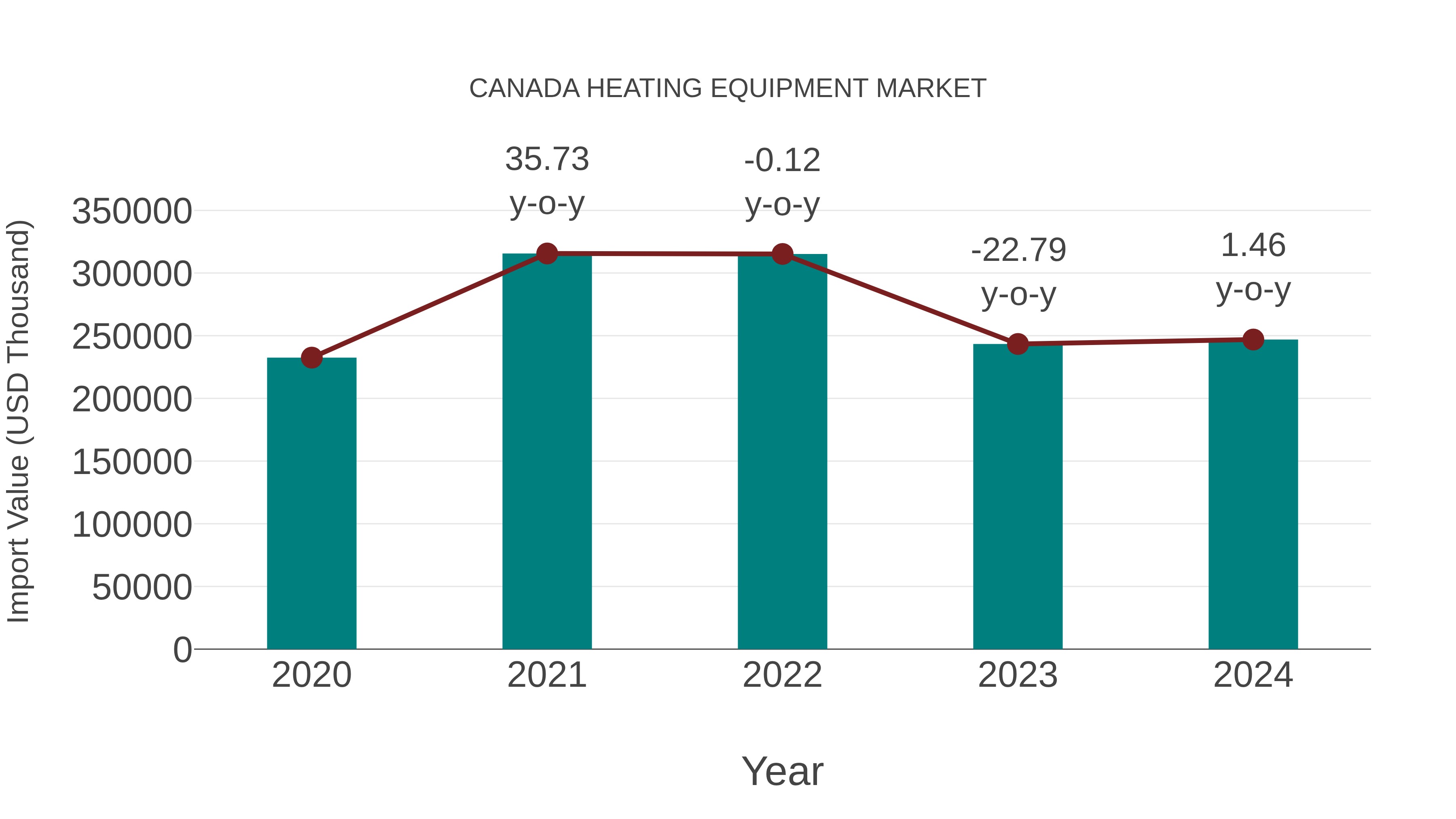
Canada Heating Equipment Market Growth Rate
According to 6Wresearch internal database and industry insights, the Canada Heating Equipment Market is projected to grow at a compound annual growth rate (CAGR) of 5.6% during the forecast period (2026–2032).
Five-Years Growth Trajectory of the Canada Heating Equipment Market with Core Drivers
Below is the evaluation of the year-wise growth rate along with key drivers:
| Years | Estimated Annual Growth (%) | Growth Drivers |
| 2021 | 3.8 | Rising demand for energy-efficient heating solutions |
| 2022 | 4 | Increased residential construction and renovation activities |
| 2023 | 4.3 | Growing commercial and industrial heating needs |
| 2024 | 4.5 | Expansion of smart home technologies in heating equipment |
| 2025 | 4.8 | Government incentives for energy-efficient and renewable heating systems |
Topics Covered in the Canada Heating Equipment Market Report
The Canada Heating Equipment Market report thoroughly covers the market by Product, and Applications. It provides an unbiased and detailed analysis of ongoing market trends, opportunities/high-growth areas, and market drivers that will help stakeholders devise and align strategies according to current and future market dynamics.
Canada Heating Equipment Market Highlights
| Report Name | Canada Heating Equipment Market |
| Forecast period | 2026-2032 |
| CAGR | 5.6% |
| Growing Sector | Residential |
Canada Heating Equipment Market Synopsis
The Canada Heating Equipment Industry due to the gradual increase in demand for energy-efficient systems and a strong commitment to environmental sustainability is witnessing development. The smart home technology adoption and the financial aids offered by the government to support green heating solutions will have a great impact on market's future. On top of that, the continued need for heating systems in the residential, commercial, and industrial sectors is another factor supporting the market.
Evaluation of Growth Drivers in the Canada Heating Equipment Market
Below are some prominent drivers and their influence on the Canada Heating Equipment Market dynamics:
| Drivers | Primary Segments Affected | Why it Matters |
| Energy Efficiency | By Product | Demand for heat pumps and high-efficiency furnaces grows due to cost savings and sustainability. |
| Government Incentives | By Distribution Channel | Provincial rebates and tax credits for energy-efficient heating systems boost adoption. |
| Residential Growth | By Application | New homes and renovations increase demand for modern heating equipment, especially in colder areas. |
| Smart Technology | By Product | Smart thermostats and remote-control systems are popular with the rise of smart homes. |
The Canada Heating Equipment Market size is projected to grow at a CAGR of 5.6% during the forecast period (2026–2032). The increase in consumer awareness about energy efficiency, along with government policies supporting renewable energy solutions, is driving the market forward. The expanding residential construction industry, as well as the growth of smart homes, further contribute to the market's development. Additionally, surging need for industrial heating and commercial improvements to energy-efficient systems are anticipated to support Canada Heating Equipment Market growth. Moreover, advancements in heating technologies, such as the integration of AI and IoT, is helping to improve system performance and captivating more consumers.
Evaluation of Restraints in the Canada Heating Equipment Market
Below are some major restraints and their influence on the Canada Heating Equipment Market dynamics:
| Restraints | Primary Segments Affected | What this Means |
| High Initial Costs | By Product | Hefty purchasing amount for advanced heating systems may limit consumer adoption, especially for budget-conscious buyers. |
| Installation Challenges | By Product | Complicated installation requirements for some systems can increase overall costs and reduce market appeal. |
| Seasonal Demand | By Application | Heating equipment demand is seasonal, leading to supply chain and pricing challenges. |
| Lack of Consumer Awareness | By Product | Many consumers are unaware of newer energy-efficient heating technologies, slowing market growth. |
Canada Heating Equipment Market Challenges
The Canada Heating Equipment Market confronts several challenges, including high initial installation costs and technological complexities that may deter some consumers. Along with that, regulatory barriers in certain regions and the limited availability of skilled professionals for advanced system installation may slow the adoption of newer, more energy-efficient heating solutions. Furthermore, price volatility can cause uncertainty for consumers considering long-term investments in heating systems.
Canada Heating Equipment Market Trends
Several key trends are shaping the growth of the Canada Heating Equipment Market:
- Energy-Efficient Heating Systems: With rising energy costs and environmental concerns, there is an increasing demand for systems that reduce energy consumption.
- Smart Heating Solutions: The growing trend of smart home integration is driving demand for heating systems that can be controlled remotely through smartphones and smart devices.
- Sustainability Focus: Consumers and businesses are shifting towards sustainable heating solutions, such as geothermal heat pumps, which reduce reliance on fossil fuels.
- Government Incentives for Renewable Heating Systems: Programs and incentives provided by the Canadian government are making energy-efficient heating systems more accessible to a wider range of consumers.
Investment Opportunities in the Canada Heating Equipment Market
Some notable investment opportunities include:
- Energy-Efficient Systems: Funding in technologies that promote energy efficiency will be a key growth driver as both residential and commercial markets demand greener solutions.
- Geothermal Heat Pumps: With the increasing emphasis on renewable energy, geothermal heat pumps present a hopeful investment opportunity.
- Smart Heating Solutions: Establishing or investing in smart heating technologies and systems that can be controlled via mobile applications provide significant growth potential.
- E-commerce Platforms for Heating Equipment: Widening the reach of heating equipment through online sales platforms will increase accessibility and improve customer reach.
Top 5 Leading Players in the Canada Heating Equipment Market
Some leading players operating in the Canada Heating Equipment Market include:
1. Trane Technologies
| Company Name | Trane Technologies |
|---|---|
| Established Year | 2008 |
| Headquarters | Swords, Ireland |
| Official Website | Click Here |
Trane Technologies is a global leader in energy-efficient heating and cooling solutions, offering advanced products across residential, commercial, and industrial applications.
2. Carrier Global Corporation
| Company Name | Carrier Global Corporation |
|---|---|
| Established Year | 1902 |
| Headquarters | Palm Beach Gardens, USA |
| Official Website | Click Here |
Carrier is a leading manufacturer of heating, ventilation, and air conditioning (HVAC) systems, specializing in energy-efficient solutions for residential, commercial, and industrial applications.
3. Bosch Thermotechnology
| Company Name | Bosch Thermotechnology |
|---|---|
| Established Year | 1886 |
| Headquarters | Stuttgart, Germany |
| Official Website | Click Here |
Bosch offers innovative heating technologies, including boilers and heat pumps, with a focus on sustainability and energy efficiency in both residential and commercial applications.
4. Lennox International Inc.
| Company Name | Lennox International Inc. |
|---|---|
| Established Year | 1895 |
| Headquarters | Richardson, USA |
| Official Website | Click Here |
Lennox International manufactures residential and commercial heating equipment, including furnaces, heat pumps, and smart home solutions focused on energy efficiency.
5. Rheem Manufacturing Company
| Company Name | Rheem Manufacturing Company |
|---|---|
| Established Year | 1925 |
| Headquarters | Atlanta, USA |
| Official Website | Click Here |
Rheem is a leading manufacturer of heating, cooling, and water heating products, providing energy-efficient solutions for residential, commercial, and industrial applications.
Government Regulations Introduced in the Canada Heating Equipment Market
According to Canadian government data, there are several policies that focus on enhancing the energy efficiency of heating systems. The Canada Energy Efficiency Act establishes the performance parameters for heating devices, making certain that the products in the market are only of the energy-saving type. Besides, some provinces, like Ontario and British Columbia, are offering various kinds of support for the consumers who are willing to use the energy-efficient and the renewable heating technologies.
Future Insights of the Canada Heating Equipment Market
The Canada Heating Equipment Market Share will rise steadily, owing to the introduction of energy-efficient technology, the government's support for environment friendly solutions, and smart home integration becoming more popular. There will be huge chances for the market to grow due to the constant demand for and the supply of sustainable products and high-performance heating systems in the residential, commercial, and industrial sectors respectively.
Market Segmentation Analysis
The report offers a comprehensive study of the following market segments and their leading categories:
By Product – Heat Pumps to Lead the Market
According to Rashika, Senior Research Analyst, 6Wresearch, Heat Pumps are the leading category in the Canada Heating Equipment Market due to their energy efficiency, ability to provide both heating and cooling, and growing popularity in residential and commercial sectors.
By Application – Residential to Lead the Market
Residential heating systems dominate the market due to the increasing demand for energy-efficient solutions in homes. This segment is supported by ongoing construction activities, the growing number of smart homes, and an increasing focus on reducing household energy bills.
Key Highlights of the Report:
- Canada Heating Equipment Market Outlook
- Market Size of Canada Heating Equipment Market, 2025
- Forecast of Canada Heating Equipment Market, 2032
- Historical Data and Forecast of Canada Heating Equipment Revenues & Volume for the Period 2022-2032
- Canada Heating Equipment Market Trend Evolution
- Canada Heating Equipment Market Drivers and Challenges
- Canada Heating Equipment Price Trends
- Canada Heating Equipment Porter`s Five Forces
- Canada Heating Equipment Industry Life Cycle
- Historical Data and Forecast of Canada Heating Equipment Market Revenues & Volume By Product for the Period 2022-2032
- Historical Data and Forecast of Canada Heating Equipment Market Revenues & Volume By Heat Pumps for the Period 2022-2032
- Historical Data and Forecast of Canada Heating Equipment Market Revenues & Volume By Furnaces for the Period 2022-2032
- Historical Data and Forecast of Canada Heating Equipment Market Revenues & Volume By Boilers for the Period 2022-2032
- Historical Data and Forecast of Canada Heating Equipment Market Revenues & Volume By Unitary Heaters for the Period 2022-2032
- Historical Data and Forecast of Canada Heating Equipment Market Revenues & Volume By Others for the Period 2022-2032
- Historical Data and Forecast of Canada Heating Equipment Market Revenues & Volume By Applications for the Period 2022-2032
- Historical Data and Forecast of Canada Heating Equipment Market Revenues & Volume By Residential for the Period 2022-2032
- Historical Data and Forecast of Canada Heating Equipment Market Revenues & Volume By Commercial for the Period 2022-2032
- Historical Data and Forecast of Canada Heating Equipment Market Revenues & Volume By Industrial for the Period 2022-2032
- Canada Heating Equipment Import Export Trade Statistics
- Market Opportunity Assessment By Product
- Market Opportunity Assessment By Applications
- Canada Heating Equipment Top Companies Market Share
- Canada Heating Equipment Competitive Benchmarking By Technical and Operational Parameters
- Canada Heating Equipment Company Profiles
- Canada Heating Equipment Key Strategic Recommendations
Markets Covered
The report offers a comprehensive study of the following market segments:
By Product:
- Heat Pumps
- Furnaces
- Boilers
- Unitary Heaters
- Others
By Applications:
- Residential
- Commercial
- Industrial






































