Canada Laxative Market (2026-2032) | Outlook, Size & Revenue, Competitive Landscape, Value, Analysis, Companies, Share, Growth, Industry, Segmentation, Trends, Forecast
Market Forecast By Type (Osmotic Laxatives, Stimulant Laxatives, Bulk Laxatives and Lubricant, Emollient laxatives), By Flavors (With Flavors, Without Flavors), By Source (Natural, Synthetic, Others), By Indication (Chronic Constipation, Irritable Bowel Syndrome with Constipation, Opioid-Induced constipation, Acute constipation, Others), By Mode of Purchase (Prescription, Over-the-Counter), By Dosage Form (Tablets, Capsules, Powder, Liquid and Gels, Suppositories, Others), By Route of Administration (Oral???????, Rectal), By Population Type (Children, Adults) And Competitive Landscape
| Product Code: ETC6659721 | Publication Date: Sep 2024 | Updated Date: Apr 2026 | Product Type: Market Research Report | |
| Publisher: 6Wresearch | Author: Dhaval Chaurasia | No. of Pages: 75 | No. of Figures: 35 | No. of Tables: 20 |
Canada Laxative Market: Import Trend Analysis
Canada`s import trend for the laxative market showed a notable growth rate of 16.83% from 2023 to 2024, with a compound annual growth rate (CAGR) of 13.53% for the period 2020-2024. This import momentum can be attributed to increasing consumer awareness of digestive health, leading to a demand shift towards laxative products in the market.
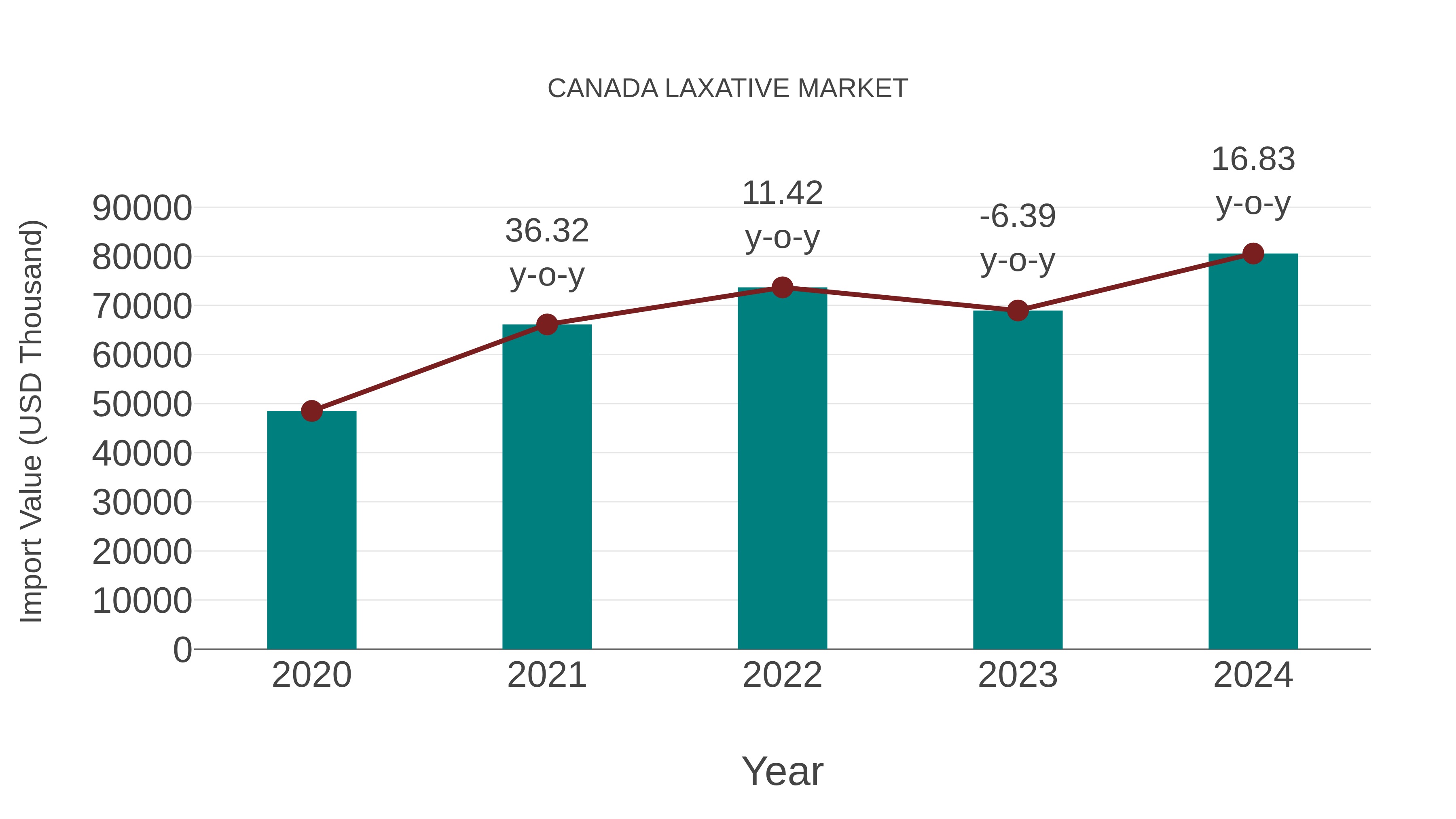
Canada Laxative Market Growth Rate
According to 6Wresearch internal database and industry insights, the Canada Laxative Market is projected to grow at a compound annual growth rate (CAGR) of 5.9% during the forecast period (2026-2032).
Topics Covered in the Canada Laxative Market Report
The Canada Laxative Market report thoroughly covers the market by type, flavors, source, indication, mode of purchase, dosage form, route of administration, and population type. The report provides a detailed analysis of ongoing market trends, opportunities/high-growth areas, and market drivers that will help stakeholders align strategies based on current and future market dynamics.
Canada Laxative Market Highlights
| Report Name | Canada Laxative Market |
| Forecast Period | 2026–2032 |
| CAGR | 5.9% |
| Growing Sector | Natural Bulk and Osmotic Laxatives |
Canada Laxative Market Synopsis
Canada Laxative Market is expected to achieve constant growth over the forecast period, backed by rising prevalence of gastrointestinal issues, aging demographics, and heightened consumer awareness regarding digestive wellness. In general, a laxative is a type of medicine or substance used to stimulate or facilitate bowel movements. The shift toward preventive healthcare and self-medication is encouraging consumers to opt for over-the-counter laxatives.
Evaluation of Growth Drivers in Canada Laxative Market
Below are some major drivers and their influence on the market dynamics:
| Drivers | Primary Segment Affected | Why It Matters (Evidence) |
| Aging Population | Chronic Constipation Segment | Canada’s increasing elderly population leads to higher demand for regular bowel care medications. |
| Expansion of OTC Availability | Over-the-Counter Products | Availability of products in pharmacies and online stores helps in the consumption of these products. |
| Rising Digestive Disorders | Osmotic & Bulk Laxatives | Increasing incidence of IBS and constipation creates demand for such products. |
| Shift Toward Natural Remedies | Natural Source Segment | Consumers prefer plant-based ingredients such as psyllium husk and senna. |
| Healthcare Awareness Campaigns | All Segments | Public awareness initiatives promote early treatment and prevention of digestive issues. |
Canada Laxative Market is expected to register growth, exponentially reaching a CAGR of 5.9% during the forecast period (2026-2032). supported by rising expenditure in healthcare, increasing demand for non-prescription medicines, and rising interest in gut health. Along with this, advancements in formulation technologies are improving product effectiveness and patient compliance. Due to growing modernization of pharmaceutical distribution, rising investments in natural health products, and robust demand from the aging population, the Canada laxative market growth is projected to gain upward momentum.
Evaluation of Restraints in the Canada Laxative Market
Below are some major restraints and their influence on the market dynamics:
| Restraints | Primary Segment Affected | What This Means (Evidence) |
| Side Effects of Overuse | Stimulant Laxatives | Risk of dependency and electrolyte imbalance discourages prolonged use. |
| Strict Regulatory Framework | Prescription Segment | Regulations by Health Canada result in delays in product approvals and launch. |
| Price Sensitivity | Premium Products | Costs associated with specialized formulations are higher. |
| Consumer Misconceptions | All Segments | Lack of proper guidance leads to incorrect usage patterns. |
| Competition from Dietary Supplements | Natural Products | Fiber supplements act as substitutes for mild laxatives. |
Canada Laxative Market Challenges
Canada laxative market is expected to grow steadily in the upcoming years. On the contrary, concerns like misuse of laxatives or lack of consulting physicians still remain major concerns. Apart from that, compliance with stringent safety or labeling requirements is also a concern. Also, competition from alternative digestive health solutions such as probiotics and dietary fibers is intensifying, which may limit the growth potential of conventional laxative products.
Canada Laxative Market Trends
Some of the major trends shaping the landscape of the Canada Laxative Market are:
- Rising Preference for Natural and Herbal Laxatives: Consumers are preferring natural and herbal laxatives that are made up of ingredients such as senna and psyllium.
- Increase in Combination Formulations: The laxative industry is developing combination products that combine various laxatives in order to minimize the side effects.
- Development of Online Pharmacy Channels: E-commerce platforms are making laxatives more accessible, particularly for discreet purchasing and subscription-based healthcare products.
Investment Opportunities in the Canada Laxative Market
The potential opportunities that could be invested in Canada Laxative Market include:
- Transformed Organic/Clean Label Products: Investing in organic laxatives could be beneficial, considering that more and more people are seeking organic products.
- Modified Digestive Health Solutions: Tailoring laxative products based on individual gut health profiles offers a high-growth niche.
- Expansion in Pediatric and Geriatric Products: Developing laxatives specifically for children and elderly patients is also an opportunity.
Top 5 Leading Players in Canada Laxative Market
Below is a list of companies operating in the Canada Laxative Market:
1. Bayer AG
| Company Name | Bayer AG |
| Headquarters | Germany |
| Established | 1863 |
| Website | Click Here |
Bayer offers a range of digestive health products, including laxatives known for their reliability and widespread availability in Canada.
2. Pfizer Inc.
| Company Name | Pfizer Inc. |
| Headquarters | USA |
| Established | 1849 |
| Website | Click Here |
Pfizer provides pharmaceutical-grade laxatives and digestive treatments, focusing on safety and efficacy.
3. Sanofi S.A.
| Company Name | Sanofi S.A. |
| Headquarters | France |
| Established | 1973 |
| Website | Click Here |
Sanofi offers a diverse portfolio of OTC digestive health products, including laxatives targeting various conditions.
4. Church & Dwight Co., Inc.
| Company Name | Church & Dwight Co., Inc. |
| Headquarters | USA |
| Established | 1846 |
| Website | Click Here |
Known for brands like Phillips’, the company provides widely used laxative solutions catering to different consumer needs.
5. Procter & Gamble (P&G Health)
| Company Name | Procter & Gamble (P&G Health) |
| Headquarters | USA |
| Established | 1837 |
| Website | Click Here |
P&G delivers consumer healthcare products, including digestive aids, focusing on innovation and accessibility.
Government Initiatives being Implemented in the Canada Laxative Market
According to Canada’s government data, several initiatives are supporting the growth of the laxative market. For example, Health Canada's Self-Care Framework encourages the safe use of laxatives and other over-the-counter drugs. Public health campaigns that promote digestive health and eating more fiber also help people learn how to deal with constipation. Along with this, the Canadian Digestive Health Foundation (CDHF) collaborates with healthcare providers to educate citizens on gastrointestinal health. Lastly, government funding for elderly care programs indirectly boosts demand for constipation management solutions in long-term care facilities.
Future Insights of the Canada Laxative Market
Over the years, the Canada Laxative Market is projected to witness moderate growth on account of innovation in drug formulations and growing emphasis on preventive healthcare. Apart from this, the emergence of microbiome-based treatments and integration of digital health tools for monitoring digestive health are anticipated to shape the future of this industry. Besides this, sustainability trends are encouraging the development of eco-friendly packaging and natural ingredients.
Market Segmentation Analysis
The report offers a comprehensive study of the following market segments and their leading categories:
By Type – Osmotic Laxatives to Lead the Market
According to Saurabh, Senior Research Analyst, 6Wresearch, Osmotic Laxatives are expected to dominate the Canada laxative market share in the coming years due to their effectiveness in treating chronic constipation with minimal side effects. Healthcare professionals like these products as they draw water into the bowel, making them safe to use for a long time.
By Flavors – With Flavors to Lead the Market
With Flavors segment is anticipated to hold the leading position in this industry as flavored formulations improve patient compliance, particularly among children and elderly patients.
By Source – Natural to Lead the Market
Natural laxatives are expected to grow at enormous rate owing to increasing consumer preference for herbal and plant-based products. Ingredients such as psyllium and senna are widely accepted for their safety and effectiveness.
Key Attractiveness of the Report
- 10 Years of Market Numbers
- Historical Data Starting from 2022 to 2025
- Base Year: 2025
- Forecast Data until 2032
- Key Performance Indicators Impacting the Market
- Major Upcoming Developments and Projects
Key Highlights of the Report:
- Canada Laxative Market Outlook
- Market Size of Canada Laxative Market, 2025
- Forecast of Canada Laxative Market, 2032
- Historical Data and Forecast of Canada Laxative Revenues & Volume for the Period 2022-2032
- Canada Laxative Market Trend Evolution
- Canada Laxative Market Drivers and Challenges
- Canada Laxative Price Trends
- Canada Laxative Porter's Five Forces
- Canada Laxative Industry Life Cycle
- Historical Data and Forecast of Canada Laxative Market Revenues & Volume By Type for the Period 2022-2032
- Historical Data and Forecast of Canada Laxative Market Revenues & Volume By Osmotic Laxatives for the Period 2022-2032
- Historical Data and Forecast of Canada Laxative Market Revenues & Volume By Stimulant Laxatives for the Period 2022-2032
- Historical Data and Forecast of Canada Laxative Market Revenues & Volume By Bulk Laxatives and Lubricant for the Period 2022-2032
- Historical Data and Forecast of Canada Laxative Market Revenues & Volume By Emollient laxatives for the Period 2022-2032
- Historical Data and Forecast of Canada Laxative Market Revenues & Volume By Flavors for the Period 2022-2032
- Historical Data and Forecast of Canada Laxative Market Revenues & Volume By With Flavors for the Period 2022-2032
- Historical Data and Forecast of Canada Laxative Market Revenues & Volume By Without Flavors for the Period 2022-2032
- Historical Data and Forecast of Canada Laxative Market Revenues & Volume By Source for the Period 2022-2032
- Historical Data and Forecast of Canada Laxative Market Revenues & Volume By Natural for the Period 2022-2032
- Historical Data and Forecast of Canada Laxative Market Revenues & Volume By Synthetic for the Period 2022-2032
- Historical Data and Forecast of Canada Laxative Market Revenues & Volume By Others for the Period 2022-2032
- Historical Data and Forecast of Canada Laxative Market Revenues & Volume By Indication for the Period 2022-2032
- Historical Data and Forecast of Canada Laxative Market Revenues & Volume By Chronic Constipation for the Period 2022-2032
- Historical Data and Forecast of Canada Laxative Market Revenues & Volume By Irritable Bowel Syndrome with Constipation for the Period 2022-2032
- Historical Data and Forecast of Canada Laxative Market Revenues & Volume By Opioid-Induced constipation for the Period 2022-2032
- Historical Data and Forecast of Canada Laxative Market Revenues & Volume By Acute constipation for the Period 2022-2032
- Historical Data and Forecast of Canada Laxative Market Revenues & Volume By Others for the Period 2022-2032
- Historical Data and Forecast of Canada Laxative Market Revenues & Volume By Mode of Purchase for the Period 2022-2032
- Historical Data and Forecast of Canada Laxative Market Revenues & Volume By Prescription for the Period 2022-2032
- Historical Data and Forecast of Canada Laxative Market Revenues & Volume By Over-the-Counter for the Period 2022-2032
- Historical Data and Forecast of Canada Laxative Market Revenues & Volume By Dosage Form for the Period 2022-2032
- Historical Data and Forecast of Canada Laxative Market Revenues & Volume By Tablets for the Period 2022-2032
- Historical Data and Forecast of Canada Laxative Market Revenues & Volume By Capsules for the Period 2022-2032
- Historical Data and Forecast of Canada Laxative Market Revenues & Volume By Powder for the Period 2022-2032
- Historical Data and Forecast of Canada Laxative Market Revenues & Volume By Liquid and Gels for the Period 2022-2032
- Historical Data and Forecast of Canada Laxative Market Revenues & Volume By Suppositories for the Period 2022-2032
- Historical Data and Forecast of Canada Laxative Market Revenues & Volume By Others for the Period 2022-2032
- Historical Data and Forecast of Canada Laxative Market Revenues & Volume By Route of Administration for the Period 2022-2032
- Historical Data and Forecast of Canada Laxative Market Revenues & Volume By Oral??????? for the Period 2022-2032
- Historical Data and Forecast of Canada Laxative Market Revenues & Volume By Rectal for the Period 2022-2032
- Historical Data and Forecast of Canada Laxative Market Revenues & Volume By Population Type for the Period 2022-2032
- Historical Data and Forecast of Canada Laxative Market Revenues & Volume By Children for the Period 2022-2032
- Historical Data and Forecast of Canada Laxative Market Revenues & Volume By Adults for the Period 2022-2032
- Canada Laxative Import Export Trade Statistics
- Market Opportunity Assessment By Type
- Market Opportunity Assessment By Flavors
- Market Opportunity Assessment By Source
- Market Opportunity Assessment By Indication
- Market Opportunity Assessment By Mode of Purchase
- Market Opportunity Assessment By Dosage Form
- Market Opportunity Assessment By Route of Administration
- Market Opportunity Assessment By Population Type
- Canada Laxative Top Companies Market Share
- Canada Laxative Competitive Benchmarking By Technical and Operational Parameters
- Canada Laxative Company Profiles
- Canada Laxative Key Strategic Recommendations
Market Covered
The report offers a comprehensive study of the following market segments:
By Type
- Osmotic Laxatives
- Stimulant Laxatives
- Bulk Laxatives
- Lubricant & Emollient Laxatives
By Flavors
- With Flavors
- Without Flavors
By Source
- Natural
- Synthetic
- Others
By Indication
- Chronic Constipation
- Irritable bowel syndrome with Constipation
- Opioid-Induced Constipation
- Acute Constipation
- Others
By Mode of Purchase
- Prescription
- Over-the-Counter
By Dosage Form
- Tablets
- Capsules
- Powder
- Liquid and Gels
- Suppositories
- Others
By Route of Administration
- Oral
- Rectal
By Population Type
- Children
- Adults
Canada Laxative Market (2026-2032): FAQs
Canada Laxative Market is projected to grow at a CAGR of 5.9% during the forecast period 2026-2032.
Potential investment prospects exist in developing organic formulations, expanding pediatric and geriatric product lines, and introducing personalized digestive health solutions.
Adults are the highest contributing group as it is likely that they will have digestive problems due to their lifestyle; however, demand is also rising in this age group as people age.
Some major challenges are regulatory constraints, risk of overuse, and competition from alternative digestive health solutions.
6Wresearch actively monitors the Canada Laxative Market and publishes its comprehensive annual report, highlighting emerging trends, growth drivers, revenue analysis, and forecast outlook. Our insights help businesses to make data-backed strategic decisions with ongoing market dynamics. Our analysts track relevent industries related to the Canada Laxative Market, allowing our clients with actionable intelligence and reliable forecasts tailored to emerging regional needs.
Yes, we provide customisation as per your requirements. To learn more, feel free to contact us on sales@6wresearch.com
|
1 Executive Summary |
|
2 Introduction |
|
2.1 Key Highlights of the Report |
|
2.2 Report Description |
|
2.3 Market Scope & Segmentation |
|
2.4 Research Methodology |
|
2.5 Assumptions |
|
3 Canada Laxative Market Overview |
|
3.1 Canada Country Macro Economic Indicators |
|
3.2 Canada Laxative Market Revenues & Volume, 2022 & 2032F |
|
3.3 Canada Laxative Market - Industry Life Cycle |
|
3.4 Canada Laxative Market - Porter's Five Forces |
|
3.5 Canada Laxative Market Revenues & Volume Share, By Type, 2022 & 2032F |
|
3.6 Canada Laxative Market Revenues & Volume Share, By Flavors, 2022 & 2032F |
|
3.7 Canada Laxative Market Revenues & Volume Share, By Source, 2022 & 2032F |
|
3.8 Canada Laxative Market Revenues & Volume Share, By Indication, 2022 & 2032F |
|
3.9 Canada Laxative Market Revenues & Volume Share, By Mode of Purchase, 2022 & 2032F |
|
3.10 Canada Laxative Market Revenues & Volume Share, By Dosage Form, 2022 & 2032F |
|
3.11 Canada Laxative Market Revenues & Volume Share, By Route of Administration, 2022 & 2032F |
|
4 Canada Laxative Market Dynamics |
|
4.1 Impact Analysis |
|
4.2 Market Drivers |
|
4.2.1 Increasing awareness about gastrointestinal health and the importance of regular bowel movements |
|
4.2.2 Growing aging population in Canada leading to higher demand for laxatives |
|
4.2.3 Rising prevalence of digestive disorders and chronic constipation |
|
4.3 Market Restraints |
|
4.3.1 Side effects and potential dependency associated with long-term use of laxatives |
|
4.3.2 Availability of alternative natural remedies and dietary supplements for digestive health |
|
5 Canada Laxative Market Trends |
|
6 Canada Laxative Market, By Types |
|
6.1 Canada Laxative Market, By Type |
|
6.1.1 Overview and Analysis |
|
6.1.2 Canada Laxative Market Revenues & Volume, By Type, 2022-2032F |
|
6.1.3 Canada Laxative Market Revenues & Volume, By Osmotic Laxatives, 2022-2032F |
|
6.1.4 Canada Laxative Market Revenues & Volume, By Stimulant Laxatives, 2022-2032F |
|
6.1.5 Canada Laxative Market Revenues & Volume, By Bulk Laxatives and Lubricant, 2022-2032F |
|
6.1.6 Canada Laxative Market Revenues & Volume, By Emollient laxatives, 2022-2032F |
|
6.2 Canada Laxative Market, By Flavors |
|
6.2.1 Overview and Analysis |
|
6.2.2 Canada Laxative Market Revenues & Volume, By With Flavors, 2022-2032F |
|
6.2.3 Canada Laxative Market Revenues & Volume, By Without Flavors, 2022-2032F |
|
6.3 Canada Laxative Market, By Source |
|
6.3.1 Overview and Analysis |
|
6.3.2 Canada Laxative Market Revenues & Volume, By Natural, 2022-2032F |
|
6.3.3 Canada Laxative Market Revenues & Volume, By Synthetic, 2022-2032F |
|
6.3.4 Canada Laxative Market Revenues & Volume, By Others, 2022-2032F |
|
6.4 Canada Laxative Market, By Indication |
|
6.4.1 Overview and Analysis |
|
6.4.2 Canada Laxative Market Revenues & Volume, By Chronic Constipation, 2022-2032F |
|
6.4.3 Canada Laxative Market Revenues & Volume, By Irritable Bowel Syndrome with Constipation, 2022-2032F |
|
6.4.4 Canada Laxative Market Revenues & Volume, By Opioid-Induced constipation, 2022-2032F |
|
6.4.5 Canada Laxative Market Revenues & Volume, By Acute constipation, 2022-2032F |
|
6.4.6 Canada Laxative Market Revenues & Volume, By Others, 2022-2032F |
|
6.5 Canada Laxative Market, By Mode of Purchase |
|
6.5.1 Overview and Analysis |
|
6.5.2 Canada Laxative Market Revenues & Volume, By Prescription, 2022-2032F |
|
6.5.3 Canada Laxative Market Revenues & Volume, By Over-the-Counter, 2022-2032F |
|
6.6 Canada Laxative Market, By Dosage Form |
|
6.6.1 Overview and Analysis |
|
6.6.2 Canada Laxative Market Revenues & Volume, By Tablets, 2022-2032F |
|
6.6.3 Canada Laxative Market Revenues & Volume, By Capsules, 2022-2032F |
|
6.6.4 Canada Laxative Market Revenues & Volume, By Powder, 2022-2032F |
|
6.6.5 Canada Laxative Market Revenues & Volume, By Liquid and Gels, 2022-2032F |
|
6.6.6 Canada Laxative Market Revenues & Volume, By Suppositories, 2022-2032F |
|
6.6.7 Canada Laxative Market Revenues & Volume, By Others, 2022-2032F |
|
6.7 Canada Laxative Market, By Route of Administration |
|
6.7.1 Overview and Analysis |
|
6.7.2 Canada Laxative Market Revenues & Volume, By Oral???????, 2022-2032F |
|
6.7.3 Canada Laxative Market Revenues & Volume, By Rectal, 2022-2032F |
|
6.8 Canada Laxative Market, By Population Type |
|
6.8.1 Overview and Analysis |
|
6.8.2 Canada Laxative Market Revenues & Volume, By Children, 2022-2032F |
|
6.8.3 Canada Laxative Market Revenues & Volume, By Adults, 2022-2032F |
|
7 Canada Laxative Market Import-Export Trade Statistics |
|
7.1 Canada Laxative Market Export to Major Countries |
|
7.2 Canada Laxative Market Imports from Major Countries |
|
8 Canada Laxative Market Key Performance Indicators |
|
8.1 Number of new product launches in the laxative market |
|
8.2 Consumer satisfaction levels with laxative products |
|
8.3 Growth in demand for organic and natural laxative options |
|
9 Canada Laxative Market - Opportunity Assessment |
|
9.1 Canada Laxative Market Opportunity Assessment, By Type, 2022 & 2032F |
|
9.2 Canada Laxative Market Opportunity Assessment, By Flavors, 2022 & 2032F |
|
9.3 Canada Laxative Market Opportunity Assessment, By Source, 2022 & 2032F |
|
9.4 Canada Laxative Market Opportunity Assessment, By Indication, 2022 & 2032F |
|
9.5 Canada Laxative Market Opportunity Assessment, By Mode of Purchase, 2022 & 2032F |
|
9.6 Canada Laxative Market Opportunity Assessment, By Dosage Form, 2022 & 2032F |
|
9.7 Canada Laxative Market Opportunity Assessment, By Route of Administration, 2022 & 2032F |
|
9.7 Canada Laxative Market Opportunity Assessment, By Population Type, 2022 & 2032F |
|
10 Canada Laxative Market - Competitive Landscape |
|
10.1 Canada Laxative Market Revenue Share, By Companies, 2025 |
|
10.2 Canada Laxative Market Competitive Benchmarking, By Operating and Technical Parameters |
|
11 Company Profiles |
|
12 Recommendations |
|
13 Disclaimer |
Export potential assessment - trade Analytics for 2030
Export potential enables firms to identify high-growth global markets with greater confidence by combining advanced trade intelligence with a structured quantitative methodology. The framework analyzes emerging demand trends and country-level import patterns while integrating macroeconomic and trade datasets such as GDP and population forecasts, bilateral import–export flows, tariff structures, elasticity differentials between developed and developing economies, geographic distance, and import demand projections. Using weighted trade values from 2020–2024 as the base period to project country-to-country export potential for 2030, these inputs are operationalized through calculated drivers such as gravity model parameters, tariff impact factors, and projected GDP per-capita growth. Through an analysis of hidden potentials, demand hotspots, and market conditions that are most favorable to success, this method enables firms to focus on target countries, maximize returns, and global expansion with data, backed by accuracy.
By factoring in the projected importer demand gap that is currently unmet and could be potential opportunity, it identifies the potential for the Exporter (Country) among 190 countries, against the general trade analysis, which identifies the biggest importer or exporter.
To discover high-growth global markets and optimize your business strategy:
Click Here
Pricing
- Single User License$ 1,995
- Department License$ 2,400
- Site License$ 3,120
- Global License$ 3,795

Thought Leadership
Search
Thought Leadership and Analyst Meet





Our Clients








Latest Reports
- New Zealand Aseptic Manufacturing Market (2026-2032)
- Netherlands Aseptic Manufacturing Market (2026-2032)
- Nauru Aseptic Manufacturing Market (2026-2032)
- Namibia Aseptic Manufacturing Market (2026-2032)
- Mozambique Aseptic Manufacturing Market (2026-2032)
- Montenegro Aseptic Manufacturing Market (2026-2032)
- Mongolia Aseptic Manufacturing Market (2026-2032)
- Monaco Aseptic Manufacturing Market (2026-2032)
- Micronesia Aseptic Manufacturing Market (2026-2032)
- Mauritius Aseptic Manufacturing Market (2026-2032)
Industry Events and Analyst Meet

HIMTEX 2026

India Refining Summit 2026

India EV Show 2026

EV tech India Expo 2026

Auto Tech Asia 2026
Whitepaper
- Middle East & Africa Commercial Security Market Click here to view more.
- Middle East & Africa Fire Safety Systems & Equipment Market Click here to view more.
- GCC Drone Market Click here to view more.
- Middle East Lighting Fixture Market Click here to view more.
- GCC Physical & Perimeter Security Market Click here to view more.
6WResearch In News
- Doha a strategic location for EV manufacturing hub: IPA Qatar
- Demand for luxury TVs surging in the GCC, says Samsung
- Empowering Growth: The Thriving Journey of Bangladesh’s Cable Industry
- Demand for luxury TVs surging in the GCC, says Samsung
- Video call with a traditional healer? Once unthinkable, it’s now common in South Africa
- Intelligent Buildings To Smooth GCC’s Path To Net Zero


