Canada Passenger Car Motor Oil Market: Import Trend Analysis
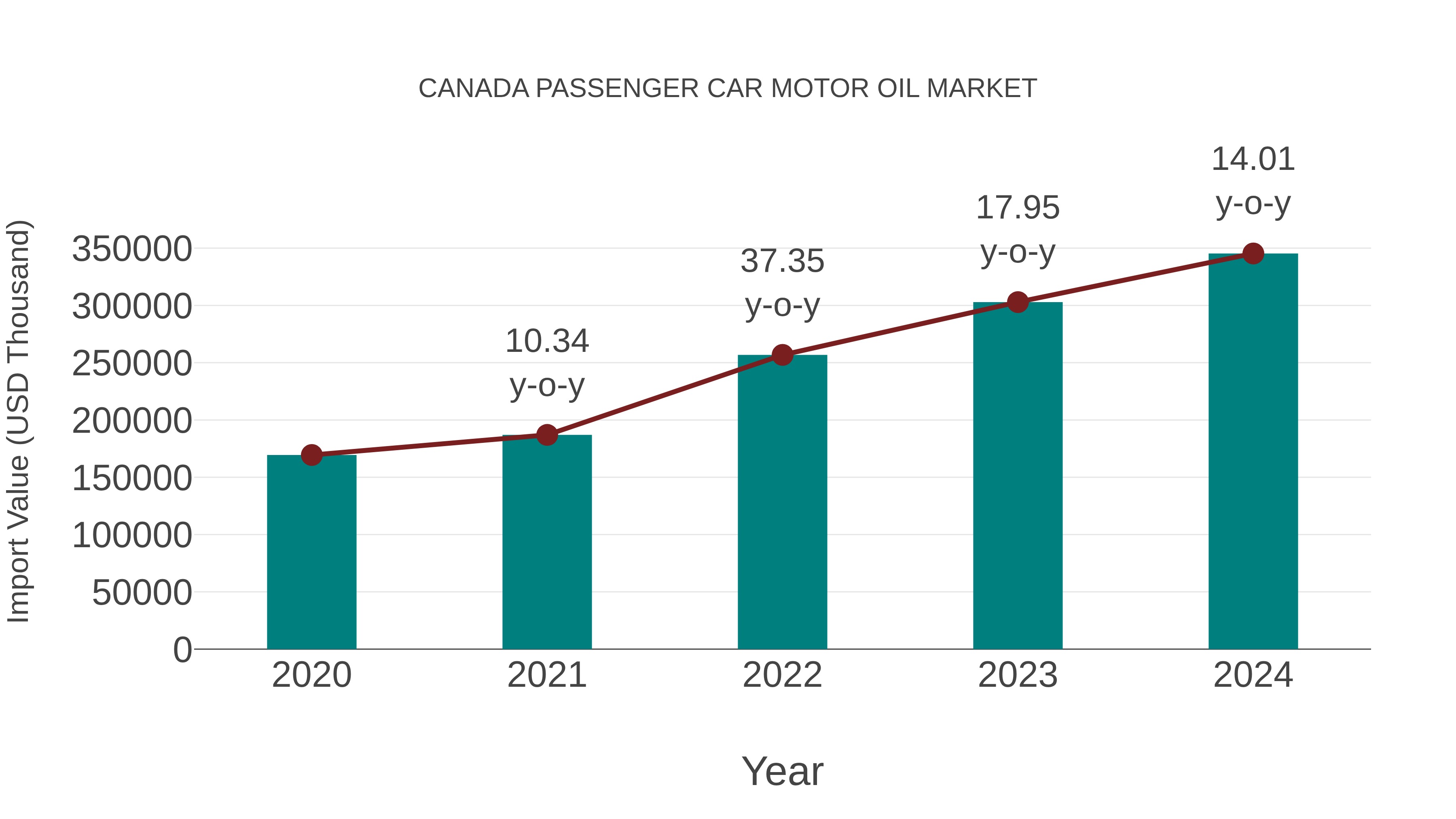
In the Canada passenger car motor oil market, the import trend showed a significant growth rate of 14.01% from 2023 to 2024, with a compound annual growth rate (CAGR) of 19.48% from 2020 to 2024. This notable uptrend in imports can be attributed to increased consumer demand for quality automotive lubricants and favorable trade policies that facilitated smoother market access for foreign suppliers.
Canada Passenger Car Motor Oil Market Overview
The Canada passenger car motor oil market is a highly competitive industry driven by factors such as increasing vehicle sales, growing awareness about the importance of regular maintenance, and technological advancements in engine oils. The market is characterized by a wide range of product offerings from both domestic and international oil manufacturers, with synthetic oils gaining popularity due to their superior performance and longer lifespan. Key players in the market focus on product innovation, strategic partnerships, and marketing initiatives to gain a competitive edge. The growing trend towards energy-efficient and environmentally friendly lubricants is also influencing market dynamics. Overall, the Canada passenger car motor oil market is expected to continue its steady growth trajectory, driven by increasing vehicle ownership and a growing emphasis on engine efficiency and longevity.
Canada Passenger Car Motor Oil Market Trends
In the Canada passenger car motor oil market, several key trends are emerging. One significant trend is the increasing demand for synthetic motor oils due to their superior performance and longer lifespan compared to conventional oils. Consumers are also showing a preference for motor oils that offer improved fuel efficiency and engine protection, driving the market towards more advanced formulations. Another trend is the growing awareness and adoption of environmentally friendly and sustainable motor oil products, as consumers become more conscious of the environmental impact of their choices. Additionally, the shift towards electric vehicles is influencing the market, with a potential impact on the demand for traditional motor oils in the long term. Overall, these trends are shaping the landscape of the Canada passenger car motor oil market towards more innovative and sustainable solutions.
Canada Passenger Car Motor Oil Market Challenges
In the Canada passenger car motor oil market, one of the key challenges faced is the increasing competition from various brands and products. With a growing number of players entering the market, it has become more difficult for companies to differentiate themselves and capture market share. This leads to price wars and promotional activities that can impact profitability. Additionally, there is a shift towards electric vehicles, which could potentially reduce the demand for traditional motor oils in the long term. Another challenge is the need for companies to keep up with changing regulations and environmental standards, which require them to innovate and develop more sustainable and eco-friendly products. Overall, the Canada passenger car motor oil market is facing challenges related to competition, changing consumer preferences, and regulatory requirements.
Canada Passenger Car Motor Oil Market Investment Opportunities
The Canada passenger car motor oil market presents lucrative investment opportunities due to the strong demand for high-quality lubricants driven by the increasing number of vehicles on the road. With consumers prioritizing engine performance, fuel efficiency, and environmental sustainability, there is a growing demand for advanced synthetic oils and specialized formulations. Investing in research and development to create innovative products that meet these evolving consumer preferences can differentiate a company in this competitive market. Additionally, leveraging strategic partnerships with automotive manufacturers and distributors can enhance market penetration and brand visibility. As the automotive industry continues to evolve towards electric vehicles and autonomous driving technologies, investing in sustainable lubricant solutions and adapting to changing market dynamics will be key to long-term success in the Canada passenger car motor oil market.
Canada Passenger Car Motor Oil Market Government Policy
In Canada, government policies related to the passenger car motor oil market primarily focus on environmental protection and energy efficiency. The government has implemented regulations to ensure that motor oils meet specific performance standards, such as the Canadian Motor Vehicle Emission Regulations, which aim to reduce vehicle emissions and improve air quality. Additionally, there are labeling requirements in place to provide consumers with information on the energy efficiency and environmental impact of motor oils. The government also encourages the use of environmentally friendly and sustainable practices in the production and disposal of motor oils through various programs and incentives. Overall, the government`s policies in Canada`s passenger car motor oil market are geared towards promoting sustainability, reducing emissions, and protecting the environment.
Canada Passenger Car Motor Oil Market Future Outlook
The future outlook for the Canada passenger car motor oil market appears promising, driven by several key factors. Increasing vehicle ownership and a growing automotive industry are expected to boost demand for motor oil in the country. Additionally, the rise in awareness about the importance of regular maintenance and the shift towards synthetic and high-performance oils are likely to drive market growth. The trend towards electric vehicles may pose a challenge in the long term, but the demand for motor oil is expected to remain steady for internal combustion engine vehicles. Market players are also focusing on product innovations, such as environmentally-friendly and fuel-efficient oils, to cater to changing consumer preferences. Overall, the Canada passenger car motor oil market is anticipated to show steady growth in the foreseeable future.
Key Highlights of the Report:
- Canada Passenger Car Motor Oil Market Outlook
- Market Size of Canada Passenger Car Motor Oil Market,2025
- Forecast of Canada Passenger Car Motor Oil Market, 2032
- Historical Data and Forecast of Canada Passenger Car Motor Oil Revenues & Volume for the Period 2022-2032F
- Canada Passenger Car Motor Oil Market Trend Evolution
- Canada Passenger Car Motor Oil Market Drivers and Challenges
- Canada Passenger Car Motor Oil Price Trends
- Canada Passenger Car Motor Oil Porter's Five Forces
- Canada Passenger Car Motor Oil Industry Life Cycle
- Historical Data and Forecast of Canada Passenger Car Motor Oil Market Revenues & Volume By Type for the Period 2022-2032F
- Historical Data and Forecast of Canada Passenger Car Motor Oil Market Revenues & Volume By Synthetic for the Period 2022-2032F
- Historical Data and Forecast of Canada Passenger Car Motor Oil Market Revenues & Volume By Conventional for the Period 2022-2032F
- Historical Data and Forecast of Canada Passenger Car Motor Oil Market Revenues & Volume By Semi-Synthetic for the Period 2022-2032F
- Historical Data and Forecast of Canada Passenger Car Motor Oil Market Revenues & Volume By High-Mileage for the Period 2022-2032F
- Historical Data and Forecast of Canada Passenger Car Motor Oil Market Revenues & Volume By Viscosity Grade for the Period 2022-2032F
- Historical Data and Forecast of Canada Passenger Car Motor Oil Market Revenues & Volume By 5W-30 for the Period 2022-2032F
- Historical Data and Forecast of Canada Passenger Car Motor Oil Market Revenues & Volume By 10W-40 for the Period 2022-2032F
- Historical Data and Forecast of Canada Passenger Car Motor Oil Market Revenues & Volume By 15W-50 for the Period 2022-2032F
- Historical Data and Forecast of Canada Passenger Car Motor Oil Market Revenues & Volume By 0W-20 for the Period 2022-2032F
- Historical Data and Forecast of Canada Passenger Car Motor Oil Market Revenues & Volume By Application for the Period 2022-2032F
- Historical Data and Forecast of Canada Passenger Car Motor Oil Market Revenues & Volume By High Performance for the Period 2022-2032F
- Historical Data and Forecast of Canada Passenger Car Motor Oil Market Revenues & Volume By Standard Driving for the Period 2022-2032F
- Historical Data and Forecast of Canada Passenger Car Motor Oil Market Revenues & Volume By Long Mileage for the Period 2022-2032F
- Historical Data and Forecast of Canada Passenger Car Motor Oil Market Revenues & Volume By Fuel Efficiency for the Period 2022-2032F
- Historical Data and Forecast of Canada Passenger Car Motor Oil Market Revenues & Volume By End Use for the Period 2022-2032F
- Historical Data and Forecast of Canada Passenger Car Motor Oil Market Revenues & Volume By Car Owners for the Period 2022-2032F
- Historical Data and Forecast of Canada Passenger Car Motor Oil Market Revenues & Volume By Dealerships for the Period 2022-2032F
- Historical Data and Forecast of Canada Passenger Car Motor Oil Market Revenues & Volume By Service Centers for the Period 2022-2032F
- Historical Data and Forecast of Canada Passenger Car Motor Oil Market Revenues & Volume By Automotive for the Period 2022-2032F
- Canada Passenger Car Motor Oil Import Export Trade Statistics
- Market Opportunity Assessment By Type
- Market Opportunity Assessment By Viscosity Grade
- Market Opportunity Assessment By Application
- Market Opportunity Assessment By End Use
- Canada Passenger Car Motor Oil Top Companies Market Share
- Canada Passenger Car Motor Oil Competitive Benchmarking By Technical and Operational Parameters
- Canada Passenger Car Motor Oil Company Profiles
- Canada Passenger Car Motor Oil Key Strategic Recommendations






































