Canada Pulses Market: Import Trend Analysis
In the Canada pulses market, the import trend showed a notable growth rate of 8.41% from 2023 to 2024, with a compound annual growth rate (CAGR) of 9.84% for the period 2020-2024. This increase in import momentum can be attributed to shifting consumer preferences towards plant-based proteins and a stable market demand for pulses in various food products.
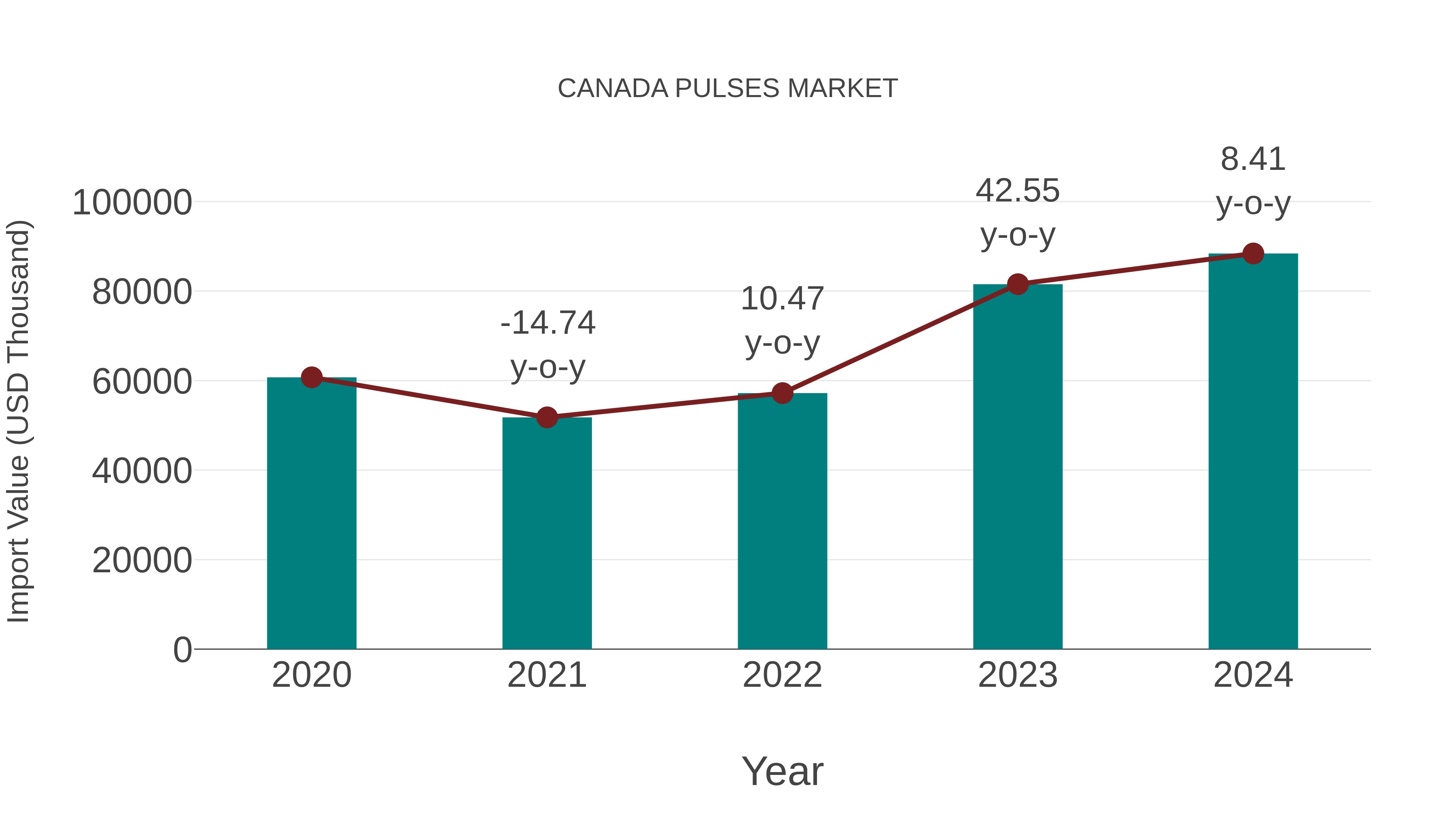
Canada Pulses Market Growth Rate
According to 6Wresearch internal database and industry insights, the Canada Pulses Market is projected to grow at a compound annual growth rate (CAGR) of 4.7% during the forecast period (2026-2032).
Five-Year Growth Trajectory of the Canada Pulses Market with Core Drivers
Below mentioned are the evaluation of years-wise growth rate along with key growth drivers:
| Years | CAGR (%) | Growth Drivers |
| 2021 | 2.1 | Expansion of pulse farming acreage in major provinces |
| 2022 | 2.8 | Rising exports to Asia and the Middle East |
| 2023 | 3.4 | Growing domestic demand for plant-based diets |
| 2024 | 3.9 | Increased innovation in pulse-based ingredients |
| 2025 | 4.3 | Government support for sustainable agricultural practices |
Topics Covered in the Canada Pulses Market Report
The Canada Pulses Market report thoroughly covers the market by product type and end use. The market report provides an unbiased and detailed analysis of ongoing market trends, opportunities/high growth areas, and market drivers, which help stakeholders devise and align their market strategies according to the current and future market dynamics.
Canada Pulses Market Highlights
| Report Name | Canada Pulses Market |
| Forecast period | 2026-2032 |
| CAGR | 4.7% |
| Growing Sector | Snack Food |
Canada Pulses Market Synopsis
Canada Pulses Market is witnessing substantial growth driven by increasing global demand, rising health-conscious consumer behavior, and expanding applications of pulses in food processing. Canada remains one of the largest global producers of lentils and peas, strengthening its export capacity. The growing shift toward plant-based proteins and rising investments in pulse-derived ingredients, such as flours and isolates, further enhance market expansion. Domestic demand is also rising due to changing dietary patterns and greater integration of pulses in packaged foods.
Evaluation of Growth Drivers in the Canada Pulses Market
Below mentioned are some prominent drivers and their influence to the market dynamics:
| Drivers | Primary Segments Affected | Why it Matters (Evidence) |
| Rising Global Demand for Plant Protein | Lentils, Chickpeas; B2B | Consumers worldwide are shifting to plant-based diets, increasing pulse exports. |
| Strong Government Support for Pulse Cultivation | All Types; Farmers | Funding incentives encourage farmers to expand pulse acreage for sustainable agriculture. |
| Growth of Snack Food Manufacturing | Mung Beans, Peas; Snack Industry | Pulses are used in protein snacks, increasing demand from food processors. |
| Increasing Use of Pulses in Flour Milling | Lentils, Fava Beans; Flour Industry | Pulse-based gluten-free flours are widely adopted in bakery and specialty food markets. |
| Enhanced Research in Pulse Varieties | All Types | Breeding programs improve disease resistance and yield, boosting farmer adoption. |
Canada Pulses Market is expected to grow at the CAGR of 4.7% during the forecast period of 2026-2032. Several factors are proliferating the growth of the market, including export expansion and rising plant-protein consumption across the country. The snack food industry is now majorly contributing for boosting the pulses consumption in the country, as it has started incorporating pulse-based ingredients as consumers seek healthy, high-protein snacks. Productivity is being enhanced, coupled with Canada’s competitive position in the global pulses sector, which is also being strengthened due to ongoing agricultural research focused on developing high-yield and disease-resistant pulse varieties. In addition to this, the Canada Pulses Market growth is driven by the rising demand for pulses in gluten-free flour processing, bakery applications, and plant-based food manufacturing.
Evaluation of Restraints in the Canada Pulses Market
Below mentioned are some major restraints and their influence to the market dynamics:
| Restraints | Primary Segments Affected | What This Means (Evidence) |
| Weather-Dependent Yield Variability | All Types | Unpredictable climate affects pulse yields, reducing supply stability. |
| Market Fluctuations in Global Prices | Export-Oriented Pulses | Volatile international prices impact farmer profitability. |
| Limited Processing Capacity in Some Provinces | Flour Industry | Shortages of advanced milling infrastructure restricts production of pulse-based ingredients. |
| High Competition from International Suppliers | All Types | Competing pulse-producing countries challenge Canada’s market share. |
| Supply Chain Inefficiencies in Rural Areas | Home Use & B2C | Long transportation times increase cost and reduce freshness in retail markets. |
Canada Pulses Industry Challenges
On the other hand, the market deals with numerous challenges. Such as, yield variability due to climatic changes and fluctuation in global prices. Also, some other challenges that create barrier to the market growth are limited value-added processing facilities in certain regions, inconsistent export logistics, and transportation blockages across rural provinces. Another major challenge can be a high competition from emerging pulse-producing nations.
Canada Pulses Market Trends
Key trends evaluating the landscape of the Canada Pulses Market are:
- Rapid Growth of Pulse-Based Proteins: Rising production of pulse protein isolates used in plant-based beverages and meat alternatives.
- Expansion in Gluten-Free Flour Development: Popularity of pulse-based flours for bakery, snacks, and ethnic foods continues to rise.
- Increasing On-Farm Sustainability Practices: Farmers adopt regenerative practices to enhance soil fertility using pulse crops.
- Growth of Organic Pulse Farming: Demand for organic chickpeas and lentils is rising in premium export markets.
- Adoption of Advanced Sorting & Grading Technologies: Automated cleaning and grading units improve export quality compliance.
Investment Opportunities in the Canada Pulses Market
Some prominent investment opportunities in the Canada Pulses Market include:
- Pulse Protein Extraction Plants – Setting up facilities to produce protein isolates for food and beverage industries.
- Pulse Milling and Flour Processing Units – Investment in grinding and packaging infrastructure for domestic and export markets.
- Cold Storage and Warehousing Solutions – Developing climate-controlled storage for bulk export shipments.
- Organic Pulse Certification & Branding – Creating value-added export streams for premium organic pulses.
Top 5 Leading Players in the Canada Pulses Market
Some leading players operating in the market include:
1. AGT Food and Ingredients
| Company Name | AGT Food and Ingredients |
| Established Year | 2001 |
| Headquarters | Regina, Canada |
| Website | Click Here |
AGT processes pulses, staple foods, and specialty ingredients for global food manufacturers.
2. Parrish & Heimbecker Ltd. (P&H)
| Company Name | Parrish & Heimbecker Ltd. (P&H) |
| Established Year | 1909 |
| Headquarters | Winnipeg, Canada |
| Website | Click Here |
P&H operates grain handling and milling facilities, supplying pulses for food and bakery industries.
3. Richardson International
| Company Name | Richardson International |
| Established Year | 1857 |
| Headquarters | Winnipeg, Canada |
| Website | Click Here |
Richardson manages agricultural supply chains and distributes high-quality Canadian pulses worldwide.
4. Viterra Inc.
| Company Name | Viterra Inc. |
| Established Year | 2007 |
| Headquarters | Regina, Canada |
| Website | Click Here |
Viterra specializes in pulse sourcing, processing, and export logistics across major global markets.
5. Simpson Seeds Inc.
| Company Name | Simpson Seeds Inc. |
| Established Year | 1979 |
| Headquarters | Moose Jaw, Canada |
| Website | Click Here |
The company focuses on lentil and pulse production, offering high-quality cleaned and processed seeds.
Government Regulations Introduced in the Canada Pulses Market
According to Canadian Government Data, various actions have been taken by the authorities to strengthen the pulse sector development in Canada. For example, Agriculture and Agri-Food Canada (AAFC) and Canadian Agricultural Partnership, which support farmers with grants for modernizing equipment and improving crop resilience. And provides funding for research programs to enhance pulse crop yields. Additionally, Canada’s competitive advantage in global pulse markets is being strengthened, as government-backed incentives are encouraging sustainable pulse farming.
Future Insights of the Canada Pulses Market
The outlook for the Canada Pulses Market share is estimated to increase in the future due to various factors, such as increasing global reliance on plant protein and expanding export opportunities. The rising domestic consumption of pulse-based snacks and flours will be another major factor for the market growth. Also, production efficiency is being enhanced with the rising technological advancements in milling, protein extraction, and crop monitoring. Additionally, the growing sustainability initiatives and adoption of regenerative agriculture practices will continue to position Canada as a major leader in the global pulses sector.
Market Segmentation Analysis
The report offers a comprehensive study of the following market segments and their leading categories:
Lentils to Dominate the Market – By Type
According to Mohit, Senior Research Analyst, 6Wresearch, Lentils hold the largest market share in the Canada Pulses Market owing to Canada’s leading global position in lentil production and export. High yields, strong international demand, and established procurement networks ensure the dominance of lentils across domestic and export markets.
Snack Food Industry to Dominate the Market – By End-use
The Snack Food Industry segment dominates the Canada Pulses Market Share due to rising adoption of pulse-based protein snacks, roasted pulses, and flour-based chips. Growing consumer preferences for healthy, high-protein, and gluten-free snack options significantly boost demand within this segment.
Key Attractiveness of the Report
- 10 Years of Market Numbers.
- Historical Data Starting from 2022 to 2025.
- Base Year: 2025.
- Forecast Data until 2032.
- Key Performance Indicators Impacting the Market.
- Major Upcoming Developments and Projects.
Key Highlights of the Report:
- Canada Pulses Market Outlook
- Market Size of Canada Pulses Market, 2025
- Forecast of Canada Pulses Market, 2032
- Historical Data and Forecast of Canada Pulses Revenues & Volume for the Period 2022-2032
- Canada Pulses Market Trend Evolution
- Canada Pulses Market Drivers and Challenges
- Canada Pulses Price Trends
- Canada Pulses Porter`s Five Forces
- Canada Pulses Industry Life Cycle
- Historical Data and Forecast of Canada Pulses Market Revenues & Volume By Type for the Period 2022-2032
- Historical Data and Forecast of Canada Pulses Market Revenues & Volume By Chick Peas for the Period 2022-2032
- Historical Data and Forecast of Canada Pulses Market Revenues & Volume By Kaspa Peas for the Period 2022-2032
- Historical Data and Forecast of Canada Pulses Market Revenues & Volume By Lentils for the Period 2022-2032
- Historical Data and Forecast of Canada Pulses Market Revenues & Volume By Pigeon Peas for the Period 2022-2032
- Historical Data and Forecast of Canada Pulses Market Revenues & Volume By Fava Beans for the Period 2022-2032
- Historical Data and Forecast of Canada Pulses Market Revenues & Volume By Black Gram for the Period 2022-2032
- Historical Data and Forecast of Canada Pulses Market Revenues & Volume By Mung Beans for the Period 2022-2032
- Historical Data and Forecast of Canada Chick Peas Pulses Market Revenues & Volume By Others for the Period 2022-2032
- Historical Data and Forecast of Canada Pulses Market Revenues & Volume By End-use for the Period 2022-2032
- Historical Data and Forecast of Canada Pulses Market Revenues & Volume By Home Use for the Period 2022-2032
- Historical Data and Forecast of Canada Pulses Market Revenues & Volume By Snack Food Industry for the Period 2022-2032
- Historical Data and Forecast of Canada Pulses Market Revenues & Volume By Flour Industry for the Period 2022-2032
- Historical Data and Forecast of Canada Pulses Market Revenues & Volume By Others for the Period 2022-2032
- Canada Pulses Import Export Trade Statistics
- Market Opportunity Assessment By Type
- Market Opportunity Assessment By End-use
- Canada Pulses Top Companies Market Share
- Canada Pulses Competitive Benchmarking By Technical and Operational Parameters
- Canada Pulses Company Profiles
- Canada Pulses Key Strategic Recommendations
Market Covered
The report offers a comprehensive study of the subsequent market segments:
By Type
- Chick Peas
- Kaspa Peas
- Lentils
- Pigeon Peas
- Fava Beans
- Black Gram
- Mung Beans
- Others
By End-use
- Home Use
- Snack Food Industry
- Flour Industry
- Others






































