Canada Tyres Market Year-wise Growth Rate (2021-2031F)
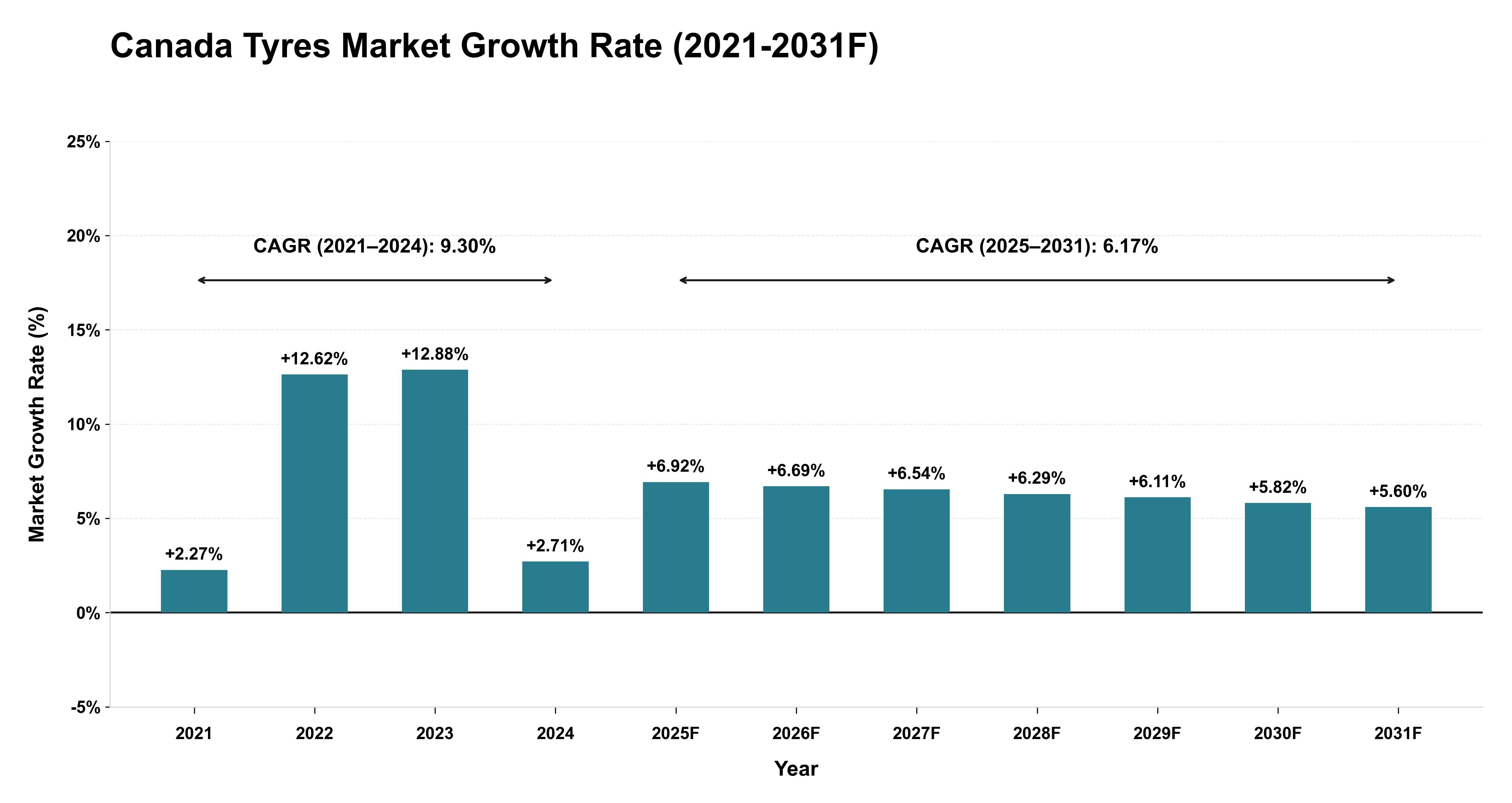
The Canada Tyres Market witnessed a notable growth acceleration from 2021 to 2023, driven by robust demand from the automotive sector due to increasing vehicle sales and a focus on safety and performance. This period saw a significant historical CAGR of 9.30%, reflecting strong consumer confidence and economic stability. However, in 2024, the growth tapered slightly at 2.71%, indicating a temporary slowdown possibly due to supply chain disruptions or market saturation in certain segments. Looking ahead to 2031, the forecast CAGR of 6.17% suggests a more stable growth trajectory, with consistent demand from both OEMs and replacement markets supported by technological advancements in tire durability and sustainability practices. The steady growth rates from 2025 to 2031 signal a mature yet resilient market adapting to changing consumer preferences and regulatory standards in Canada's automotive landscape.
Canada Tyres Market Overview
The Canada Tyres Market is a mature and competitive industry characterized by a diverse range of offerings catering to various vehicle types and consumer preferences. The market is driven by factors such as increasing vehicle sales, a growing emphasis on road safety, and the adoption of advanced tire technologies. Key players in the market include Bridgestone, Michelin, Goodyear, and Continental, among others. The market is also witnessing a shift towards eco-friendly and energy-efficient tires due to rising environmental concerns. With a focus on innovation and product differentiation, manufacturers are introducing tires with enhanced durability, performance, and fuel efficiency. Additionally, the online retail segment is gaining traction, offering convenience and a wide selection of tires to consumers across Canada.
Canada Tyres Market Trends
The Canada tyres market is currently experiencing a shift towards eco-friendly and sustainable options, driven by increasing awareness of environmental concerns. Consumers are showing a preference for tires made from recycled materials or those designed for better fuel efficiency to reduce their carbon footprint. Additionally, there is a growing demand for tires with enhanced safety features, such as all-weather performance and improved grip on wet surfaces, in response to changing weather patterns and road conditions. The market is also witnessing a rise in online sales of tires, as consumers increasingly prefer the convenience of browsing and purchasing products from the comfort of their homes. Overall, the Canada tyres market is moving towards a more environmentally conscious and technologically advanced landscape to meet evolving consumer preferences and regulatory requirements.
Canada Tyres Market Challenges
In the Canada Tyres Market, some key challenges include intense competition from both domestic and international tire manufacturers, fluctuating raw material prices, and changing consumer preferences towards eco-friendly and fuel-efficient tires. Regulatory requirements for safety and environmental standards also pose challenges for tire companies, requiring continuous innovation and investment in research and development. Additionally, the seasonality of tire demand in Canada due to harsh winter conditions and varying regional preferences for tire types further complicate market dynamics. To stay competitive in this challenging market, tire companies need to focus on product differentiation, sustainability practices, and efficient supply chain management to meet the demands of Canadian consumers while navigating industry challenges.
Canada Tyres Market Investment Opportunities
In the Canada Tyres Market, there are several promising investment opportunities for investors to consider. One potential avenue is the growing demand for eco-friendly and energy-efficient tires, driven by increasing environmental awareness and government regulations promoting sustainable practices. Investing in research and development of innovative tire technologies, such as low rolling resistance tires or those made from sustainable materials, could prove lucrative. Additionally, with the rise of electric vehicles in Canada, there is a growing need for specialized tires designed to cater to the unique requirements of EVs, presenting another opportunity for investment. Furthermore, strategic partnerships with automotive manufacturers or tire retailers to expand distribution channels and reach a wider customer base could also be a profitable investment strategy in the dynamic Canada Tyres Market.
Canada Tyres Market Government Policy
The Canadian government has implemented various policies related to the tires market to promote environmental sustainability and public safety. These policies include regulations on tire labeling to inform consumers of the fuel efficiency and environmental impact of tires, as well as mandates for tire recycling and disposal to minimize the environmental impact of waste tires. Additionally, the government has set standards for tire safety and performance to ensure that tires sold in the Canadian market meet certain quality and safety requirements. Overall, the government`s policies aim to encourage the use of environmentally friendly tires, promote responsible disposal practices, and enhance road safety for Canadian consumers.
Canada Tyres Market Future Outlook
The Canada Tyres Market is projected to experience steady growth in the coming years, driven by factors such as increasing vehicle sales, growing demand for high-performance and environmentally friendly tires, and advancements in tire technology. The shift towards electric vehicles and the implementation of stringent regulations regarding tire efficiency and safety are also expected to fuel market growth. Additionally, the rising popularity of online tire sales and the expansion of distribution channels are likely to contribute to the market`s expansion. However, challenges such as fluctuating raw material prices and intense competition among key players may present obstacles to the market`s growth trajectory. Overall, the Canada Tyres Market is poised for continued advancement, with a focus on innovation, sustainability, and meeting evolving customer needs.
Key Highlights of the Report:
- Canada Tyres Market Outlook
- Market Size of Canada Tyres Market,2025
- Forecast of Canada Tyres Market, 2032
- Historical Data and Forecast of Canada Tyres Revenues & Volume for the Period 2022-2032F
- Canada Tyres Market Trend Evolution
- Canada Tyres Market Drivers and Challenges
- Canada Tyres Price Trends
- Canada Tyres Porter's Five Forces
- Canada Tyres Industry Life Cycle
- Historical Data and Forecast of Canada Tyres Market Revenues & Volume By Type for the Period 2022-2032F
- Historical Data and Forecast of Canada Tyres Market Revenues & Volume By Radial for the Period 2022-2032F
- Historical Data and Forecast of Canada Tyres Market Revenues & Volume By Bias Ply for the Period 2022-2032F
- Historical Data and Forecast of Canada Tyres Market Revenues & Volume By Tubeless for the Period 2022-2032F
- Historical Data and Forecast of Canada Tyres Market Revenues & Volume By Tube Type for the Period 2022-2032F
- Historical Data and Forecast of Canada Tyres Market Revenues & Volume By Material for the Period 2022-2032F
- Historical Data and Forecast of Canada Tyres Market Revenues & Volume By Natural Rubber for the Period 2022-2032F
- Historical Data and Forecast of Canada Tyres Market Revenues & Volume By Synthetic Rubber for the Period 2022-2032F
- Historical Data and Forecast of Canada Tyres Market Revenues & Volume By Recycled Material for the Period 2022-2032F
- Historical Data and Forecast of Canada Tyres Market Revenues & Volume By Carbon-Based for the Period 2022-2032F
- Historical Data and Forecast of Canada Tyres Market Revenues & Volume By Vehicle Type for the Period 2022-2032F
- Historical Data and Forecast of Canada Tyres Market Revenues & Volume By Passenger Cars for the Period 2022-2032F
- Historical Data and Forecast of Canada Tyres Market Revenues & Volume By Commercial Vehicles for the Period 2022-2032F
- Historical Data and Forecast of Canada Tyres Market Revenues & Volume By Two-Wheelers for the Period 2022-2032F
- Historical Data and Forecast of Canada Tyres Market Revenues & Volume By Off-Road Vehicles for the Period 2022-2032F
- Historical Data and Forecast of Canada Tyres Market Revenues & Volume By End Use for the Period 2022-2032F
- Historical Data and Forecast of Canada Tyres Market Revenues & Volume By OEMs for the Period 2022-2032F
- Historical Data and Forecast of Canada Tyres Market Revenues & Volume By Aftermarket for the Period 2022-2032F
- Historical Data and Forecast of Canada Tyres Market Revenues & Volume By Fleet Operators for the Period 2022-2032F
- Historical Data and Forecast of Canada Tyres Market Revenues & Volume By Agriculture and Construction for the Period 2022-2032F
- Historical Data and Forecast of Canada Tyres Market Revenues & Volume By End Use for the Period 2022-2032F
- Historical Data and Forecast of Canada Tyres Market Revenues & Volume By Professional Tattooing for the Period 2022-2032F
- Historical Data and Forecast of Canada Tyres Market Revenues & Volume By Tattoo Studios for the Period 2022-2032F
- Canada Tyres Import Export Trade Statistics
- Market Opportunity Assessment By Type
- Market Opportunity Assessment By Material
- Market Opportunity Assessment By Vehicle Type
- Market Opportunity Assessment By End Use
- Market Opportunity Assessment By End Use
- Canada Tyres Top Companies Market Share
- Canada Tyres Competitive Benchmarking By Technical and Operational Parameters
- Canada Tyres Company Profiles
- Canada Tyres Key Strategic Recommendations






































