Canada Wine Market: Import Trend Analysis
In the Canada wine market, the import trend showed a modest growth rate of 0.84% from 2023 to 2024. However, the compound annual growth rate (CAGR) for 2020-2024 was -0.34%, indicating a slight decline overall. This could be attributed to shifting consumer preferences or market stabilization efforts following fluctuations in demand and trade policies.
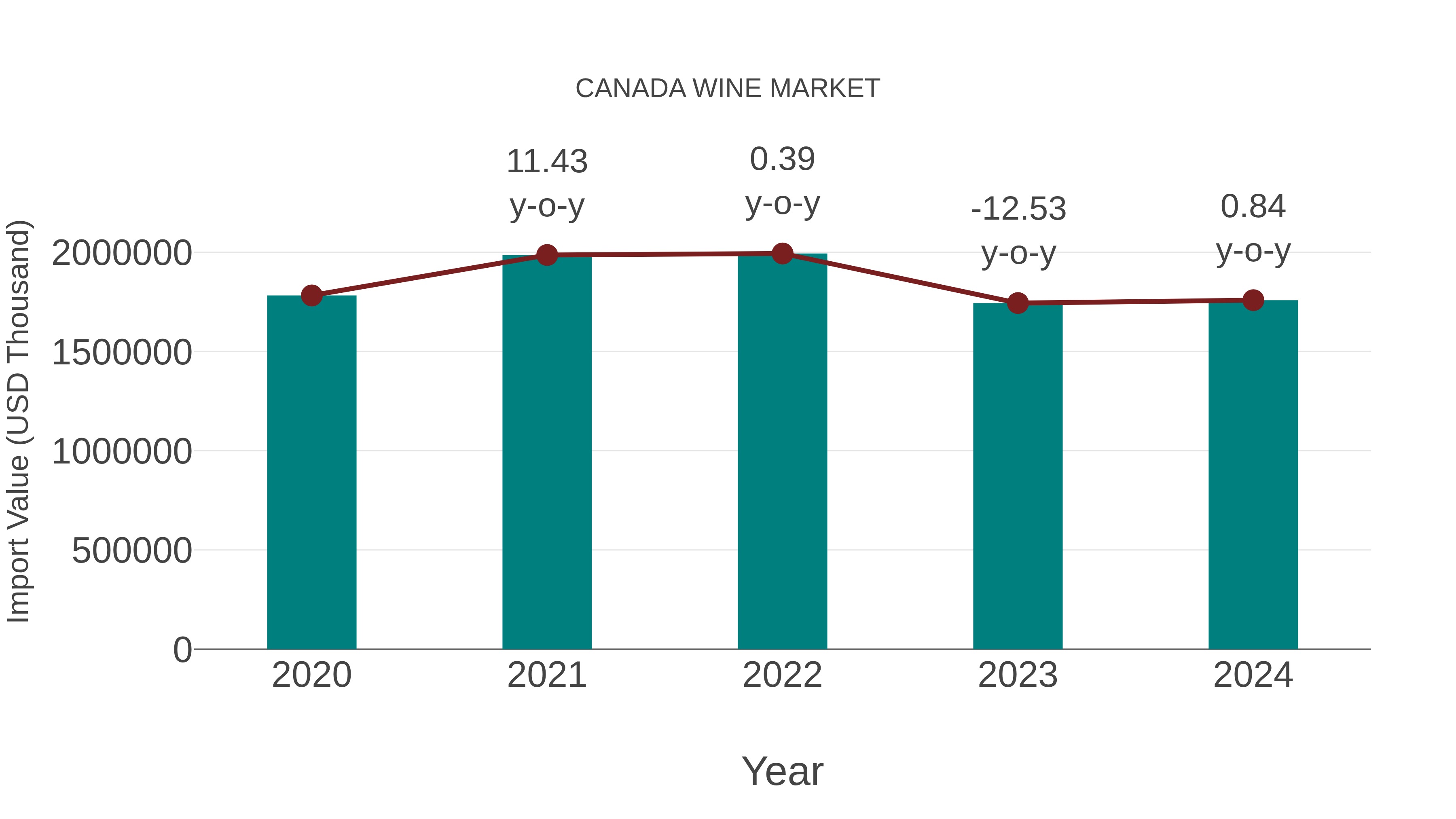
Canada Wine Market Growth Rate
According to 6Wresearch internal database and industry insights, the Canada Wine Market is projected to grow at a compound annual growth rate (CAGR) of 5.2% during the forecast period (2026–2032).
Five-Years Growth Trajectory of the Canada Wine Market with Core Drivers
Below is the evaluation of the year-wise growth rate along with key drivers:
| Years | Estimated Annual Growth (%) | Growth Drivers |
| 2021 | 3.8 | Rising interest in premium wines, especially among younger consumers, and higher imports from key wine regions. |
| 2022 | 4.2 | Growth in wine tourism and events, increasing awareness and consumption. |
| 2023 | 4.4 | Increase in online wine sales, providing convenient purchasing options. |
| 2024 | 4.7 | Growing demand for organic and biodynamic wines, driven by health-conscious trends. |
| 2025 | 5 | Popularity of wine pairings in foodservice, boosting overall wine consumption. |
Topics Covered in the Canada Wine Market Report
The Canada Wine Market report thoroughly covers the market by Product Types, Colors, and Distribution Channels. The report provides an unbiased and detailed analysis of ongoing market trends, opportunities/high-growth areas, and market drivers that will help stakeholders devise and align strategies according to current and future market dynamics.
Canada Wine Market Highlights
| Report Name | Canada Wine Market |
| Forecast period | 2026-2032 |
| CAGR | 5.2% |
| Growing Sector | Food and Beverage |
Canada Wine Market Synopsis
The Canada Wine Industry is anticipated to experience a constant rise, pulled by the surging demand for quality and organic wines along with the trend of wine-based activities like wine tourism. Another factor contributing significantly to the growth of the market is the hard push from the online sales and the development of wine retailing. On top of that, the traditional wine culture of Canada, with the increasing curiosity towards international wines is giving the market a positive outlook.
Evaluation of Growth Drivers in the Canada Wine Market
Below are some prominent drivers and their influence on the Canada Wine Market dynamics:
| Drivers | Primary Segments Affected | Why it Matters |
| Rising interest in premium wines | By Product Types | Millennials are opting for premium wines, driving sales. |
| Growth of wine tourism and events | By Distribution Channel | Wine events and tourism are raising awareness and boosting consumption. |
| Expansion of online wine sales | By Distribution Channel | Online wine shopping is growing, offering more variety. |
| Demand for organic and biodynamic wines | By Product Types | Health trends are increasing demand for organic and biodynamic wines. |
The Canada Wine Market Size is projected to grow at a CAGR of 5.2% during the forecast period (2026–2032). The demand for premium wines, especially organic and biodynamic ones, is the main reason for continuous growth. Online wine sales have been on the rise, and the wine tourism industry is growing, which means more market access and consumption. Besides that, Canada's importing fine wines position allows the market to be more dynamic and consequently, gives the consumer a larger variety of wines to choose from. The Canada wine market growth is also accompanied by changing consumer preference as people have increasingly started looking for high-quality, eco-friendly wine choices.
Evaluation of Restraints in the Canada Wine Market
Below are some major restraints and their influence on the Canada Wine Market dynamics:
| Restraints | Primary Segments Affected | What this Means |
| Price sensitivity for premium wines | By Product Types | High prices for premium wines may discourage price-sensitive consumers, reducing demand. |
| Limited awareness of wine categories | By Product Types | Lack of consumer awareness about wine types, like organic or biodynamic wines, may slow their growth. |
| Import dependencies | By Product Types | Dependence on imports can lead to chain supply challenges, especially with changing trade rules. |
| Weather-related disruptions in wine production | By Product Types | Climate changes can impact wine production in key regions, affecting supply reliability. |
Canada Wine Market Challenges
The Canada Wine Market faces challenges like price sensitivity, particularly in the premium wine segment, which restricts growth in high-end categories. Additionally, consumer limited knowledge on wine types like organic or biodynamic wines can hamper the entry of these product in the market. Also, climate changes influencing wine production regions may also disrupt supply, making it challenging to meet consumer demand consistently.
Canada Wine Market Trends
Several key trends are shaping the growth of the Canada Wine Market:
- Shift to premium wines: Consumers are spending more on high-quality wines, driving growth in premium segments like still and sparkling wines.
- Wine tourism and events: Wine tourism and events are increasing consumption and raising awareness.
- Growth of online wine sales: Consumers are choosing online shopping for convenience and access to more wine options.
- Rising demand for organic wines: Health trends are boosting demand for organic wines as sustainable choices.
Investment Opportunities in the Canada Wine Market
Some notable investment opportunities include:
Expand online wine retail: Invest in e-commerce platforms to meet rising demand and offer more wine options.
- Develop organic wine offerings: Increase availability of organic and biodynamic wines to attract health-conscious and eco-friendly consumers.
- Invest in wine tourism and events: Develop wine tourism infrastructure and host events to boost consumption and brand visibility.
- Improve wine distribution logistics: Invest in logistics and cold chain services to improve storage, reduce spoilage, and ensure a consistent supply year-round.
Top 5 Leading Players in the Canada Wine Market
Some leading players operating in the Canada Wine Market include:
1. Andrew Peller Limited
| Company Name | Andrew Peller Limited |
| Established Year | 1961 |
| Headquarters | Ontario, Canada |
| Website | Click Here |
Andrew Peller Limited is one of the largest wine companies in Canada, offering a wide range of premium wines from across Canada and internationally.
2. The Wine Shop
| Company Name | The Wine Shop |
| Established Year | 1999 |
| Headquarters | Ontario, Canada |
| Website | Click Here |
The Wine Shop specializes in retail wine sales across Canada, focusing on high-quality wines and expanding their organic wine portfolio.
3. LCBO (Liquor Control Board of Ontario)
| Company Name | LCBO (Liquor Control Board of Ontario) |
| Established Year | 1927 |
| Headquarters | Ontario, Canada |
| Website | Click Here |
LCBO is a major distributor of wines in Canada, offering a broad selection of local and international wines, including organic and biodynamic varieties.
4. Cave Spring Cellars
| Company Name | Cave Spring Cellars |
| Established Year | 1983 |
| Headquarters | Ontario, Canada |
| Website | Click Here |
Cave Spring Cellars is a well-known winery offering premium wines, with a focus on sustainable practices and organic wine production.
5. Constellation Brands
| Company Name | Constellation Brands |
| Established Year | 1945 |
| Headquarters | Ontario, Canada |
| Website | Click Here |
Constellation Brands is a global wine producer with a strong presence in Canada, offering a diverse range of wines, including organic and biodynamic options.
Government Regulations Introduced in the Canada Wine Market
According to Canadian Government data, several policies impact the wine industry, such as the Canadian Food Inspection Agency (CFIA), which imposes strict labeling and quality control criteria for all wines sold in Canada. The Agriculture and Agri-Food Canada supports wine producers through grants for sustainable wine production and technology adoption. Additionally, the Canadian Wine Regulations ensure the integrity and transparency of wine labeling, promoting consumer confidence.
Future Insights of the Canada Wine Market
The Canada wine market share is likely to see a gradual increase, mainly boosted by a higher interest in premium and organic wines. Besides, the online sale of wine, along with the wine tourism, will contribute a lot to the overall uplift in the consumption of wine. Along with this, as increasing number people are becoming considerate about health and the environment more than ever, will generate the requirement for organic and biodynamic wines, thus promoting market penetration.
Market Segmentation Analysis
The report offers a comprehensive study of the following market segments and their leading categories:
By Product Types – Still Wine to Lead the Market
According to Priya, Senior Research Analyst, 6Wresearch, Still wines are expected to dominate the Canada Wine Market due to their wide consumption across households, restaurants, and foodservice establishments. The versatility and consistency of still wines contribute to their popularity in the market.
By Colors – Red Wine to Lead the Market
Red wines are the most popular in Canada due to their ability to pair well with a variety of foods, particularly in dining and foodservice settings. Their widespread appeal makes red wines the dominant category in the market.
By Distribution Channel – Offline to Lead the Market
Offline channels, including supermarkets, specialty stores, and restaurants, lead the market due to their accessibility and in-person shopping experiences. While online wine sales are growing, offline channels remain the primary way consumers purchase wine in Canada.
Key Attractiveness of the Report
- 10 Years of Market Numbers
- Historical Data Starting from 2022 to 2025
- Base Year: 2025
- Forecast Data until 2032
- Key Performance Indicators Impacting the Market
- Major Upcoming Developments and Projects
Key Highlights of the Report:
- Canada Wine Market Outlook
- Market Size of Canada Wine Market, 2025
- Forecast of Canada Wine Market, 2032
- Historical Data and Forecast of Canada Wine Revenues & Volume for the Period 2022-2032
- Canada Wine Market Trend Evolution
- Canada Wine Market Drivers and Challenges
- Canada Wine Price Trends
- Canada Wine Porter`s Five Forces
- Canada Wine Industry Life Cycle
- Historical Data and Forecast of Canada Wine Market Revenues & Volume By Product Types for the Period 2022-2032
- Historical Data and Forecast of Canada Wine Market Revenues & Volume By Still Wine for the Period 2022-2032
- Historical Data and Forecast of Canada Wine Market Revenues & Volume By Sparkling Wine for the Period 2022-2032
- Historical Data and Forecast of Canada Wine Market Revenues & Volume By Dessert Wine for the Period 2022-2032
- Historical Data and Forecast of Canada Wine Market Revenues & Volume By Fortified Wine for the Period 2022-2032
- Historical Data and Forecast of Canada Wine Market Revenues & Volume By Colors for the Period 2022-2032
- Historical Data and Forecast of Canada Wine Market Revenues & Volume By Red Wine for the Period 2022-2032
- Historical Data and Forecast of Canada Wine Market Revenues & Volume By Rose Wine for the Period 2022-2032
- Historical Data and Forecast of Canada Wine Market Revenues & Volume By White Wine for the Period 2022-2032
- Historical Data and Forecast of Canada Wine Market Revenues & Volume By Other Colors for the Period 2022-2032
- Historical Data and Forecast of Canada Wine Market Revenues & Volume By Distribution Channel for the Period 2022-2032
- Historical Data and Forecast of Canada Wine Market Revenues & Volume By Offline for the Period 2022-2032
- Historical Data and Forecast of Canada Wine Market Revenues & Volume By Online for the Period 2022-2032
- Canada Wine Import Export Trade Statistics
- Market Opportunity Assessment By Product Types
- Market Opportunity Assessment By Colors
- Market Opportunity Assessment By Distribution Channel
- Canada Wine Top Companies Market Share
- Canada Wine Competitive Benchmarking By Technical and Operational Parameters
- Canada Wine Company Profiles
- Canada Wine Key Strategic Recommendations
Markets Covered
The report offers a comprehensive study of the following market segments:
By Product Types
- Still Wine
- Sparkling Wine
- Dessert Wine
- Fortified Wine
By Colors
- Red Wine
- Rose Wine
- White Wine
- Other Colors
By Distribution Channel
- Offline
- Online






































