Cape Verde Fruit Pulp Market: Top 5 Importing Countries and Market Competition (HHI) Analysis
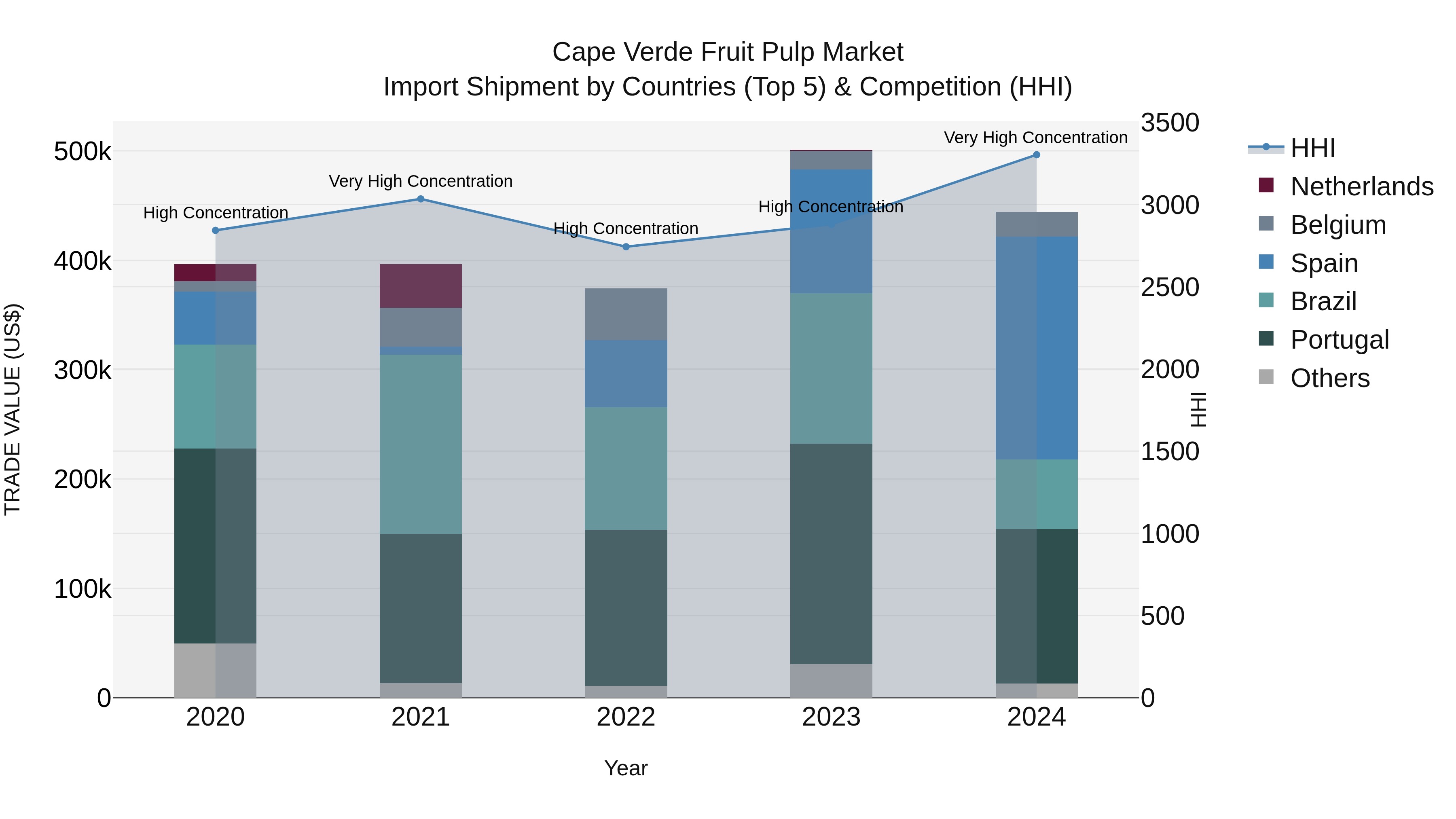
Cape Verde`s fruit pulp import market in 2024 is dominated by top exporters Spain, Portugal, Brazil, Belgium, and Italy. The market concentration, as measured by the HHI, has significantly increased from 2023 to 2024, indicating a high level of dominance by these key exporting countries. Despite a negative growth rate in 2024 compared to the previous year, the compound annual growth rate (CAGR) from 2020 to 2024 remains positive at 2.86%, showcasing steady expansion in the fruit pulp import market in Cape Verde over the past few years.
Cape Verde Fruit Pulp Market Overview
The fruit pulp market in Cape Verde is expanding as the demand for fruit-based products such as juices, sauces, and purees rises. Fruit pulp is a key ingredient in the food and beverage industry, offering convenience and flavor. The market is driven by growing consumer preference for natural and healthy products, though it faces challenges related to seasonal fruit availability and production costs.
Drivers of the market
The Cape Verde fruit pulp market benefits from the rising demand for natural and healthy food ingredients in beverages, dairy products, and baked goods. Fruit pulp is used to enhance the flavor and nutritional value of various food products. The growth of the food and beverage industry in Cape Verde, along with increasing consumer preference for natural ingredients, drives the demand for fruit pulp.
Challenges of the market
The Cape Verde Fruit Pulp market faces challenges such as limited local production and high import dependence. Cape Verde has a relatively small agricultural sector, which limits the availability of locally produced fruit pulp. This leads to a reliance on imports, increasing costs and vulnerability to supply chain disruptions. Additionally, the market may experience challenges related to quality control and maintaining consistency in fruit pulp products.
Government Policy of the market
There are no specific policies for the fruit pulp market in Cape Verde. However, general food safety regulations apply to fruit pulp production and distribution. The government ensures that fruit pulp products meet safety standards, are properly labeled, and comply with hygiene regulations to protect consumers.
Key Highlights of the Report:
- Cape Verde Fruit Pulp Market Outlook
- Market Size of Cape Verde Fruit Pulp Market, 2024
- Forecast of Cape Verde Fruit Pulp Market, 2031
- Historical Data and Forecast of Cape Verde Fruit Pulp Revenues & Volume for the Period 2021-2031
- Cape Verde Fruit Pulp Market Trend Evolution
- Cape Verde Fruit Pulp Market Drivers and Challenges
- Cape Verde Fruit Pulp Price Trends
- Cape Verde Fruit Pulp Porter`s Five Forces
- Cape Verde Fruit Pulp Industry Life Cycle
- Historical Data and Forecast of Cape Verde Fruit Pulp Market Revenues & Volume By Fruit Type for the Period 2021-2031
- Historical Data and Forecast of Cape Verde Fruit Pulp Market Revenues & Volume By Mango for the Period 2021-2031
- Historical Data and Forecast of Cape Verde Fruit Pulp Market Revenues & Volume By Strawberry for the Period 2021-2031
- Historical Data and Forecast of Cape Verde Fruit Pulp Market Revenues & Volume By Apple for the Period 2021-2031
- Historical Data and Forecast of Cape Verde Fruit Pulp Market Revenues & Volume By Guava for the Period 2021-2031
- Historical Data and Forecast of Cape Verde Fruit Pulp Market Revenues & Volume By Berries for the Period 2021-2031
- Historical Data and Forecast of Cape Verde Fruit Pulp Market Revenues & Volume By Citrus Fruits for the Period 2021-2031
- Historical Data and Forecast of Cape Verde Fruit Pulp Market Revenues & Volume By Others for the Period 2021-2031
- Historical Data and Forecast of Cape Verde Fruit Pulp Market Revenues & Volume By Form for the Period 2021-2031
- Historical Data and Forecast of Cape Verde Fruit Pulp Market Revenues & Volume By Liquid for the Period 2021-2031
- Historical Data and Forecast of Cape Verde Fruit Pulp Market Revenues & Volume By Powder for the Period 2021-2031
- Historical Data and Forecast of Cape Verde Fruit Pulp Market Revenues & Volume By Application for the Period 2021-2031
- Historical Data and Forecast of Cape Verde Fruit Pulp Market Revenues & Volume By Food and Beverages for the Period 2021-2031
- Historical Data and Forecast of Cape Verde Fruit Pulp Market Revenues & Volume By Distribution for the Period 2021-2031
- Historical Data and Forecast of Cape Verde Fruit Pulp Market Revenues & Volume By E-Commerce for the Period 2021-2031
- Historical Data and Forecast of Cape Verde Fruit Pulp Market Revenues & Volume By Convenience Stores for the Period 2021-2031
- Historical Data and Forecast of Cape Verde Fruit Pulp Market Revenues & Volume By Supermarkets/Hypermarkets for the Period 2021-2031
- Historical Data and Forecast of Cape Verde Fruit Pulp Market Revenues & Volume By Specialty Stores for the Period 2021-2031
- Historical Data and Forecast of Cape Verde Fruit Pulp Market Revenues & Volume By Others for the Period 2021-2031
- Cape Verde Fruit Pulp Import Export Trade Statistics
- Market Opportunity Assessment By Fruit Type
- Market Opportunity Assessment By Form
- Market Opportunity Assessment By Application
- Market Opportunity Assessment By Distribution
- Cape Verde Fruit Pulp Top Companies Market Share
- Cape Verde Fruit Pulp Competitive Benchmarking By Technical and Operational Parameters
- Cape Verde Fruit Pulp Company Profiles
- Cape Verde Fruit Pulp Key Strategic Recommendations






































