Cape Verde Modular Kitchen Market: Top 5 Importing Countries and Market Competition (HHI) Analysis
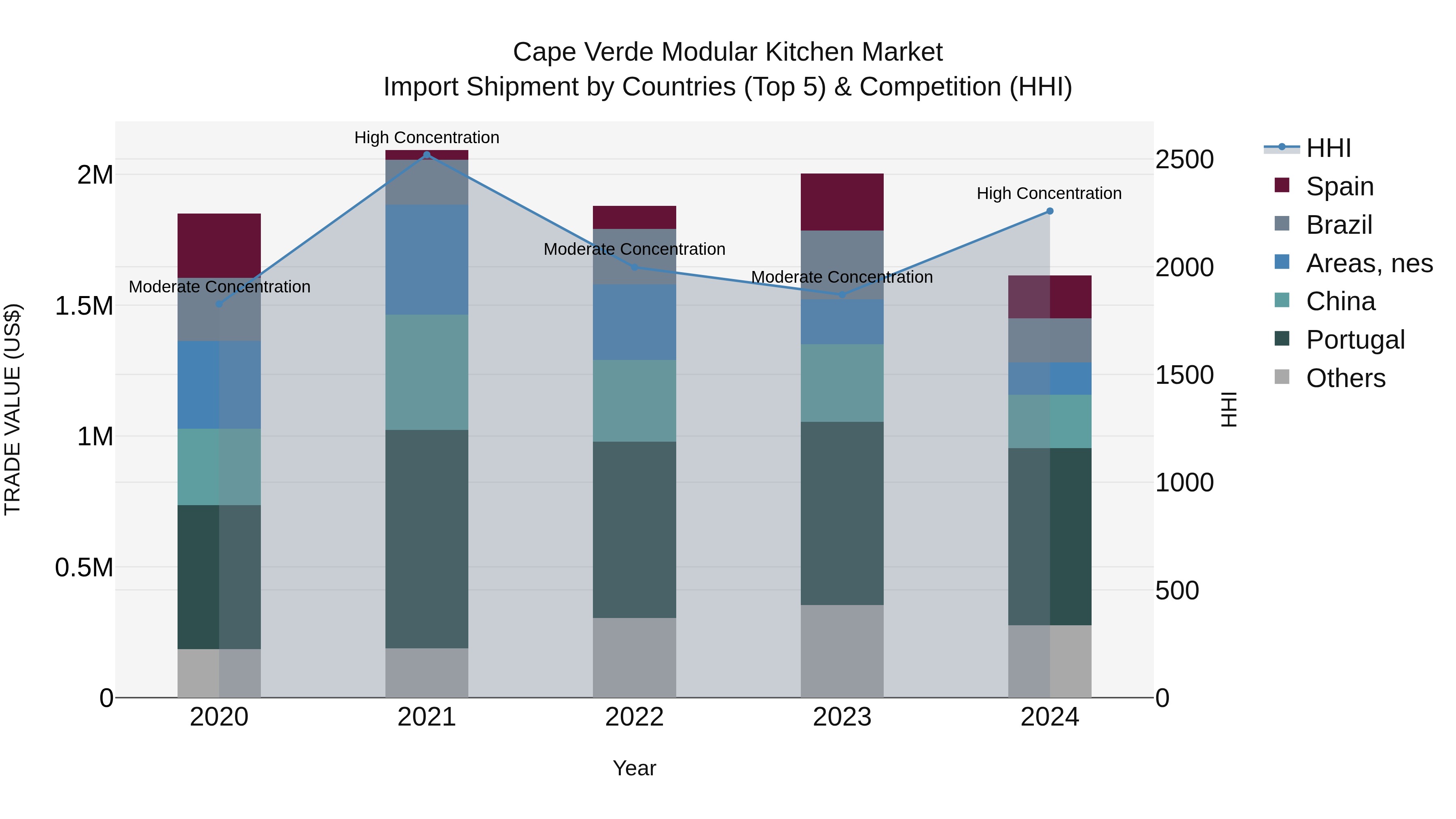
The modular kitchen import market in Cape Verde saw a shift in concentration levels from moderate to high in 2024, with top exporting countries being Portugal, China, Brazil, Spain, and Areas, nes. The market experienced a negative compound annual growth rate (CAGR) of -3.35% from 2020 to 2024, with a significant decline in growth rate from 2023 to 2024 at -19.4%. This indicates a challenging environment for import shipments in the Cape Verde modular kitchen market, potentially influenced by various factors such as economic conditions and competitive dynamics among exporting countries.
Cape Verde Modular Kitchen Market Overview
The modular kitchen market in Cape Verde features kitchen designs and solutions that use pre-fabricated units and components to create functional and aesthetically pleasing kitchen spaces. Modular kitchens offer benefits such as flexibility in design, ease of installation, and customization options. The market is growing due to the increasing demand for modern and efficient kitchen solutions, as well as advancements in kitchen design technology. The growth of this market is supported by the expanding real estate sector and the rising trend of home renovation and remodeling.
Drivers of the market
The Cape Verde Modular Kitchen market is influenced by the growing trend of modernizing kitchen spaces with efficient, customizable, and aesthetically pleasing solutions. Modular kitchens offer benefits such as space optimization, easy installation, and flexibility in design and configuration. The rise in home renovation projects, increasing urbanization, and the demand for functional and stylish kitchen solutions contribute to the growth of the modular kitchen market. Additionally, advancements in modular kitchen designs and materials that enhance durability and convenience further drive market expansion.
Challenges of the market
The modular kitchen market in Cape Verde faces challenges related to high import costs and limited local demand. The relatively small size of the market and the lack of local manufacturing capabilities can affect growth opportunities. Additionally, there may be limited awareness about the benefits and design options of modular kitchens among consumers and businesses. The market is also constrained by logistical difficulties in transporting and installing modular kitchen units, particularly in remote areas. The slow pace of infrastructure development and limited investment in home improvement can further impact the markets potential.
Government Policy of the market
The government could promote the modular kitchen market by investing in innovative kitchen designs and technologies that enhance functionality and efficiency. This includes providing grants or subsidies for companies developing modular kitchen solutions, funding research into new kitchen technologies, and promoting the use of modular kitchens in residential and commercial spaces.
Key Highlights of the Report:
- Cape Verde Modular Kitchen Market Outlook
- Market Size of Cape Verde Modular Kitchen Market, 2024
- Forecast of Cape Verde Modular Kitchen Market, 2031
- Historical Data and Forecast of Cape Verde Modular Kitchen Revenues & Volume for the Period 2021-2031
- Cape Verde Modular Kitchen Market Trend Evolution
- Cape Verde Modular Kitchen Market Drivers and Challenges
- Cape Verde Modular Kitchen Price Trends
- Cape Verde Modular Kitchen Porter`s Five Forces
- Cape Verde Modular Kitchen Industry Life Cycle
- Historical Data and Forecast of Cape Verde Modular Kitchen Market Revenues & Volume By Product for the Period 2021-2031
- Historical Data and Forecast of Cape Verde Modular Kitchen Market Revenues & Volume By Floor Cabinet & Wall Cabinets for the Period 2021-2031
- Historical Data and Forecast of Cape Verde Modular Kitchen Market Revenues & Volume By Tall Storage Cabinets for the Period 2021-2031
- Historical Data and Forecast of Cape Verde Modular Kitchen Market Revenues & Volume By Others for the Period 2021-2031
- Historical Data and Forecast of Cape Verde Modular Kitchen Market Revenues & Volume By End-User for the Period 2021-2031
- Historical Data and Forecast of Cape Verde Modular Kitchen Market Revenues & Volume By Residential for the Period 2021-2031
- Historical Data and Forecast of Cape Verde Modular Kitchen Market Revenues & Volume By Commercial for the Period 2021-2031
- Historical Data and Forecast of Cape Verde Modular Kitchen Market Revenues & Volume By Distribution Channel for the Period 2021-2031
- Historical Data and Forecast of Cape Verde Modular Kitchen Market Revenues & Volume By Offline (Contractors, Builders, and Others) for the Period 2021-2031
- Historical Data and Forecast of Cape Verde Modular Kitchen Market Revenues & Volume By Online for the Period 2021-2031
- Cape Verde Modular Kitchen Import Export Trade Statistics
- Market Opportunity Assessment By Product
- Market Opportunity Assessment By End-User
- Market Opportunity Assessment By Distribution Channel
- Cape Verde Modular Kitchen Top Companies Market Share
- Cape Verde Modular Kitchen Competitive Benchmarking By Technical and Operational Parameters
- Cape Verde Modular Kitchen Company Profiles
- Cape Verde Modular Kitchen Key Strategic Recommendations






































