Chile Bisphenol a Market Top 5 Importing Countries and Market Competition (HHI) Analysis
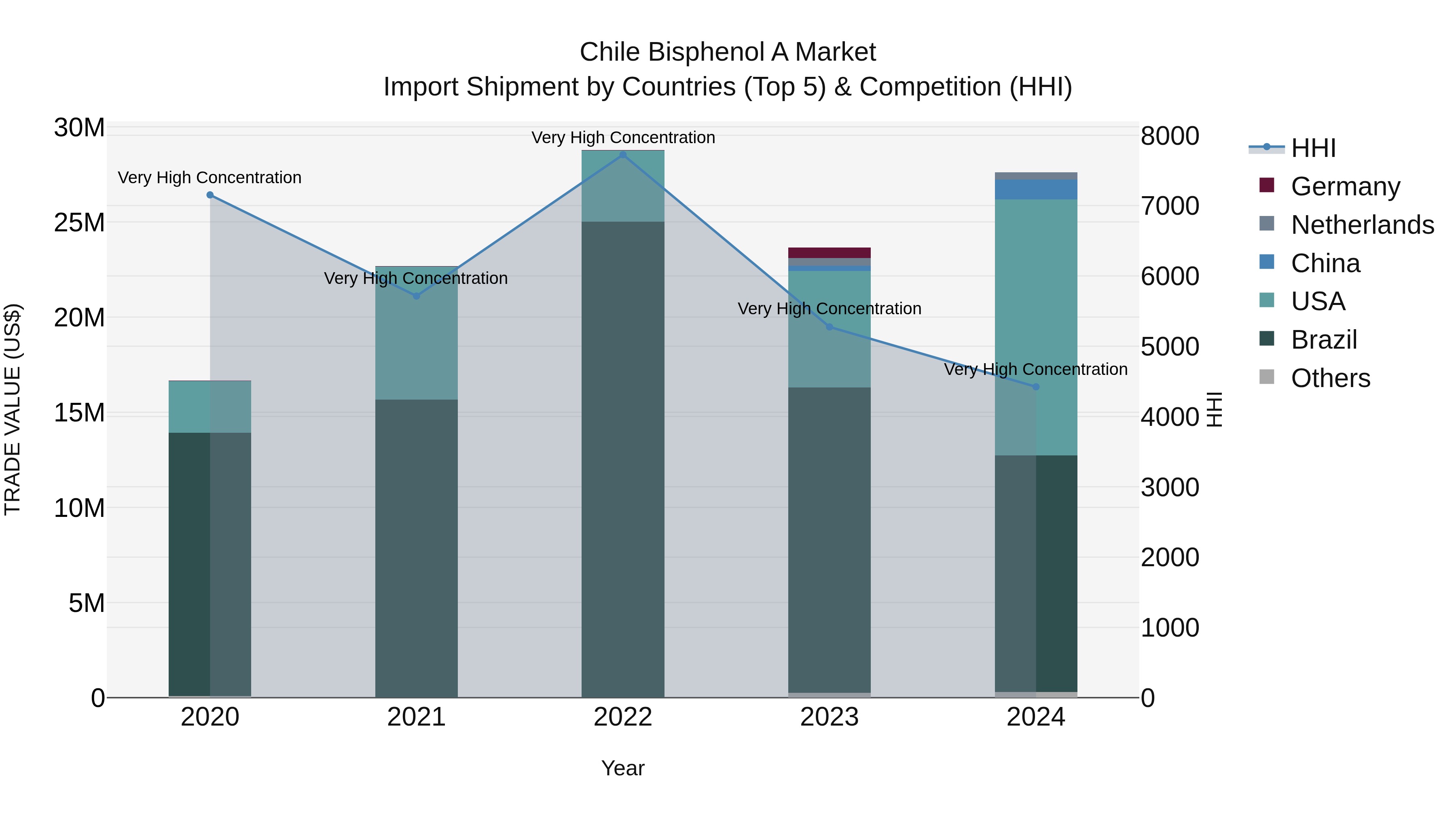
Chile`s import market for bisphenol A in 2024 continued to see significant concentration among top exporting countries, with the USA, Brazil, China, Netherlands, and South Korea leading the pack. The Herfindahl-Hirschman Index (HHI) remained at high levels, indicating a concentrated market structure. The compound annual growth rate (CAGR) for bisphenol A imports from 2020 to 2024 stood at a robust 13.46%, with a notable growth rate of 16.7% from 2023 to 2024, pointing towards sustained market expansion and the increasing importance of these key exporting countries in supplying bisphenol A to Chile.
Chile Bisphenol A Market Overview
The Chile Bisphenol A (BPA) market is experiencing steady growth driven by increasing demand from various end-use industries such as packaging, automotive, and electronics. BPA is a key ingredient in the production of polycarbonate plastics and epoxy resins, making it essential for manufacturing a wide range of consumer products. The market is also influenced by regulatory developments aimed at restricting the use of BPA in certain applications due to its potential health risks. Despite these challenges, manufacturers are investing in research and development to explore alternative materials and technologies to meet the changing market demands. Overall, the Chile BPA market is expected to continue its growth trajectory, driven by evolving consumer preferences and ongoing technological advancements.
Chile Bisphenol A Market Trends
The Chile Bisphenol A market is experiencing a shift towards BPA-free products driven by increasing awareness of the potential health risks associated with BPA exposure. Consumers are seeking safer alternatives, leading to a growing demand for BPA-free packaging, especially in the food and beverage industry. Regulatory measures and bans on BPA in certain products have also influenced market dynamics, pushing manufacturers to adopt alternative materials. The market is witnessing a rise in the use of substitutes such as BPS and BPF, as well as a focus on developing innovative, non-toxic packaging solutions. Sustainable and eco-friendly packaging options are gaining traction, reflecting a broader trend towards more environmentally conscious consumer choices in Chile. Overall, the Chile Bisphenol A market is evolving towards safer, greener, and more sustainable practices.
Chile Bisphenol A Market Challenges
In the Chile Bisphenol A market, one of the main challenges faced is increasing regulatory scrutiny and consumer awareness regarding the potential health risks associated with BPA. This has led to a growing demand for BPA-free products, putting pressure on manufacturers to find alternative solutions. Additionally, the fluctuation in raw material prices and the competitive landscape in the market pose challenges for companies operating in the sector. Adapting to changing regulations, ensuring product safety, and differentiating themselves in a crowded market are key challenges for players in the Chile Bisphenol A market. Overall, companies need to stay informed about regulatory developments, invest in research and development for alternative products, and focus on building consumer trust to navigate these challenges successfully.
Chile Bisphenol A Market Investment Opportunities
The Chile Bisphenol A market presents promising investment opportunities due to the increasing demand for BPA in various industries such as food and beverage packaging, automotive, and electronics. With Chile`s growing economy and industrial development, the demand for BPA is expected to rise further. Investors can consider opportunities in BPA manufacturing plants, distribution channels, or technology advancements for more sustainable and efficient production processes. Additionally, focusing on developing BPA alternatives or promoting BPA-free products could also be a lucrative investment strategy, considering the global trend towards eco-friendly and health-conscious solutions. Overall, the Chile Bisphenol A market offers diverse investment avenues for those looking to capitalize on the growing demand and evolving industry landscape.
Chile Bisphenol A Market Government Policy
The Chilean government has implemented strict regulations regarding the use of Bisphenol A (BPA) in various products. In 2011, Chile banned the use of BPA in baby bottles and sippy cups due to health concerns, particularly related to potential hormone-disrupting effects. Additionally, the Ministry of Health has established maximum limits for BPA in food packaging materials to ensure consumer safety. The government continues to monitor and regulate the presence of BPA in various products to protect public health and the environment. Companies operating in the Chilean market must comply with these policies to ensure their products meet regulatory standards and avoid potential fines or penalties for non-compliance.
Chile Bisphenol A Market Future Outlook
The Chile Bisphenol A market is expected to witness steady growth in the coming years due to increasing demand from various end-use industries such as automotive, electronics, and packaging. The market is likely to be driven by factors such as growing awareness about the benefits of Bisphenol A in manufacturing processes and the rising trend of using BPA-based products in consumer goods. However, regulatory measures focusing on the environmental impact of Bisphenol A could pose a challenge to market growth. Overall, the Chile Bisphenol A market is anticipated to expand at a moderate pace, with key players focusing on product innovation and sustainability to meet changing consumer preferences and regulatory requirements.
Key Highlights of the Report:
- Chile Bisphenol A Market Outlook
- Market Size of Chile Bisphenol A Market, 2021
- Forecast of Chile Bisphenol A Market, 2031
- Historical Data and Forecast of Chile Bisphenol A Revenues & Volume for the Period 2021 - 2031
- Chile Bisphenol A Market Trend Evolution
- Chile Bisphenol A Market Drivers and Challenges
- Chile Bisphenol A Price Trends
- Chile Bisphenol A Porter's Five Forces
- Chile Bisphenol A Industry Life Cycle
- Historical Data and Forecast of Chile Bisphenol A Market Revenues & Volume By Application for the Period 2021 - 2031
- Historical Data and Forecast of Chile Bisphenol A Market Revenues & Volume By Polycarbonate Resin for the Period 2021 - 2031
- Historical Data and Forecast of Chile Bisphenol A Market Revenues & Volume By Epoxy Resin for the Period 2021 - 2031
- Historical Data and Forecast of Chile Bisphenol A Market Revenues & Volume By Unsaturated Polyester Resins for the Period 2021 - 2031
- Historical Data and Forecast of Chile Bisphenol A Market Revenues & Volume By Flame Retardants for the Period 2021 - 2031
- Historical Data and Forecast of Chile Bisphenol A Market Revenues & Volume By Others for the Period 2021 - 2031
- Historical Data and Forecast of Chile Bisphenol A Market Revenues & Volume By End-use for the Period 2021 - 2031
- Historical Data and Forecast of Chile Bisphenol A Market Revenues & Volume By Eye wear for the Period 2021 - 2031
- Historical Data and Forecast of Chile Bisphenol A Market Revenues & Volume By Automotive component for the Period 2021 - 2031
- Historical Data and Forecast of Chile Bisphenol A Market Revenues & Volume By Electronics for the Period 2021 - 2031
- Historical Data and Forecast of Chile Bisphenol A Market Revenues & Volume By Wind Energy Composites for the Period 2021 - 2031
- Historical Data and Forecast of Chile Bisphenol A Market Revenues & Volume By Paint and Coating for the Period 2021 - 2031
- Historical Data and Forecast of Chile Bisphenol A Market Revenues & Volume By Green House for the Period 2021 - 2031
- Historical Data and Forecast of Chile Bisphenol A Market Revenues & Volume By Others for the Period 2021 - 2031
- Chile Bisphenol A Import Export Trade Statistics
- Market Opportunity Assessment By Application
- Market Opportunity Assessment By End-use
- Chile Bisphenol A Top Companies Market Share
- Chile Bisphenol A Competitive Benchmarking By Technical and Operational Parameters
- Chile Bisphenol A Company Profiles
- Chile Bisphenol A Key Strategic Recommendations






































