Chile Glassware Market Top 5 Importing Countries and Market Competition (HHI) Analysis
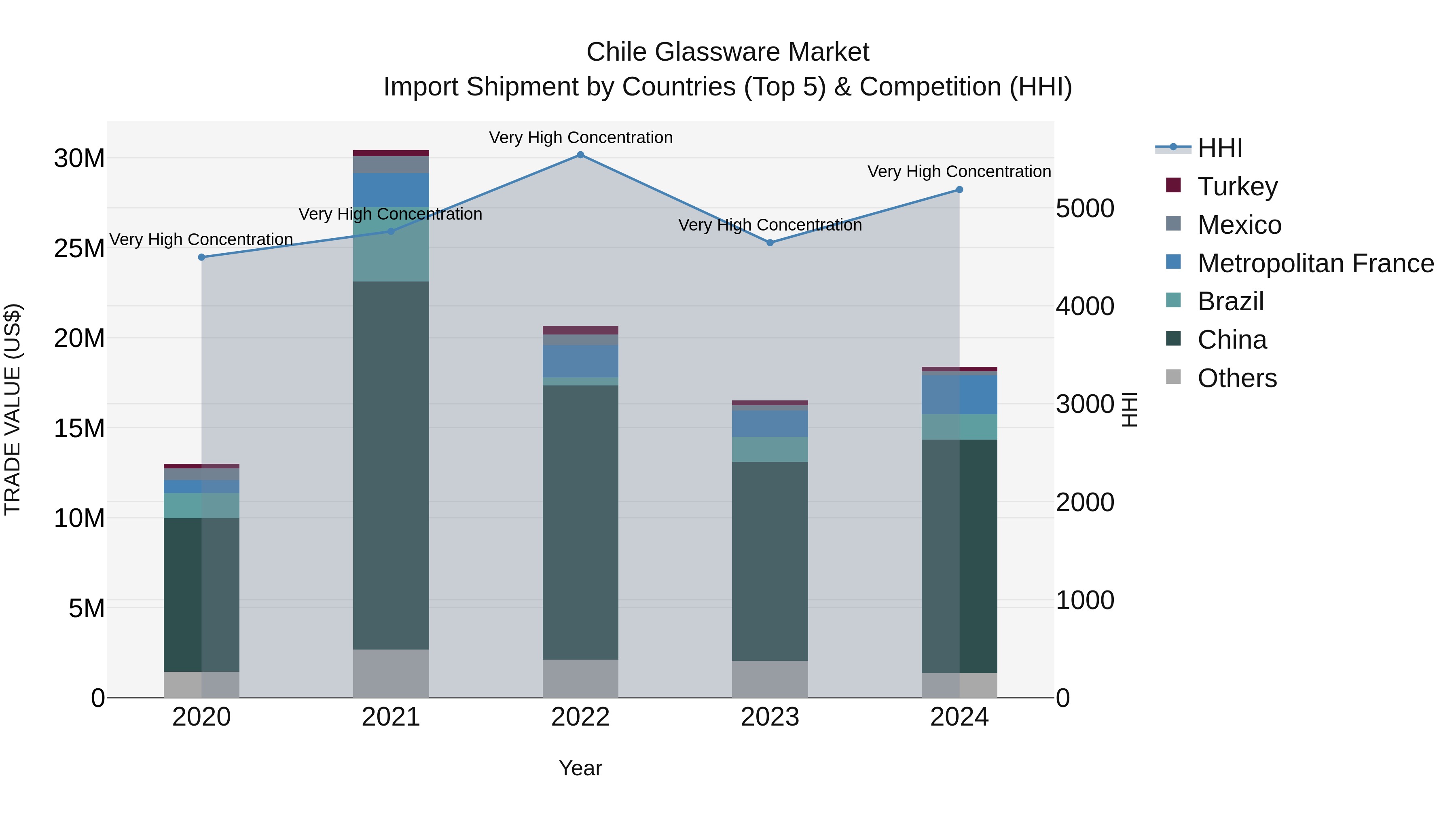
Chile continues to see significant import shipments of glassware, with top exporting countries in 2024 being China, Metropolitan France, Brazil, Turkey, and Mexico. The market remains highly concentrated, as indicated by the high Herfindahl-Hirschman Index (HHI) in 2024. The industry has shown strong growth, with a compound annual growth rate (CAGR) of 9.08% from 2020 to 2024. The growth momentum is also impressive, with a growth rate of 11.21% from 2023 to 2024, reflecting a positive outlook for the Chilean glassware import market.
Chile Glassware Market Overview
The Chile Glassware market supplies a wide range of glass vessels and containers for laboratory, scientific, and industrial applications, offering products such as beakers, flasks, test tubes, and glassware accessories. Glassware provides essential tools for chemical analysis, experimentation, and quality control in research laboratories, educational institutions, and manufacturing facilities. Key trends in this market include the adoption of borosilicate glass materials, precision manufacturing techniques, and customized glassware solutions to meet the needs of diverse end-users and applications.
Drivers of the market
In Chile, the glassware market is experiencing growth due to factors such as increasing consumer interest in entertaining at home, growing demand for decorative and functional glass products, and rising investments in hospitality and foodservice industries. Glassware products, including drinking glasses, stemware, barware, and decorative items, offer advantages such as transparency, elegance, and versatility, making them essential for serving and enjoying beverages and culinary creations. Moreover, innovations in glass design, manufacturing techniques, and customization options are driving market growth in Chile.
Challenges of the market
In the Chile glassware market, one of the main challenges is meeting changing consumer preferences for unique designs and sustainable materials. Additionally, addressing concerns related to product safety, durability, and cost competitiveness compared to alternative materials poses challenges for glassware manufacturers and retailers.
Government Policy of the market
Glassware encompasses a wide range of products, including drinking glasses, plates, bowls, and decorative items, used in households, restaurants, and hospitality establishments. Recognizing the cultural and economic significance of glassware in daily life and the hospitality industry, the Chile government may implement policies to support its production, distribution, and export. These policies may include quality standards for glassware manufacturing, export promotion programs to target international markets, and trade agreements to facilitate market access for Chile glassware products. Additionally, the government may provide technical assistance and training to glassware manufacturers to improve product design, quality, and competitiveness.
Key Highlights of the Report:
- Chile Glassware Market Outlook
- Market Size of Chile Glassware Market, 2024
- Forecast of Chile Glassware Market, 2031
- Historical Data and Forecast of Chile Glassware Revenues & Volume for the Period 2021-2031
- Chile Glassware Market Trend Evolution
- Chile Glassware Market Drivers and Challenges
- Chile Glassware Price Trends
- Chile Glassware Porter's Five Forces
- Chile Glassware Industry Life Cycle
- Historical Data and Forecast of Chile Glassware Market Revenues & Volume By Type for the Period 2021-2031
- Historical Data and Forecast of Chile Glassware Market Revenues & Volume By Soda Lime Glass for the Period 2021-2031
- Historical Data and Forecast of Chile Glassware Market Revenues & Volume By Lead Glass for the Period 2021-2031
- Historical Data and Forecast of Chile Glassware Market Revenues & Volume By Heat Resistant Glass for the Period 2021-2031
- Historical Data and Forecast of Chile Glassware Market Revenues & Volume By Distribution Channel for the Period 2021-2031
- Historical Data and Forecast of Chile Glassware Market Revenues & Volume By e-Commerce for the Period 2021-2031
- Historical Data and Forecast of Chile Glassware Market Revenues & Volume By Supermarkets/Hypermarkets for the Period 2021-2031
- Historical Data and Forecast of Chile Glassware Market Revenues & Volume By Specialized Stores for the Period 2021-2031
- Historical Data and Forecast of Chile Glassware Market Revenues & Volume By End-user for the Period 2021-2031
- Historical Data and Forecast of Chile Glassware Market Revenues & Volume By Hotels & Restaurants for the Period 2021-2031
- Historical Data and Forecast of Chile Glassware Market Revenues & Volume By Corporate Canteens for the Period 2021-2031
- Historical Data and Forecast of Chile Glassware Market Revenues & Volume By Bars & Caf for the Period 2021-2031
- Historical Data and Forecast of Chile Glassware Market Revenues & Volume By Household for the Period 2021-2031
- Historical Data and Forecast of Chile Glassware Market Revenues & Volume By Others for the Period 2021-2031
- Chile Glassware Import Export Trade Statistics
- Market Opportunity Assessment By Type
- Market Opportunity Assessment By Distribution Channel
- Market Opportunity Assessment By End-user
- Chile Glassware Top Companies Market Share
- Chile Glassware Competitive Benchmarking By Technical and Operational Parameters
- Chile Glassware Company Profiles
- Chile Glassware Key Strategic Recommendations






































